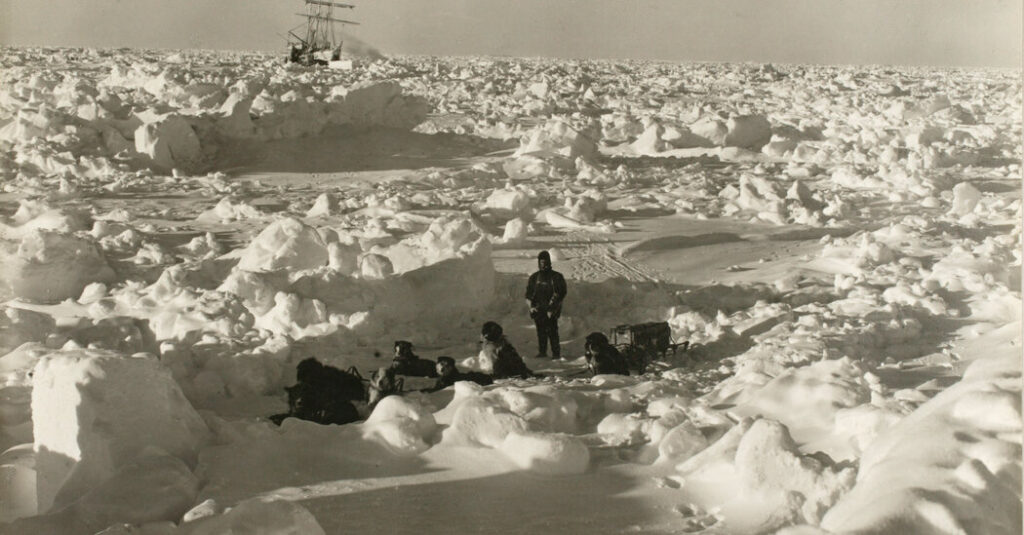
Step 1: Jot down your ideas and share with a partner.
Late in 1914, an expedition led by the explorer Ernest Shackleton attempted to be the first to cross Antarctica. But early in 1915, his ship, called the Endurance, sank. Shackleton and his crew made it to safety, and their story became one of the greatest tales of leadership and survival in exploration history. The remains of the shipwreck were discovered in 2022.
-
What else, if anything, do you know about this expedition?
-
What ideas do you have about why the Endurance could have sunk? What questions would you ask to find out more?
Step 2: Read a Times article about a recent study.
Read the New York Times article “Wreck of Shackleton’s Endurance Tied to Culprit Other Than Ice,” published on Oct. 6. It begins:
On Oct. 27, 1915, after being caught and crushed by packed ice for nine months in the Weddell Sea off Antarctica, Ernest Shackleton and his crew abandoned the Endurance and their quest to traverse the frozen continent by land. The doomed ship drifted atop the ice for three more weeks before finally sinking.
For over a century, experts have put the blame for the ship’s demise on an ice floe overwhelming the rudder and creating a large gash in the vessel. But a study released Monday in the journal Polar Record contends that the ship, not the ice, was to blame. The Endurance was ill equipped for its mission, a flaw that Shackleton was aware of long before he launched to Antarctica.
Jukka Tuhkuri, an ice researcher and naval architect at Aalto University in Finland and author of the new study, was aboard Endurance22 with the team that discovered the wreck in 2022. As a side project, he began analyzing diaries, personal correspondences and the ship’s wreckage to find out why the Endurance sank.
Step 3: Analyze the study.
1. What was the scientific question that researchers wanted to answer?
2. How did researchers plan and carry out their investigation?
3. What do you notice in the image above? How do you think researchers used it for the study?
4. What new data did the investigation yield? (Data is the factual information collected during observations, experiments or studies.)
5. What explanation did researchers construct using the data they collected and interpreted to answer their original question?
6. What significance does this research have for science, the world or our lives?
7. What is one thing you learned about this study or about how scientists approach their work?
8. What further questions do you have about this research and its significance?
Step 4: Work with others to come up with your own scientific investigation.
In this study, Jukka Tuhkuri, an ice researcher and naval architect, analyzed primary source documents and architectural drawings to better understand what caused the Endurance to sink in the Antarctic ice. Collaborate with others to propose another investigation of a different historical polar expedition. For example, a scientist might want to investigate why the British Commonwealth Trans-Antarctic Expedition led by Sir Vivian Fuchs from 1957-1958, which was the first successful land crossing of Antarctica, succeeded where Shackleton failed.
-
What scientific question might you want to answer?
-
Briefly describe how you might design a study using similar techniques mentioned in the article to try to answer that question.
More?
• Science Practice, a new resource aligned with the Science and Engineering Practices for the Next Generation Science Standards, aims to help students better understand how scientists actively gather evidence-based knowledge and solve problems. Learn more about this feature in this introductory post.
• See all the lesson plans in this series.
The post Science Practice | A Study on Shackleton’s Endurance appeared first on New York Times.