Like the dying and rising gods of old, cinema refuses to stay down for the count. It sputters and flails, and routinely shows signs of irrelevance and senescence to the point that it can seem to hover at the edge of extinction. Yet Bi Gan’s beautiful, sprawling and boundary-pushing hallucination “Resurrection” makes the case that — as its title emphatically announces — the movies themselves have remarkable staying power. Even as some of the captains of the mainstream entertainment industry appear intent on killing off cinematic practices like moviegoing, moviemakers like Bi are keeping the art very much alive.
“Resurrection” is a glorious and hugely ambitious work that, in short, tracks a chameleonlike character called the Deliriant (Jackson Yee) across a century’s worth of diverse adventures, each resembling a mini-movie and involving the senses (sight, hearing and so on). In the second, for instance, the Deliriant crawls out of a fetal position and into trouble (as one does), gets roughed up and eludes bullets in a mirrored labyrinth like that in “The Lady From Shanghai,” Orson Welles’s 1948 noir. At one point in this section, a man jabs a spike in his ear and plays a Theremin, an electronic instrument that produces the eerie, vacillating sounds you sometimes hear in older movies when things take a turn for the strange.
Strange describes the world of “Resurrection,” as does entrancing, tender, surprising, mournful and, at times, mystifying; it too is a labyrinth of a kind, one that Bi has filled with abrupt turns, elusive figures and shattering moments. Written by him and Zhai Xiaohui, it opens on a delirious note with a section that resembles a so-called silent film. Early moving pictures were rarely silent and were often shown with accompanying sounds, both prerecorded and live, including music, effects and narration. For his take on early cinema, Bi takes his cue from the period’s inventively freewheeling visionaries, playing with light, color and shape and using old-fashioned, explanatory title cards to sketch in the back story.
In a “wild and brutal era,” the opening card reads, people have learned that the secret to eternal life is to not dream. Like candles that never burn, these dreamless beings can live forever. Those who secretly continue to dream are known as Deliriants. “They bring pain to reality and chaos to history,” the text continues. “They send time into spasms.” Those who can see through illusions are called Big Others. This is more provocative than clarifying and may send some viewers into spasms, but it announces the movie’s imaginative horizons. It also, instructively, introduces the familiar metaphor of movies being like dreams (and, by extension, references the later, more dubious conceit of Hollywood as a dream factory).
The first image in “Resurrection” is of a bright yellow flame flickering in a black expanse, an image that invokes Plato’s allegory of the cave, in which restrained prisoners see shadows cast on the wall but not the fire casting them. An elegant mystery woman (Shu Qi) with a chignon and a long skirt enters and soon begins traveling through a series of beguiling and enchantingly lovely spaces — a picturesque garret, an elaborate opium den and vividly hued, at times abstracted halls and rooms — until she at last finds the Deliriant. Chalk-white, weak and wounded, he resembles a catastrophically ravaged, Quasimodo-like figure, but he’s a dreamer, and his heart is a magical machine that produces great, liberating sensations.
This inaugural section presents the movie’s themes, including the Deliriant as the very embodiment of cinema. Despite this premise, the narrative ellipses, the pantomimed action and eccentric nomenclature, the whole thing is easy enough to follow, particularly if you ease into the ravishing flow. Bi is an art-film savant, but he’s also an entertainer, and he keeps things moving as he floods the screen with beauty, playful visual associations and references to diversions like hand shadows, puppets, protocinematic machines and old movies. At one point, Bi also recreates one of the first fiction films, the Lumière brothers’ 1895 “L’Arroseur arrosé,” in which a puckish boy causes a man who’s watering a garden to spray himself. Here it’s the Deliriant who’s holding a hose, as if he were tending a garden of dreams.
That’s an apt description for Bi, who’s 36, and over the past decade has become a widely lauded fixture on the international film festival circuit. “Resurrection” is just his third feature. (It was awarded a special prize at the 2025 edition of Cannes.) Bi’s visual imagination is thrilling, and his craft and technique are outstanding even when his storytelling kinks up. The convolutions of the second, noirish episode, for instance, bring to mind the story of how, when Howard Hawks was preparing his classic 1946 version of Raymond Chandler’s detective novel “The Big Sleep,” he contacted Chandler to inquire about a confusing plot point that even the writer couldn’t explain. That picture turned out just fine, and so does “Resurrection.”
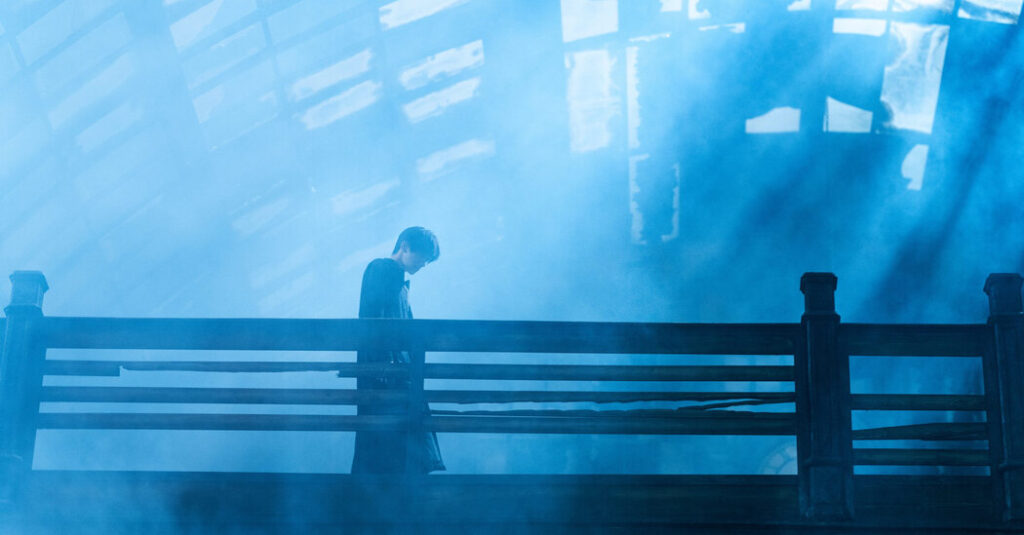
As the Deliriant continues on this voyage into cinema, his appearance shifts repeatedly, and Bi changes up his visual and narrative approach. The third section opens with the Deliriant pulling up to a derelict Buddhist temple with a truckload of men. The palette is now a wintry bluish-gray, the editing slower and the camera moves and conversations longer. What transpires is just as otherworldly as before and edges into more overt philosophical territory, as does the livelier fourth section, set in a contemporary city. There, amid secret signals, cubistic angles and washes of muted color, a goateed Deliriant and a cute tyke join forces to run a scam (shades of “Paper Moon”) on a wealthy mark using scent as their hook.
There’s a melancholic cast to “Resurrection”; yet while it’s easy to see it as a kind of requiem for cinema, Bi’s filmmaking remains too dynamic to inspire funereal tears. To underscore the elegiac tone, Bi recurrently drops in shots of burning candles, images that echo the opening title cards. The Deliriant burns bright, yes, but his time is also running out, an existential plight that echoes debates about the end of cinema. That movies like this keep getting made offers proof that even after a century-plus of changes and calamities, new technologies and viewing habits, it endures. One of the Lumière brothers is purported to have said that the cinema is an invention without a future, but maybe its future is still being invented.
Perhaps that sounds overly idealistic, but movies like “Resurrection” are, in their own right, arguments for the art. In the transporting penultimate episode, the Deliriant pops up in a wash of deep red at a dilapidated waterfront, his hair bleached blond and bare arms muscled. He soon hooks up with a seductress, and together they rush off into a dramatic, tightly compressed miniature thriller — complete with thugs, fights, fangs, a singing gangland boss and yet more film allusions — that Bi presents in one hypnotic, seemingly uninterrupted camera movement. As the Deliriant races toward the end, dodging fists and taking hits, he falls and staggers, even as Bi himself continues to leap and soar in his own fantastic voyage.
Resurrection Not rated. In Mandarin, with subtitles. Running time: 2 hours 40 minutes. In theaters.
Manohla Dargis is the chief film critic for The Times.
The post ‘Resurrection’ Review: A Hallucinatory Voyage Into Cinema appeared first on New York Times.