Monique Brown is looking for a job, and she figures that Jimmy’s Corner bar is the best place in New York City to do it. There she was at 1 p.m. on Wednesday on a barstool, an I.P.A. in her right hand, a shot of Jagermeister in her left and her eyes trained on the door.
Many of her old colleagues at ABC still work nearby. If one of them happened to walk in, Ms. Brown had a plan: pitch them hard, and use Jimmy’s cheap drinks and amazing jukebox to soften them up.
“I mean, a beer and a shot of Jager for $10?” said Ms. Brown, 52, who spent decades working in TV production before being laid off in October. “What’s not to like about that?”
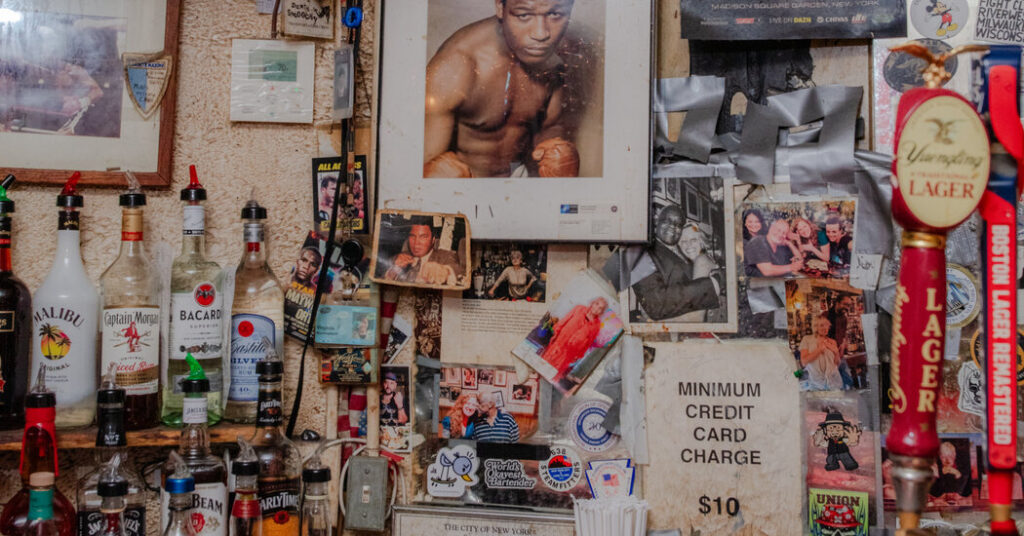
New York is a city of hustlers, of odds makers and shot takers. For 54 years, Jimmy’s Corner has been their bar. Shaped like a railroad apartment and dark as a subway platform, it stands behind a dirty blue awning a few steps from Broadway, surrounded by the theaters and corporate theme restaurants of Times Square.
It is filled with photos of boxers and posters from big boxing matches — mementos gathered by its founder, Jimmy Glenn, a former amateur boxer and boxing trainer who was friendly with Muhammad Ali and Mike Tyson before he died in 2020, at age 89.
Now the bar faces the prospect of eviction by a very different sort of New York institution : the Durst Organization, one of the city’s largest private owners of commercial property. The company’s portfolio includes several huge buildings like 4 Times Square, a 48-story skyscraper, as well as structures that are squat and humble, like the brick three-story walk-up on West 44th Street that houses Jimmy’s Corner.
The issue, it will surprise no one to learn, is money.
For decades, the Durst family enjoyed a close relationship with Mr. Glenn. During the 1970s and ’80s, when Times Square attracted a rogue’s gallery of drug dealers, pimps and prostitutes, he helped keep his section of West 44th Street safe — and improve the value of Durst-owned properties — by employing his charm and his hulking physique to encourage any ruffians to move along.
Perhaps that explains the current monthly rent, a bit above $5,000 a month, a fraction of the going rate.
Mr. Glenn’s son Adam took over the bar in 2015, and after the elder Mr. Glenn died, the Dursts decided to sell the property, said Jovana Rizzo, a spokeswoman for the company. Over a year ago, the Dursts offered Mr. Glenn a year and $250,000 to move.
Mr. Glenn tells the story differently. Seven months ago, the Durst Organization demanded he vacate by July, he said, and initially offered no money to terminate his lease.
Any day now, Mr. Glenn said, he expects to receive an order for the bar’s eviction. Like any good son of a boxer, he decided to throw the first punch. He filed a lawsuit last Thursday in State Supreme Court in Manhattan, accusing the company of discrimination and fraud.
The Durst Organization made its offer “even though we were not required to do so,” Ms. Rizzo said. “These efforts have not been met with good faith. We have done our best to be good neighbors, and we regret it has come to this.”
Mr. Glenn, 44, started filling buckets of ice for the bar at the age of 4, he said. He went on to graduate from Stuyvesant High School and Harvard Law and became a lawyer focused on mergers and acquisitions for the very white-shoe law firm Simpson, Thacher & Bartlett. He quit the law to run the bar.
Mr. Glenn is realistic about his prospects. He understands the land beneath his bar is worth many multiples of what he pays in rent. He is willing to move Jimmy’s Corner someplace cheaper with the right offer.
Anything less, he said, would disrespect the legacy of his father.
“Maybe they underestimated how important this place is to me,” Mr. Glenn said.
In interviews this week, most patrons said they were unaware of the spat. When they learned of it, most described it as inevitable.
“Nobody can stay in a location like this and sell beers for $5,” Eli Amorim, 55, said during his lunch break from his job with the Brazilian consulate.
On Tuesday night, Dave Maki sat just inside the door of Jimmy’s Corner. Before him, the bar was wrapped in duct tape. The wall beside him featured a yellow poster advertising the “Fight of the Century” between Muhammad Ali and Joe Frazier at Madison Square Garden in 1974.
Mr. Maki looked around and smiled.
“It’s the only real bar in the neighborhood,” said Mr. Maki, 42, a project manager at the New York Public Library who has frequented Jimmy’s Corner for eight years. “Every other place sucks.”
Stella Raine Chu contributed reporting.
Christopher Maag is a reporter covering the New York City region for The Times.
The post One of the Last Times Square Dive Bars Faces Eviction appeared first on New York Times.