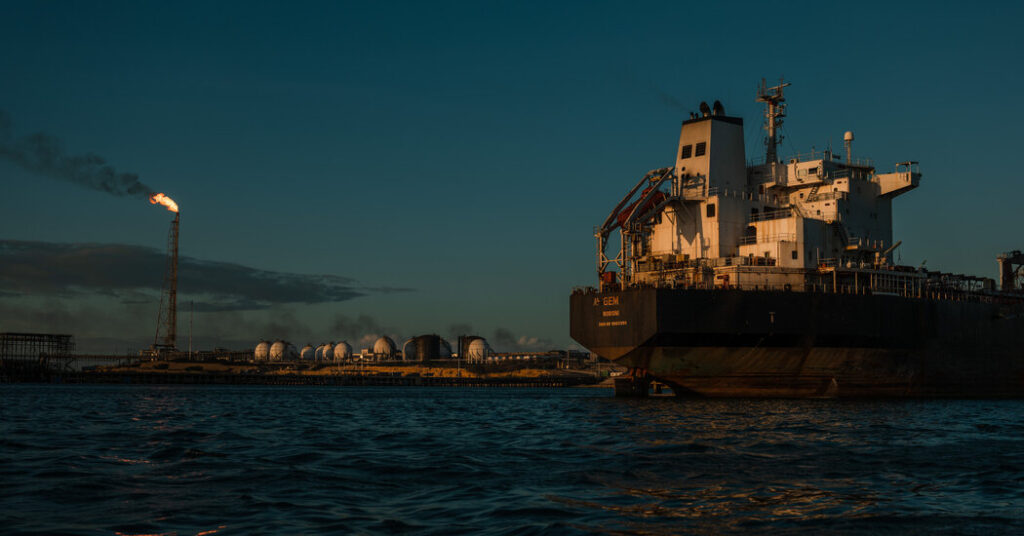
The U.S. seizure of an oil tanker off the coast of Venezuela laid bare a crucial factor in the standoff between Caracas and Washington: Oil remains the lifeblood of Venezuela’s fragile economy.
Venezuela relies on oil and oil-related products for nearly all its export revenues. Officials use the income from the oil industry to keep the government functioning, maintain weapons systems and import necessities, like food.
More tanker seizures would restrict this revenue stream, according to economists. Each seized cargo amounts to a loss in income and Venezuela could be forced to sell its oil at a steep discount to traders still willing to risk dealing with the country.
Oil reigns supreme in Venezuela
Venezuela boasts reserves of rare earth minerals, vast tracts of arable land and glistening Caribbean beaches, which could lure foreign tourists. But oil is still the driving force of the economy, as it has been for much of the past century.
Venezuela is afflicted by what economists call “Dutch disease,” in which a government develops an unhealthy dependence on natural resource exports to the detriment of other sectors. The concept, initially applied to the Netherlands when natural gas deposits were found in the North Sea, involves a currency appreciation from natural resource exports, making other exports less competitive.
Oil currently accounts for about 88 percent of Venezuela’s $24 billion in export revenues, and each tanker that is seized would erode income needed to import food and medicines. Products related to oil production, like petrochemicals, account for much of the rest.
“A continued policy of seizures would cause a steep decline in Venezuela’s import capacity, plunging the country into a new recession,” said Francisco Rodríguez, a Venezuelan economist at the University of Denver.
Making matters worse, Venezuela’s oil output has declined because of mismanagement, corruption and U.S. sanctions. Oil prices have also fallen from the sky-high levels that buoyed the socialist-inspired revolution of the late Hugo Chávez, the predecessor of the current president, Nicolás Maduro.
As recently as 2012, Venezuela obtained about $120 billion a year from oil exports, compared to the current level of about $21 billion, Mr. Rodríguez said.
During this period, Venezuela’s economy endured “the single largest economic collapse for a non-conflict country in almost half a century,” according to the International Monetary Fund.
Venezuela still sits on more oil than Saudi Arabia, Russia or the United States, roughly 17 percent of the world’s known oil reserves, according to the Oil & Gas Journal, an industry publication.
But feuds with international oil companies, as well as the challenges of extracting the country’s tar-like oil, have strained Venezuela’s capacity to draw greater benefits from its reserves by increasing production.
Who buys Venezuela’s oil?
Historically, the United States was the largest buyer of Venezuela’s oil. This relationship was built on geography, political affinities and the specific needs of U.S. refineries.
Now, China acquires about 80 percent of Venezuela’s oil exports. The buyers are often China’s so-called “teapot refineries,” known for their compact size and capability for processing heavily discounted crude oil.
But for Venezuelan oil to actually reach China, the cargoes often pass through an opaque web to avoid sanctions, involving traders, middlemen and tankers.
Skipper, the name of the tanker seized by the United States on Wednesday, is thought to have been deployed in this type of trade.
It was carrying oil from the state-owned Petróleos de Venezuela, and was falsely flying Guyana’s flag, that country’s maritime authority said. The ship’s ultimate destination was Asia.
Even as tensions simmer between the Trump administration and Venezuela, the United States remains another important buyer of Venezuela’s oil, which is often transported to refineries in Texas, Louisiana and Mississippi.
Another key destination for Venezuelan oil is Cuba, where communist leaders have for years relied on these imports to prevent electricity blackouts and provide fuel for the island nation’s dilapidated fleet of automobiles.
But it is not clear how much hard currency, if any, Venezuela gets from this arrangement. The oil has often been made available to Cuba in exchange for “services” such as the Cuban doctors who have bolstered Venezuela’s health system.
The Chevron factor
Chevron, the U.S. oil giant and capitalist icon, enjoys unusual standing in Venezuela, which is led by self-described socialists. Chevron’s operations constitute nearly a quarter of Venezuela’s oil production.
Chevron has also figured out how to work with both Venezuela’s government and the Trump administration, which renewed the company’s license to operate in Venezuela.
Chevron’s emergence as a pillar of Venezuela’s economy stretches back to a bet it made two decades ago to remain in Venezuela when the authorities began nationalizing foreign-owned oil assets. Rivals like Exxon Mobil and ConocoPhillips opted to leave Venezuela at the time.
Even as the Trump administration has stepped up its military pressure campaign targeting Venezuela’s leadership, U.S. warships have allowed tankers carrying oil from Chevron’s operations to reach the United States.
That trade helped boost Venezuela’s oil exports, which rose to 920,000 barrels a day in November, a 3 percent increase from the previous month.
Rebecca F. Elliott contributed reporting from New York.
Simon Romero is a Times correspondent covering Mexico, Central America and the Caribbean. He is based in Mexico City.
The post Oil Tanker Seizure Hits Venezuela’s Lifeblood. Here’s What to Know. appeared first on New York Times.