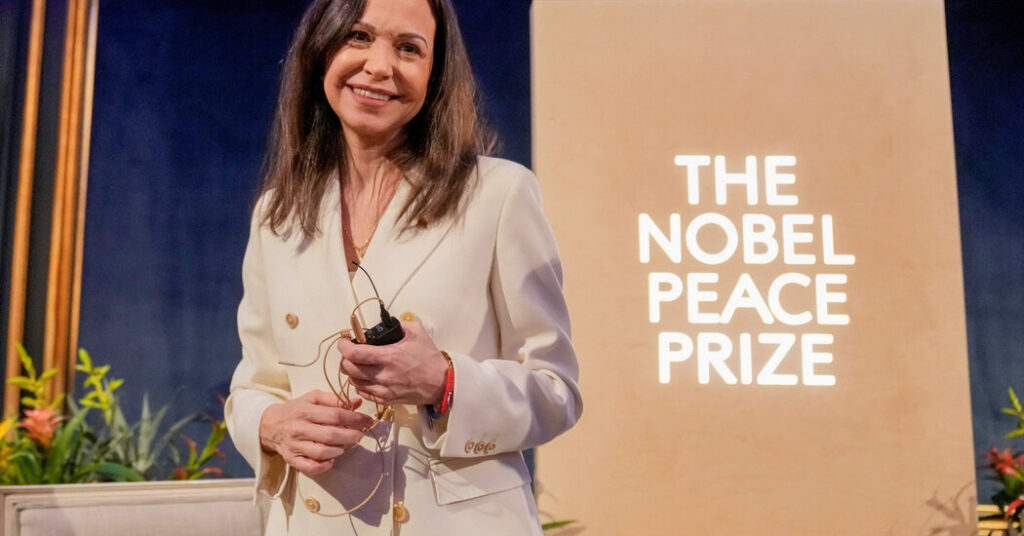
María Corina Machado, the Venezuelan opposition leader, said she was able to leave the country with the help of the United States after spending more than a year in hiding.
“We had support from the United States government,” she told reporters in Oslo on Thursday, hours after arriving in Norway to join the festivities surrounding her receipt of the Nobel Peace Prize.
Ms. Machado declined to disclose the details of her departure, explaining that she wanted to protect her collaborators. The Trump administration has not publicly commented on Ms. Machado’s departure from Venezuela.
While Norway has a tiny Venezuelan population, Ms. Machado’s appearance in Oslo attracted a small, but exuberant crowd of supporters. When she emerged at around 2:30 a.m. Thursday on the balcony of the historic Grand Hotel, people below erupted into cheers, chanted “freedom’’ and “peace in Spanish, and sang the Venezuelan national anthem.
Ms. Machado went into hiding soon after last year’s presidential election, in which the candidate she supported won a landslide victory, according to international monitors, despite concerted government efforts to intimidate and disable the opposition. President Nicolás Maduro claimed he was the winner and held on to power by repressing those who opposed him.
Earlier on Thursday, Ms. Machado said that the Venezuelan government had not known where she had been staying and would have tried to prevent her from traveling to Norway, where her daughter accepted the Peace Prize on Wednesday on her behalf.
Venezuela’s interior minister, Diosdado Cabello, claimed on Wednesday, without providing evidence, that the government was aware of her movements. Venezuelan officials also previously said that Ms. Machado would be considered a fugitive if she left the country.
Ms. Machado acknowledged that she could face arrest if she returned to Venezuela under the current government. She added that she was unsure when she would be able to go back.
“I believe that the risk, even though it was very high, was worthwhile,” she said, referring to her trip. “And of course, the risk of going back is perhaps even higher.”
Ms. Machado has re-entered the world stage as President Trump has drastically escalated his pressure on the Venezuelan government, whom his administration has accused of flooding the United States with drugs and criminals, claims that experts have refuted. On Wednesday, the United States seized an oil tanker off the coast of the South American country.
Ms. Machado has not directly commented on the seizure, but on Thursday she repeatedly voiced support for Washington’s efforts to cut off Mr. Maduro’s sources of funding.
“I believe that President Trump’s actions have been decisive to reach the point where we are right now, in which the regime is weaker than ever,” she told reporters.
She added: “You need to raise the cost of staying in power and lower the cost of leaving power. Only when you do that, this regime will break down. And that’s where we’re moving toward right now.”
Ms. Machado repeatedly dodged questions about Mr. Trump’s threats of starting military action in Venezuela. But she has emulated the Trump administration’s portrayal of Mr. Maduro’s government, calling him a criminal mastermind engaged in a vast array of illegal activities in partnership with America’s adversaries.
“Venezuela has already been invaded,” she said at a news conference with Norwegian Prime Minister, Jonas Gahr Store, earlier on Thursday. “We have the Russian agents, we have the Iranian agents, we have terrorist groups such as Hezbollah, Hamas, operating freely in accordance with the regime. We have the Colombian guerrilla, the drug cartels.”
Venezuela has economic and security ties with Iranian, Chinese and Russian companies, and sells most of its oil to China, but there has been no conclusive evidence that Hezbollah and Hamas are present in Venezuela.
Mr. Maduro’s largest corporate partner is Chevron, the American energy giant, which has continued to export Venezuelan oil to the United States despite Mr. Trump’s military escalation.
Analysts said Ms. Machado’s decision to leave Venezuela has re-established her as a major player in the escalating brinkmanship between Mr. Trump and Mr. Maduro. But they say Ms. Machado is facing a ticking clock, confronting the challenge of converting her international prominence into political change before she loses support inside Venezuela.
Previous Venezuelan opposition leaders who have gone into exile have quickly faded into relative obscurity.
The Trump administration has presented its military campaign in the Caribbean as a war against cartels, which it says are terrorizing the United States by causing an epidemic of drug-related deaths. It has labeled Mr. Maduro a “narco-terrorist,” and the head of two criminal organizations.
“I believe every country has the right to defend itself,” Ms. Machado said, referring to the U.S. military buildup.
Venezuela plays practically no role in the production and smuggling of fentanyl, which is responsible for the majority of drug-related deaths in the United States, and the South American country is a relatively minor player in the cocaine trade.
Ms. Machado did not discuss her next political moves, saying she would initially dedicate time to reconnecting with her three children and her team, and undergoing medical checkups.
“I couldn’t sleep last night, going over and over again about the first instant when I saw my children,” she said. “For many weeks, I have been thinking of that possibility, and which one of them I would hug first.”
Genevieve Glatsky contributed reporting from Bogotá, Colombia.
Anatoly Kurmanaev covers Russia and its transformation following the invasion of Ukraine.
The post Nobel Peace Prize Winner Machado Says U.S. Helped Her Leave Venezuela appeared first on New York Times.