Venezuelan opposition leader María Corina Machado said Thursday that the country has been “invaded” by criminal enterprises supporting the Nicolás Maduro regime, calling on the international community to “cut those sources.”
During a news conference in Oslo with Norwegian Prime Minister Jonas Gahr Store, hours after missing the ceremony in which she was awarded the Nobel Peace Prize, Machado was asked about the prospect of U.S. military intervention in Venezuela.
“Some people talk about invasion in Venezuela, the threat of an invasion in Venezuela, and I answer, ‘Venezuela has already been invaded,’” she said, without directly responding to the question.
“We have the Russian agents, we have the Iranian agents, we have terrorist groups such as Hezbollah, Hamas, operating freely in accordance with the regime. We have the Colombian guerrilla, the drug cartels that have taken over 60 percent of our populations — and not only involving drug trafficking but in human trafficking, prostitution.”
This, she said, has turned Venezuela into the “criminal hub of the Americas,” adding that “what has sustained the regime is a very powerful and strongly funded repression system.”
Maduro began his third term as Venezuela’s president in January, after a contested election.
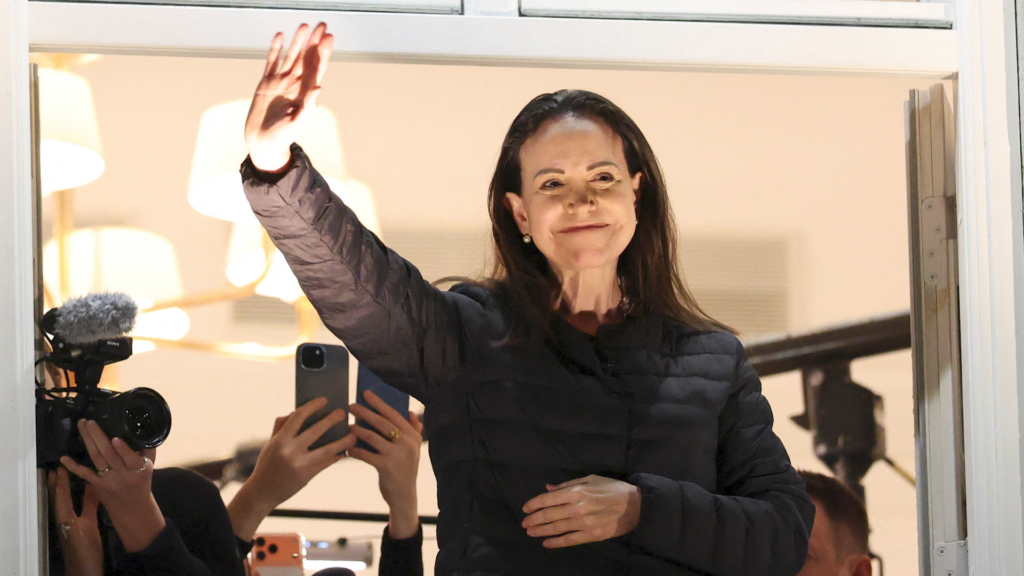
Machado, who secretly left Venezuela but has not yet disclosed the details of her escape, had greeted a group gathered outside the Grand Hotel on Wednesday, hours after she missed the ceremony where she was awarded the Nobel. Ana Corina Sosa Machado accepted the award and delivered a speech on her mother’s behalf.
Maduro’s government, which has banned Machado from leaving Venezuela for the past decade, had said that the opposition leader would become a fugitive if she tried to leave the country.
She had last been seen in public in January, when she was briefly detained while leaving a rally the day before Maduro was sworn in to a new term in office. She has been in hiding ever since, evading an arrest warrant. Although she has made no public appearances inside Venezuela, Machado has done live and recorded interviews this year from her presumed place of hiding.
In her news conference Thursday, she said she planned to return to Venezuela, even if she had to remain in hiding.
Machado gained international attention last year when she prepared to challenge Maduro in Venezuela’s election. After she was banned from running by the government, she endorsed and campaigned for a stand-in.
Ballot audits by The Washington Post and independent monitors showed Machado’s candidate, Edmundo González, won more than two-thirds of the vote. But Maduro, the authoritarian socialist who has held power since the 2013 death of Hugo Chávez, claimed reelection.
Jorgen Watne Frydnes, the chair of the Norwegian Nobel Committee, said he was “profoundly happy to confirm that [Machado] is safe and that she will be with us here in Oslo.” He did not say when she would appear.
The Nobel Institute released audio of a phone call between Machado and Frydnes before she boarded a plane to Oslo. “There are many things we had to go through, and so many people who risked their lives so that I could get to Oslo. And I am very grateful to them. And this is a measure of what this recognition means to the Venezuelan people,” she said. And then: “I literally have to fly right now.”
In naming Machado the winner of this year’s Peace Prize in October, the Norwegian Nobel Committee described her as “a brave and committed champion of peace” and “a woman who keeps the flame of democracy burning amid a growing darkness.”
At the time, Machado dedicated the prize, in part, to her ally, President Donald Trump, “for his decisive support of our cause.”
Since September, the Trump administration has launched strikes against more than 20 boats it alleges were carrying drugs to the United States, killing at least 87 people, while massing troops, warships and aircraft in the region. Trump this week told Politico that Maduro’s “days are numbered” and declined to rule out sending in U.S. troops.
Machado has drawn criticism for her public support of the military campaign. During one recent video appearance at a forum in Miami, she said Trump’s actions would “protect millions of lives of Latin American citizens and certainly Venezuelan citizens.”
Machado had released little information about her trip to Oslo; a news conference planned for Tuesday was abruptly canceled that day.
Venezuelan Interior Minister Diosdado Cabello claimed that Machado was hiding in the U.S. Embassy in Caracas. The government reinforced security around the facility; the streets nearby were guarded by secret police.
Cabello called Maduro’s supporters to a demonstration Wednesday. “We know nothing about Oslo,” he said. “We didn’t participate in that action.”
Sosa said Wednesday that her mother “wants to live in a free Venezuela and she will never give up on that purpose.”
“That is why we all know and I know that she will be back in Venezuela very soon,” she said. In the speech she read, Machado thanked those who risked their lives and defended human rights in the country: “To them belongs this honor, to them belongs this day, to them belongs the future.”
Machado, a former lawmaker who was once mocked by Chávez, the founder of Venezuela’s socialist state, is a longtime foe of Maduro.
After years on the fringes of the opposition, she became the driving force of the movement as the country approached presidential elections in 2024. Her campaign for González, her stand-in, rallied crowds across the country, becoming the biggest political threat to Maduro in more than a decade of his rule.
In July 2024, Venezuelans voted overwhelmingly in favor of the opposition, but Maduro refused to release the precinct-level results.
In the days after the election, Machado’s team, with the help of thousands of regular Venezuelans stationed at polling sites, managed to prove the opposition’s triumph by collecting the original receipts from more than 80 percent of voting machines nationwide.
The government launched a crackdown on political opponents, arresting thousands, and Machado went into hiding in the country.
González fled to Spain in September 2024 to evade an arrest warrant. He attended the Nobel ceremony in Oslo on Wednesday.
The post Nobel laureate calls Venezuela a ‘criminal hub,’ asks for international help appeared first on Washington Post.