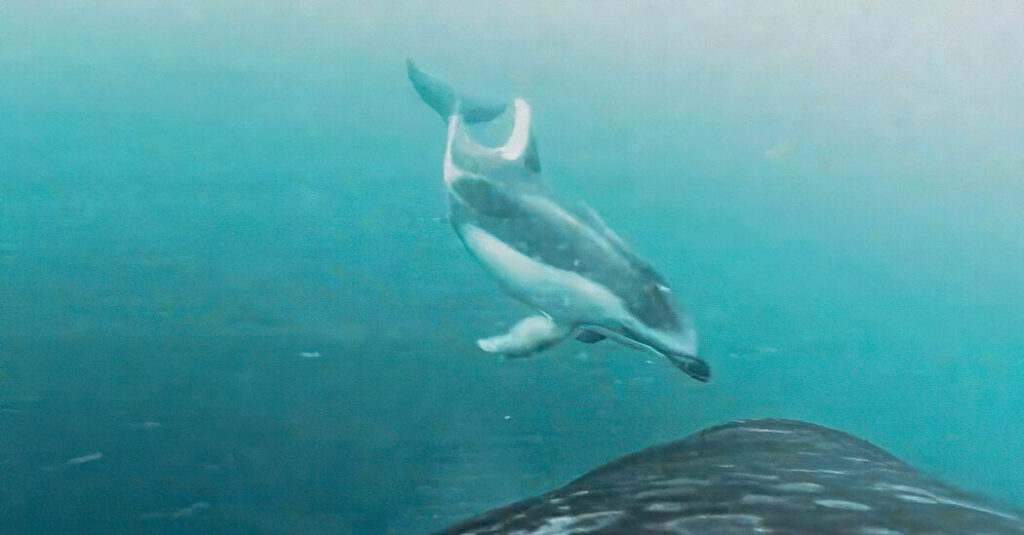
In the waters off British Columbia, an unusual partnership unfolds. Resident killer whales trail Pacific white-sided dolphins to hunt Chinook salmon, and may even share fish scraps with them, a new study finds.
From a boat, the interaction between the orcas and dolphins looks like organized chaos, the study authors said. But underwater, an opportunistic alliance gives orcas access to prey that would otherwise be less accessible.
“Sometimes you can have an unlikely friend that helps guide you to a buffet or takes you to an underground speakeasy,” said Sarah Fortune, a marine ecologist at Dalhousie University and lead author of the study.
Pacific white-sided dolphins, a playful species with distinctive white coloration, are often seen alongside a population of fish-eating orcas in coastal Pacific Northwest waters. The orcas appear to tolerate the dolphins, showing no evasive or aggressive behavior.
Previously, scientists thought that the dolphins mobbed orcas or stole their prey. But the new study, published on Thursday in the journal Scientific Reports, may be the first to document cooperative foraging between the species — showing that dolphins earn their share.
Both species invest time and energy in this foraging activity, Dr. Fortune said. The findings dispel the idea that dolphins are “stealing bits of fish” from the killer whales and getting a “free lunch,” she added.
To study the interaction, Dr. Fortune and her colleagues attached tags with suction cups to resident killer whales off Vancouver Island in British Columbia. Each tag was equipped with a camera and acoustic recorder, capturing underwater video and vocalizations. Drones filmed from above.
The combination of underwater and aerial footage provided a fuller picture of the dynamics between the two marine mammals. As the orcas trailed behind the dolphins, the recordings documented every instance when a dolphin was near a killer whale, the echolocation clicks, whether the killer whale was locating the fish and whether dolphins were present when tagged whales ate at the surface.
Scientists identified 25 occasions when orcas trailed dolphins on foraging hunts. When the dolphins dove, the killer whales did, too. At greater depths, where the whales often catch salmon, the dolphins swam alongside, producing echolocation clicks and homing in on fish targets, perhaps acting as scouts for the orcas. The study documents eight occasions when orcas ate and shared Chinook salmon with other orcas; dolphins were present for four of them, in one instance scavenging fish scraps.
From the acoustic data, scientists found that both species alternated periods where they echolocated. “We hypothesize that it could be that they’re eavesdropping on each other,” Dr. Fortune said. If the dolphin is echolocating, then the killer whale could potentially hear that return echo and map out where that fish target is, and vice versa, she added.
“It’s some really cool, impressive data collection,” said Michael Weiss, research director for the Center for Whale Research in Washington State who was not involved in the study. “There’s certainly an interaction happening, and there’s probably benefits to one or both of them,” he added, but more data were needed to confirm that they were indeed cooperating.
Erin Ashe, a marine conservation scientist at the nonprofit Ocean Initiative who was not involved with the new research, noted that studies like this one demonstrate how some animals, including dolphins, inhabit complex ecosystems in which they hunt, move, prey and evade predation.
In contrast to the resident orcas that eat fish, a transient population known as Bigg’s killer whales hunt marine mammals, including sea lions, porpoises and dolphins. Both populations swim the same waters but avoid each other.
“It could be that the dolphins are having some sort of refuge with the fish-eating killer whales,” Dr. Ashe said. “The refuge might allow dolphins to get close to killer whales that don’t pose a threat. They can sort of size up their predator on some level.”
Alexa Robles-Gil is a science reporter and a member of the 2025-26 Times Fellowship class, a program for journalists early in their careers.
The post Killer Whales Find an ‘Unlikely Friend’ in Dolphins appeared first on New York Times.