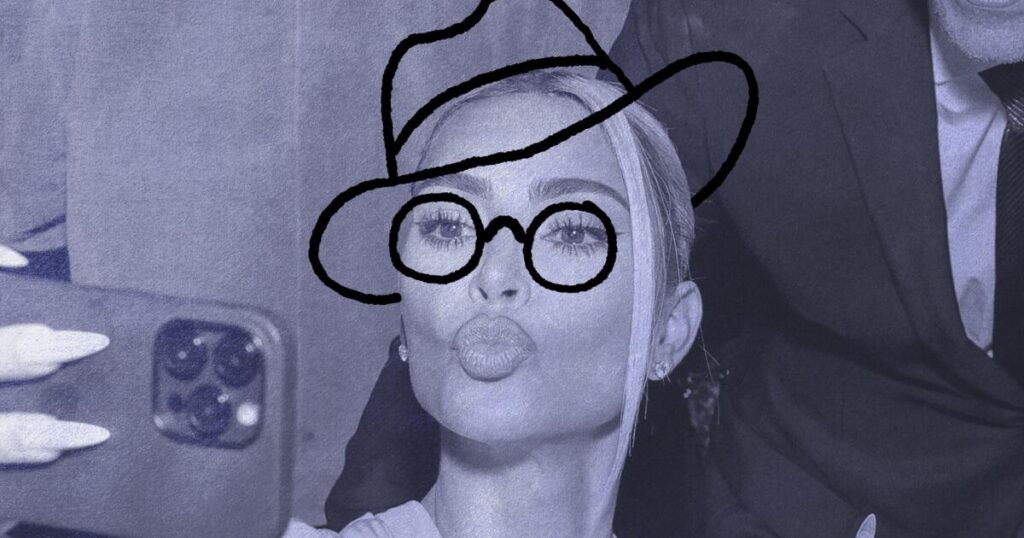
W. David Marx’s doomscroll through 21st century pop culture, “Blank Space,” is largely a catalog of cringe.
Kardashians keep barging in, joined by Paris Hilton, Milo Yiannopoulos, MAGA-hatted trolls, latter-day Hitler enthusiast Kanye West and more. The collection of Z-listers in the book runs so deep that there’s no room for even some of the most infamous Kevin Federline-level hacks to fit into its pages. In Marx’s reckoning, we’ve lived with 25 years of mediocrity, with no end in sight. Couture is now fast fashion. Art is IP, AI, the MCU and NFTs. Patronage has become grift.
“Where society once encouraged and provided an abundance of cultural invention, there is now a blank space,” Marx writes. Yes, he’s side-eyeing Taylor Swift, or at least her savvy-bordering-on-cynical approach to fandom. The title of the book, after all, is a nod to one of her hits. This might seem like get-off-my-lawn grousing from a critic who misses the good old days. But Marx’s critique isn’t rooted in pop culture preferences so much as concern with the ruthless ways that capitalism and the internet have manipulated the way we consume, discuss and make use of the arts. Algorithms engineered for sameness and profit have effectively sidelined provocation. Revanchist conservatism, he suggests, has rushed to fill the vacuum.
Weren’t we doing OK not so long ago? The Obama era might have been a high point of inclusivity on the surface, but the past decade has demonstrated just how thin that cultural veneer was. As Marx writes, in a brutal deadpan: “Trump won the election. Not even Lena Dunham’s pro Hillary rap video as MC Pantsuit for Funny or Die could convince America to elect its first female president.” MAGA, Marx argues, wasn’t simply a product of Donald Trump’s cult of personality; it was the culmination of years of ever-intensifying hotspots for macho preening like Vice magazine (cofounded by Gavin McInnes, who’d later found the Proud Boys) and manosphere podcasters like Joe Rogan. Trump — regressive, abusive, reactionary — wasn’t special, just electable.
Marx’s background is in fashion journalism, and “Blank Space” can feel unduly cantilevered toward that world, detailing the history of hip lines like A Bathing Ape and luxury brands’ uncomfortable embrace of streetwear. But fashion writing is good training to make the point that the cultural flattening, across all disciplines, is rooted in matters of class and money. A certain degree of exclusivity matters when it comes to culture, especially for high-end brands, and it starts with street-level changes. But the street, now, is built on ideas of instant fame — “selling out,” once a pejorative, is now an ambition.
That shift, combined with the algorithm’s demand for attention, has made culture more beige and craven. Memes, #fyp, and Hawk Tuah Girlare our common currency now. Artists from Beyonce on down are dragged “into unambiguous business roles, and pushing fans to spend their money, not just on media, but across a wide range of premium, mediocre commodities,” Marx writes. “In this new paradigm, the ‘culture industry’ could no longer sustain itself on culture alone. Personal fame was a loss leader to sell stuff.”
There’s plenty of room to disagree with all this: You and I can reel off any number of novels, art films and TV shows that demonstrate the kind of boundary-pushing Marx says he seeks. (It makes a certain sense that highbrow books and movies would get short shrift in “Blank Space,” being relatively niche pursuits, but his relative neglect of prestige TV feels like a curious lapse.) Still, for every “Children of Men” there are a dozen “Minions” knockoffs, for every “To Pimp a Butterfly” a tidal wave of brain rot. The early-aughts “poptimism” that judged the judgey for demonstrating judgment opened the door to an everything-is pretty-OK lack of discernment.
Whether that’s what put us on a slippery slope to Kanye West peddling T-shirts with swastikas on them is open to debate. But there’s no question that artists are fighting uphill like never before. “How did advocating for timeless artistry at the expense of shallow commercial reality become an ‘elitist’ position?” Marx asks toward the end, pressing creators and consumers alike to sidestep poptimism’s guilt-tripping and operate outside the boundaries of the algorithm.
What would that look like? It may help to set the time machine to a century ago. In “A Danger to the Minds of Young Girls,”critic Adam Morgan considers the case of Margaret C. Anderson, who founded the literary magazine the Little Review in 1914. Though its circulation was as minuscule as its name suggests, it wielded outsize influence on Modernist writing. Recruiting firebrand poet Ezra Pound as her European talent scout, Anderson began publishing works by T.S. Eliot, Gertrude Stein and others, most famously serializing James Joyce’s “Ulysses,” a decision that made her a target of censors and conservatives.
The woman at the center of what Morgan calls “America’s first modern culture war” was a poor fit for her times. Headstrong, queer and disinterested in Victorian pieties, she escaped her smothering Indianapolis family and headed to Chicago, where she hustled work as a bookseller and book reviewer. But her approval of then-risque fare like Theodore Dreiser’s “Sister Carrie” got her tut-tutted by editors. “What they wanted of me was moral rather than literary judgments,” she said.
She struck out on her own, launching the Little Review with her lover, Jane Heap. Anderson was enchanted by outsiders — not just avant-garde writers but radicals like Emma Goldman. She fired back at haters in the letters section. When money was tight, she relocated to a tent north of Chicago to keep the magazine afloat. And when moral scolds seized on excerpts of “Ulysses” — citing the Comstock Act’s ban on sending “obscene” material via U.S. mail — she protested. Copies of the magazine were seized and burned, and her lawyer’s argument that Joyce’s language was too complex to serve as pornography fell on deaf ears.
Even that lawyer, John Quinn, knew the effort was likely futile: “You’re damned fools trying to get away with publishing ‘Ulysses’ in this puritan-ridden country,” he wrote to Anderson and Heap. (The two were sentenced to pay a fine of $50 each, around $900 today.) Through the sepia filter of today, it can be easy to romanticize this tale — a lesbian champion of the arts making the world safe for Modernism. But one valuable thing Morgan’s history does is scrub the sheen off of Anderson’s accomplishment. Anderson had to play a long game, with no guarantee of success. She was forever pleading with patrons for support from month to month. She had to cloak her sexuality, make frustrating compromises in what she published, and absorb attacks and mockery from masses that treated her like a curiosity piece.
Yet it wasn’t wasted effort: Her advocacy for “Ulysses” paved the way for its eventual U.S. publication, with the controversy helping its cause. (James Joyce, like Kim Kardashian, understood a sex scandal could be good for business.) In her later years she lived largely as she pleased, collecting lovers and becoming a follower of weirdo mystic G.I. Gurdjieff. Anderson didn’t have an algorithm to battle, but she did have a censorious moral atmosphere to navigate around, and her story is an object lesson in the one virtue the algorithm has little tolerance for — patience. If we want more works like “Ulysses” in our world (and far less cringe), the financial and critical path is no easier now than it was then. But it will demand a stubbornness from creators and dedication from consumers that the current moment is designed to strip from us.
Athitakis is a writer in Phoenix and author of “The New Midwest.”
The post James Joyce, like Kim Kardashian, understood a sex scandal could be good for business appeared first on Los Angeles Times.