The phrase “horse and carriage” often evokes images of old-fashioned carts on cobblestone streets or tourist carriages in Central Park.
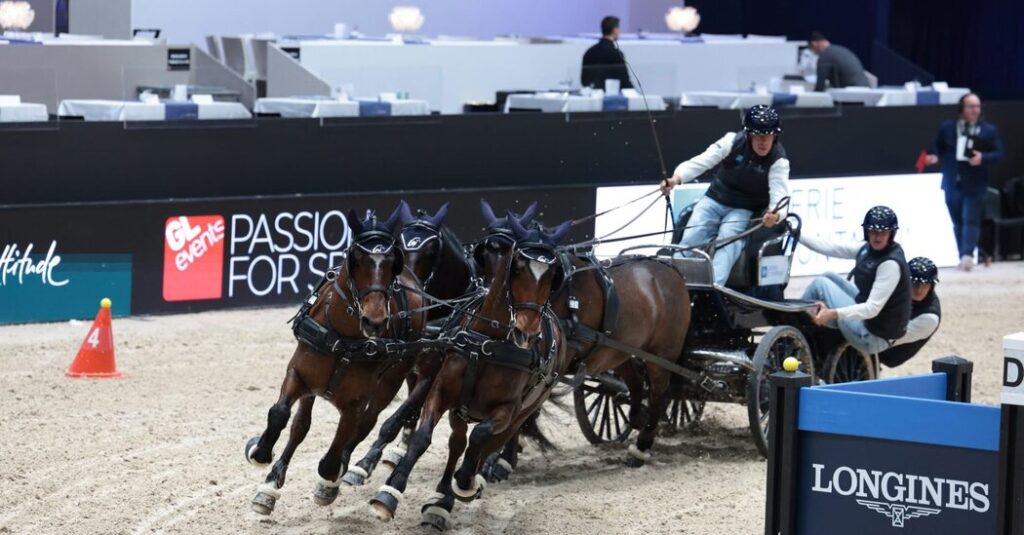
But at the CHI Geneva equestrian competition this weekend, horses and carriages will instead be racing through tight obstacles, with three people deftly navigating and balancing the attached cart as music blasts over loudspeakers.
The competition, where the Fédération Équestre Internationale, the governing body of equestrian sport, will hold the fifth leg of its nine-event Driving World Cup, draws the world’s top competitors in four-in-hand driving. It runs over two days, with two rounds the first day that dictate the starting order for Day 2, which has a preliminary round and a drive-off of the top three competitors. In each round, drivers must navigate various obstacles.
“Driving is about bringing horses together to work as a team and people together to work as a team — between people and between horses and people,” said Benjamin Aillaud, a French driver who will be competing in a wild card slot in Geneva.
The obstacles that make up a course include cones, which have mere centimeters of clearance for the carriage to pass through, each with a ball balanced on it. If a ball falls, a four-second time penalty is applied, similar to the score keeping in show jumping.
There are also “marathon” obstacles, which have a series of gates — also with balls balanced on them — that the drivers have to pass through in a certain order, though they can do so in whatever pattern they choose.
In Geneva, the indoor arena is so large that the course will include a water obstacle and a small hill. At the competition, “we will see fast horses galloping, speed, action,” said Michael Mayer, the course designer for the event, who previously competed in the sport for Switzerland. The course “must be fluid, nice and horse-friendly,” he said. “At the end, the horse is in the center.”
The competition showcases the speed and power of horses, said Bram Chardon, a Dutch driver who won the Geneva competition from 2021 to 2023. “If you see four horses flying into an obstacle, and just with minimum commands they come back” and maneuver through a series of tight turns, he said, “it’s unbelievable what they do.”
While most equestrian sports focus on the connection between a single horse and rider, driving is a true team effort. In this type of competition, each driver must control a team of four horses and has two other people on the carriage, called grooms.
One groom acts as a navigator, standing behind the driver and offering guidance through the course, as well as helping to track times and alerting the driver if the team is behind the time of competitors.
The other groom rides in the back, helping to manage the carriage and ensure it stays clear of obstacles. “The most human energy comes from the last groom, the back stepper, who is literally keeping the carriage in balance,” Chardon said.
And then there are the horses, each with its own disposition, asked to work as a team in navigating the course.
“With four of them, the commands are so little, the understanding needs to be so extremely fine-tuned,” Chardon said.
Aillaud said it was important to figure out “how do you manage to bring four individual horses to work as a team with three people on the carriage who need to be exactly on the same idea, in the same moment, on full speed?”
That communication and training starts long before entering the arena. You can’t simply hook up a team of four to a carriage and expect them to perform, Aillaud said.
Drivers develop relationships with each horse and challenge them through different exercises, under saddle and attached to a carriage, to build various muscles and skills. Then they eventually build teams of four horses who get along and move well together.
“When you ride, you look after the rhythm, you look after the spirit of a horse under the saddle and also the relationship you have with him,” Aillaud said. It’s the same idea with driving, but you need to get “four horses to be on the same line and to communicate.”
In moments when this all comes together and everyone is working in harmony, “it’s a very interesting mix between speed, power and calm,” he said.
Driving as a sport dates back millenniums, said Mark Wentein, the president of the driving jury in Geneva, connecting it to chariot racing in ancient Greece and Rome.
“We could say today that the four-in-hand indoor World Cup driving competition is linked to this speed, this power, this acceleration,” he said.
In 1970, driving became a recognized discipline by the F.E.I. under Prince Philip, the Duke of Edinburgh, who was president of the organization at the time.
Traditional driving competitions are held outdoors and have three separate phases, similar to eventing, the three-day equestrian competition. The World Cup competition combines several of those elements into a high-speed indoor event, called combined marathon.
Spectators in Geneva will also get some insight into the drivers’ process. Competitors wear microphones, and as the team arrives at each marathon obstacle, the music is lowered so that spectators can hear the way drivers speak to their horses to navigate the complicated patterns.
“You see more the difficulty, I think, because you see the complicity between the driver and the horse, and the attention they have,” said Alban Poudret, sports director for the Geneva competition.
And that’s where the excitement lies: in witnessing the harmony and teamwork of three people and four horses working as one amid a booming arena and cheering crowd. “It’s a horse competition,” Wentein said, “but it’s also action and show.”
The post In the Sport of Driving, Four Horses Pull a Cart Around an Arena. Quickly. appeared first on New York Times.