This story was supported by the Pulitzer Center.
The town hall in Akranes, on the west coast of Iceland, filled quickly as locals streamed in to the residents’ meeting. The mood was happy, positive, relaxed. In between speeches, a woman sang folk songs while her family played guitar and melodica. Yet when the guest speaker, an American named Marty Odlin, took the stage, he struck a deadly serious tone.
“We woke up Godzilla,” he told the assembled residents. “It’s burning down forests and towns and stealing fish and doing all sorts of terrible things. It’s a horrible monster, but we did that. We woke it up. And so we have to fix it.”
Odlin, the founder of a US climate startup called Running Tide, had become a well-known figure around Akranes that summer of 2022 in his signature neon beanie and fisherman’s flannels. He was setting up a base of operations in a nearby harbor, planning to unleash a counteroffensive against the Godzilla of climate change. Odlin had outlined a plan to create jobs in this former fishing hub of 8,000. He’d need people to help sink huge volumes of biomass in the surrounding ocean. Together, they’d remove gigatons of carbon from Earth’s atmosphere—and make money by selling carbon credits to Silicon Valley hyperscalers. The exponential growth in tech companies’ emissions, driven by an explosion in demand for data centers and AI, had made the carbon-credit market hotter than ever. Lowercarbon Capital, a VC firm cofounded by Chris Sacca of Shark Tank, had led a $54 million Series B funding round for Running Tide earlier that year.
At first, Running Tide painted a vision of free-floating “micro forests” of seaweed seeded on biodegradable buoys, which would float in the ocean before sinking under their own weight, locking that carbon deep in the sea. Within nine months of his appearance in Akranes, though, that vision had morphed into something else: dumping around 25,000 tons of chemically treated Canadian wood chips off Iceland’s coast. Some ocean-carbon experts describe the work as “poor science fiction” that likely removed no atmospheric carbon while contributing to marine pollution. Ship-tracking data indicates that in the process, the startup likely violated the maritime rights of multiple countries.
By the time WIRED visited Running Tide’s Iceland headquarters in the autumn of 2024, the party was over. An orange jacket emblazoned with the Running Tide logo hung on a coat rack. A sensor buoy gathered dust in a corner. Gone was the founder, along with his grand plans and his neon beanie. Gone were the hundred or so workers once employed by the company. The startup, at one time the next great hope for carbon removal, left in its wake thousands of credits uncertified by any independent entity.
WIRED spoke with nearly 40 sources from France, Iceland, the United Kingdom, and the United States, as well as with international scientists who advise the United Nations, to trace Running Tide’s meteoric rise and fall. They include scientists directly involved with marine geoengineering science, carbon dioxide removal experts, lawmakers, government officials, buyers of the company’s credits, and former Running Tide staff, most of whom requested anonymity to describe sensitive information. WIRED analyzed corporate financial filings, emails and other internal documents, patent applications, carbon-accounting records, and shipping data to reveal the story of how a small-scale operator with little geoengineering expertise was able to gather millions of dollars from blue-chip investors.
The demise of Running Tide is not the end of a story but the beginning. Investors have kept right on pouring hundreds of millions of dollars into experimental and potentially harmful technologies designed to lock away more carbon in the sea—a warning of what could be next as the demand for carbon removal grows.
A Novel Theory
The idea of companies “offsetting” their carbon footprint began in the 1980s. Back then, you could buy into, say, a forestry or bamboo-growing project that offered up to 80 years of carbon sequestration. As the popularity of offsetting grew, middlemen emerged to verify credits that had been produced and offer them to potential buyers. An offsetter would make a claim about a project, an intermediary like the nonprofit Verra, which runs the Verified Carbon Standard Program, would kick the tires and list the credits on a registry, and emitters would buy them. By 2022 this had turned into a $1.9 billion industry, with Verra overseeing the lion’s share of sales. Each project listed on its marketplace is independently verified, and information on each deal—down to the carbon ton—is publicly available.
That year, the market was rocked by controversy: One of the world’s largest carbon-offset projects, a forest-conservation program run by the billion-dollar firm South Pole, was reported to have knowingly sold more credits than the project was ultimately worth. Elias Ayrey, an independent expert in forest ecology, had analyzed satellite imagery of South Pole’s forests in Kariba, Zimbabwe, and found the company’s calculations were a vast overestimate. South Pole acknowledged the discrepancy but denied overselling the project, and exited the Kariba program in October 2023. The company’s then CEO resigned the following month over the controversy. Verra ultimately concluded that just over half the 26.8 million credits issued should be canceled.
To some, the failure of an organization like Verra to catch the South Pole debacle suggested the whole market was bunk. To others, it was an opportunity. Large companies with emissions to offset now had cover to stop relying on third-party verifiers. They could argue for bypassing this seemingly broken system and embrace the alternative: in-house verification of credits bought directly to offset their emissions.
At the same time, the credits evolved. Alongside traditional nature-based offsets, many of which focused on tree-growing and offered up to 200 years of carbon sequestration, new companies began selling “carbon-removal” services directly to emitters, offering to lock away carbon for up to 800 years using novel, technology-based solutions such as injecting dissolved CO2 into underground rocks, scrubbing carbon from the air with machines, or sinking carbon-rich biomass into the deep sea. In less than two years, companies bought around $2.6 billion in carbon-removal credits, up from just $55 million in 2022, with many of these unverified by any third party. Microsoft, to date the biggest buyer in the space, reported in 2023 that it had bought 2.8 million tons of carbon-removal credits designed to lock carbon away for at least 200 years; of these, only 42,000 were listed as third-party verified. It was in this market, offering its seaweed-sinking solution, that Running Tide would operate.
Odlin had founded Running Tide in 2017, eventually setting up its headquarters in Portland, Maine, a short distance from where his father had run a very successful groundfishing fleet for decades. The company had first experimented with raising oysters to improve ocean health, but by 2020 had expanded into carbon removal. “We make little buoys out of terrestrial biomass and some minerals,” Odlin once explained on stage at South by Southwest, “and spray some kelp spores on them and spread them out in the ocean.”
Seaweed would grow on these buoys, absorbing carbon from the ocean to do so, and drawing carbon down from the atmosphere into the sea to replace it. In time, these free-floating biodegradable buoys would then break apart, and the seaweed that had grown on them would sink. Thanks to the way carbon is cycled by the ocean, the carbon in that seaweed, if sunk in the right places, would then be sequestered for over 800 years in the deep sea. Or so the industry theory went.
Theory alone had been enough for Running Tide to sell small bundles of credits to Shopify in 2020 and Stripe in 2021. But a bigger fish was in its sights: Microsoft. And to land a big contract with the tech giant, it needed evidence its technology would work.
During its first phase of experimentation, the company dropped 120-pound moorings to the seafloor, each attached to a floating buoy. Running between each mooring and buoy was a cotton line, inoculated with seaweed spores. This experiment would allow the startup to understand seaweed growth and calculate carbon-removal potential before moving on to creating its free-floating biodegradable buoys. In the winter of 2021, the startup released as many as 1,600 of these anchored lines off of the Maine coast. Problems with the tests soon emerged.
The cotton lines were supposed to be good for seeding kelp, but they weren’t very resilient in seawater. Within months, a few dozen buoys had been lost. Two moorings from the batch washed up hundreds of miles south at Cape Cod, resulting in an inquiry from the Massachusetts Division of Marine Fisheries to the Maine Department of Marine Resources about their origins.
While the majority of the lines remained intact, there was another problem: The seaweed “wasn’t really growing,” says one former staffer who joined the company in July 2021. During the hiring process, the source says Odlin had told them that the company was capable of growing 10,000 tons of kelp a year. When field data started coming in, the source found it alarming. Forget 10,000 tons of kelp. “I was like: OK, this is not even 100 tons. Maybe it’s not even 10 tons.” A few months later, alleging an “undercurrent of dishonesty” at the company, the source left Running Tide altogether. Odlin says that the company was capable of spawning around 10,000 tons in its hatchery at the time, not on the deployed buoys, and denies that he misrepresented the company’s capacity.
Two ex-staffers said they felt that their data or output was manipulated in order to garner new rounds of investment. When Chris Payne, a veteran marine scientist, joined Running Tide’s kelp team in early 2022, he recalls, “they had us gluing algae on the buoys so they could take pictures to show people.”
Shortly after Payne joined Running Tide, he raised another concern: a lack of proper diving protocols. Typically, when divers are doing underwater work on a project like the one in Maine, their time both at the surface and at depth is carefully timed out and tracked by a supervisor to prevent decompression sickness. Running Tide didn’t do any tracking, former staffers allege. And yet, recalls one ex-employee who was on a buoy cleanup team, “they wanted us to do multiple ‘bounce’ dives in a day down to 100 feet.” The source added: “I wasn’t comfortable doing that.” Finnian Donovan, Running Tide’s former director of operations, confirms that individuals were responsible for logging their own dives, but maintains that the data was looked over by a safety officer. He also claims divers weren’t asked to descend to this depth: “Deepest that we had anyone go was 30 feet,” he says.
Payne, alarmed by what he says was the lack of a dive safety manual, safety records, gear protocol, and a dive control board, says he raised the idea of creating protocols. He says that management told him: “If there’s any problems … we can blame the dive company that we rent our gear from.” Donovan says he was never made aware of this, but that the statement would be at odds with the company’s safety protocols. “We recognized that it was the most dangerous thing that anyone at the company was doing,” he said. He also asserted that Running Tide had a dive safety manual.
Six former employees WIRED spoke with reported similar concerns about diving safety and problems with the company’s product. They raised these concerns in emails, texts, and documents from that time, which WIRED has reviewed. Internal presentations from late 2021 and early 2022, seen by WIRED, show that the company was aware that it was struggling to scale up its kelp growing.
In interviews with WIRED, the former leaders of Running Tide framed these issues as growing pains. “We were trying to both be R&D and a developed industry at the same time, which makes it kind of complicated,” says Kristinn Árni L. Hróbjartsson, the organization’s former general manager in Iceland. This problem wasn’t unique to Running Tide, Hróbjartsson says, but permeates the marine carbon-removal sector to this day. “It’s being evaluated as if it were an actual industry. Everybody is just still figuring out what to do.”
Odlin says staff may have glued seaweed onto buoys, but claims that this was a way of showing the “project road map” to investors. “There’s a big difference between falsifying data about the performance of a company and making a render of something you’re trying to do in the future,” he says. Still, Odlin admitted that he thinks Running Tide actually grew less than 10 tons of seaweed in the ocean during the company’s entire operations.
Not Up to Standard
While the Casco Bay experiment showed that Running Tide was still a long way from being able to grow large amounts of kelp, publicly the company presented the tests as evidence that its free-floating buoy technology was progressing. But having already sold credits to investors, it needed a carbon-removal strategy that would scale. Internal company documents show that Running Tide was considering a shift in plans in December 2021 from primarily building algae buoys to sinking wood chips in the ocean (Odlin says they started conducting experiments with wood chips in 2020). The development of the algae-sinking buoys would continue alongside the wood-chip sinking.
The wood-chip project was supposed to strike at Godzilla in two ways. First, the chips would be coated with alkaline dust from industrial lime kilns and dumped in the water. In theory, they’d float on the surface for a while, and the alkaline dust would react with dissolved CO2 in the sea. Carbon in the atmosphere would then dissolve in the sea to replace the CO2 consumed in this reaction. Then, when the wood chips became waterlogged, they’d sink to the ocean floor. Since the wood wouldn’t decompose on land or be used as fuel, its carbon would be prevented from reentering the atmosphere and instead be sequestered in the deep sea.
Not long after the Casco Bay work had finished, the company moved its operations to Iceland. Former employees and local aquaculture farmers in Maine felt that this was because Running Tide had used up its social capital for seaweed experiments in the area, and the company never applied for additional experimental permits for growing seaweed in Maine. Odlin says the decision was influenced by a multitude of factors, including Iceland’s favorable water conditions for kelp: “We felt like being further in the north and being able to exploit the longer growing time would have been advantageous early on.” Plus, when it comes to marine expertise, Iceland is “head and shoulders” above everybody else, Odlin says. “Iceland’s the Silicon Valley of marine technology.”
When Running Tide formally applied to the Icelandic government for research permits in March 2022, its work raised concerns. “It was really unclear what kind of research they were actually doing,” says Hrönn Egilsdóttir, head of the Environmental Division at the Marine and Freshwater Research Institute in Iceland. The institute assessed Running Tide’s application for an initial research permit, and later provided a further assessment to the Environment Agency of Iceland.
The startup’s proposal and research was “not up to standard,” Egilsdóttir says, as Running Tide did not sufficiently quantify its carbon removal or potential ecosystem impact on the deep sea. The shifting scope of the company’s work also concerned Egilsdóttir. Running Tide’s initial permit application had focused on algae-sinking buoys, and in July, the Ministry of Foreign Affairs had signed off on the company releasing 50,000 tons of these. “Large kelp will be cultivated in spheres/floating capsules, which are being designed and are expected to be basketball-sized and made from materials including wood mass, lime, and binders,” the ministry’s sign-off note read.
But as Running Tide’s application continued through the approval process, Egilsdóttir flagged how the work seemed to be shifting. “It is clear that considerable changes have occurred in both the scope and nature of the operation since the application for the original research permit was submitted,” Egilsdóttir wrote in an October 2022 email. “In Phase 1, the primary goal is not to cultivate kelp and sink it into the deep sea but to discharge tree bark mixed with alkaline substances.” An estimated 10,000 tons of wood chips, between 1 and 3 centimeters in size and combined with lime and calcium oxide/calcium hydroxide, would be released, company documents suggested.
Egilsdóttir therefore recommended that for the seaweed sinking, a “third party be engaged to conduct research and evaluate the results,” and pointed out that across marine science there was “a significant lack of necessary knowledge and scientific research to justify large-scale implementations such as those that Running Tide is aiming for.” Regarding the wood chips, Egilsdóttir advised that Running Tide “conduct a small-scale experiment as the first step” and to structure operations in such a way that the carbon sequestration of the technique could be assessed. The email closed by recommending that “extensive research on the effectiveness and environmental impacts” of Running Tide’s proposed operations be conducted.
That prompted the country’s Environment Agency to advise that a third party verify the experiments’ effects, that the experiments themselves be smaller, and that Running Tide submit a more detailed research proposal to obtain the permits. Running Tide offered no evidence that any of these steps were taken.
While the permit application was under review, Running Tide set up its base of operations in Akranes. In June, Odlin attended the residents’ meeting to present the startup’s work to the local community. Sinkable seaweed-growing buoys would be their strategy for sequestering carbon, Odlin told the attendees, stating that the company would be building “buoys out of biomass” that would also be coated with limestone to boost their carbon removal and then seeded with kelp.
The application dragged on into the autumn, with a 2024 investigation by the Icelandic magazine Heimildin lifting the lid on the government’s decisionmaking process. In December 2022, the Environment Agency came to the conclusion that Running Tide’s activities would, under the law, amount to dumping materials in the sea, and require a separate permit. But then, in May 2023, the Ministry of Environment, Energy, and Climate reached its own conclusion, deciding that Running Tide’s work constituted research, not dumping, and signed off on the company’s plans. The Environment Agency, in response, declared that it then had no jurisdiction over how Running Tide carried out its activities. The minister of environment, energy, and climate at the time described the project publicly as “the largest permanent carbon-capture project in the world.” Both he and the then minister for foreign affairs declined to speak with WIRED.
While Running Tide’s research permit was the first of its kind ever granted in Iceland, it was not published on government websites. When Heimildin published its investigation, there was an outcry across Icelandic social media over the fact that the project had been allowed to go ahead.
Egilsdóttir, who initially evaluated the proposal, says the decision by the ministers was “weird,” adding there was no justification for issuing Running Tide a permit, and that the application “should have failed.” She says that in the aftermath of Running Tide’s experiments, there was no “scientific output” that she has seen that validates the company’s carbon sequestration claims.
Trouble in the Land of Ice and Fire
Running Tide had initially thought its license to operate in Iceland would arrive quickly. But as securing its permit and necessary permissions stretched throughout 2022, the startup’s Icelandic deployment schedule kept bumping: from summer 2022, to fall 2022, and then to spring 2023. All the time, Running Tide was spending money—including, according to a former employee, $18,000 a day on renting a barge that was needed to transport materials out into the ocean. The company did, however, receive a boost in the spring—finally landing a long-sought contract with Microsoft. In March 2023, the tech giant purchased 12,000 tons of Running Tide carbon-removal credits. The race was now on to get them fulfilled.
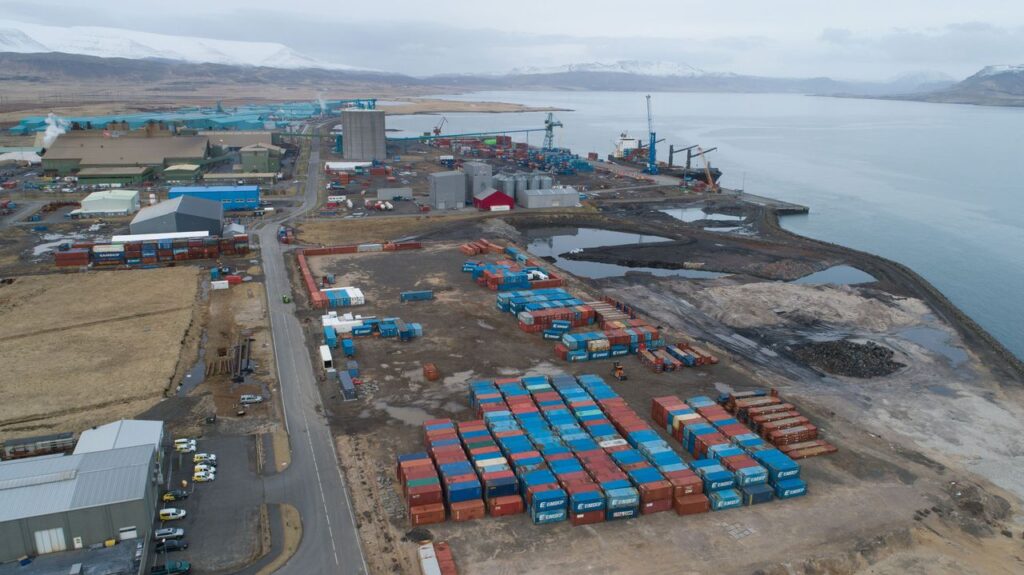
Over the course of summer 2023, Running Tide sent at least 11 deployments of treated wood chips out to sea from Grundartangi Harbor, an industrial port near Akranes where the carbon-removal company’s neighbors included an aluminum smelter and a ferrosilicon plant. The team was in a constant battle against the unpredictable Icelandic conditions. “Our weather window up here in the North, it’s super small,” says one former employee.
Across 30 hours, they would load barges with thousands of tons of wood chips mixed with alkaline material. Equipment troubles plagued the team, former staffers say. Most issues stemmed from the wood chips being extremely light; the equipment the company had purchased for handling the chips was for dense materials, like concrete. Out on the ocean there were other issues.
Following Iceland’s “cod wars” with the United Kingdom, which ended in the 1970s, the United Nations formally established so-called exclusive economic zones, or EEZs, that extend a country’s sovereignty into the ocean, ranging anywhere from 3 to 200 nautical miles offshore. Running Tide’s permit granted it permission to operate only within Iceland’s EEZ. But after analyzing the movements of the company’s carbon-removal projects using MarineTraffic, a ship tracking and maritime analytics provider, as well as GPS coordinates in emails between Running Tide and the Icelandic Coast Guard, WIRED found evidence that Running Tide may have violated the Faroe Islands’ EEZ in January 2023 and Canada’s EEZ in 2024. According to documents uploaded on Running Tide’s website, the company also violated Denmark’s EEZ in 2023. Running Tide did not seek permission from any of these countries to operate in their waters.
By early 2024, Jón Ólafsson, professor emeritus at the University of Iceland and an expert in carbon fluxes around the Arctic Sea, had grown alarmed by statements that Running Tide, and in particular Odlin, were making to the press, speaking as if they had unlimited access to Icelandic waters. The company’s activities seemed especially preposterous because, according to Ólafsson, their wood-chip dumping could not have sequestered any carbon from the atmosphere. “Throwing wood chips into the ocean does nothing for the atmosphere,” Ólafsson told Heimildin, the Icelandic magazine.
The location where Running Tide dumped the Nova Scotian wood naturally “releases about as much [carbon] back to the atmosphere in winter as it fixes in the summer,” says Ólafsson, who published a peer-reviewed article on this very topic—carbon fluxes in the North Atlantic—in 2021. According to Ólafsson’s decades of research, it was physically impossible for the ocean to absorb carbon for more than six months in those locations. When told this information by WIRED, Odlin said he was not familiar with the scientists or the 2021 paper. “This is what academics do. This is what happens when people are stuck in institutions and don’t have to live in the real world,” Odlin said. “I could care less what that guy thinks.”
Outside of Iceland, scientists also began raising questions about Running Tide’s chip-sinking techniques, based on documents the company published on its website. Coating wood chips with lime kiln dust and sinking them are “essentially two mutually exclusive processes to my mind, in terms of carbon sequestration,” says James Kerry, an adjunct senior research fellow at James Cook University, Australia, and a senior marine and climate scientist at the conservation organization OceanCare.
It is impossible for both methods to work, Kerry contends. If the wood chips sank, the alkaline enhancement—a chemical reaction that can only occur at the surface—wouldn’t have happened. And if the wood chips stayed at the surface long enough for alkaline enhancement, the chips would likely “have ended up as marine pollution” along the coasts of Iceland and Northern Europe.
In the final carbon-accounting report for its wood-chip-sinking work, originally published on Running Tide’s website and since taken down, the company mentions both forms of sequestration, but does not claim carbon credits for its ocean alkalinity enhancement. Pointing out that the small monitoring devices and few cameras they had were insufficient to do any environmental impact assessment of the actual experiments, Kerry believes that the project appeared to be “about making money before any kind of proper science had been conducted.” In his view, “there is no scientific justification based on what they were trying to study to dump 19,000 tons of something in the ocean.”
Odlin confirms that for all of the Icelandic wood-chip ocean deposits, it was impossible for Running Tide to monitor the wood chips for more than three hours after their release, saying, “We couldn’t measure signal from noise in the ocean on the alkalinity.”
The Dead Zone
Despite having sold credits to Stripe, Shopify, Microsoft, and the Chan Zuckerberg Initiative, financial pressures on Running Tide continued to mount as the flow of funds from Silicon Valley dried up. According to one former employee, Odlin would start meetings in spring 2024 by announcing that the company had only a few more weeks of funds before it would have to close. That June, Odlin admitted defeat.
In a LinkedIn post on June 14, 2024, Odlin wrote that “there simply isn’t the demand needed to support large-scale carbon removal.” The company ceased global operations that month. Nearly all employees in Iceland and the US were suddenly let go. One employee was presenting about Running Tide at an algae conference when he was told the news.
“People were happy with our credits. We were filling our contracts. We were selling additional contracts. It just wasn’t enough,” Odlin says. Running Tide had sold $30 million of credits and said it had commitments for tens of millions more, but by Odlin’s estimate, the company needed somewhere between $100 million and $150 million of sales. “That was, like, the rent we were designed for.”
The legacy the company leaves behind after its wood-chip dumping is unclear. It’s simply not known what effect the sinking of biomass will have on the ocean, and the scientists and deep-sea experts WIRED spoke to remain hesitant about pursuing such marine geoengineering until more is understood about the deep sea.
Dumping biomass in the ocean could create “dead zones,” areas where aquatic life is starved of oxygen, says Samantha Joye, a Regents’ Professor in the Department of Marine Sciences at the University of Georgia, who has worked on dead zones in the Mississippi Delta as well as on the cleanup of the 2010 Deepwater Horizon oil spill.
Deep sea environments—some of which provide life-saving drugs or insights into how early Earth formed—could also be forever damaged, Joye adds. A recent carbon flux report by Convex Seascape Survey, an international research collaboration, found that once the seabed is disrupted, this could actually halt the ability for sediments to absorb carbon. Joye also points out that without proper research, ocean alkalinity enhancement could also cause spikes in ocean acidity if it draws lots of carbon into the sea that isn’t then distributed into its deep waters—the very opposite of what the treated wood chips were trying to achieve.
“The deep sea and the surface ocean are intimately connected,” says Joye. “We really can’t afford to screw this up.”
Odlin, though, dismisses the idea that Running Tide did harm to the ocean. “We had multiple studies about the impact of biomass sinking on the benthic habitat. We had a bunch of experts around us.” Everything that the company did, Odlin says, was in consultation with its science advisory board, which included individuals from the Woods Hole Oceanographic Institute, Georgia Institute of Technology, and American University. “I think the probability of adverse harm to the ocean is almost zero for what we did. Zero.”
For him, the need to press ahead with carbon removal trumped the need for a perfect answer on how to manipulate the ocean’s carbon cycle. “You can’t necessarily wait for the perfect model, because there’s always going to be a better model coming,” he says.
Ultimately, Odlin says, they had the authorization they needed from the Icelandic government for the work they were doing. “All I know is we applied, and we got the approval.”
Onward and Upward
For Microsoft, Running Tide’s work was initially deemed a success: despite no independent verification that the organization sequestered any carbon, the tech giant still listed the Running Tide credits it bought in its Carbon Removal Portfolio for Fiscal Year 2023. This was in spite of Microsoft having purchased seaweed-sinking credits, says Brian Marrs, the company’s senior director of energy and carbon removal, and not those created through wood-sinking. “We have not signed contracts for that product,” Marrs says. “Our purchases were for, I guess what I consider the original product, which was the kelp algae product.”
When asked about this discrepancy between what Microsoft ordered and received, Odlin refused to go into details. “I’m not gonna comment on what Microsoft said. We had a contract with them that we filled.”
WIRED first asked Microsoft about the veracity of Running Tide’s credits in the fall of 2024. In response, the tech company cited its NDA with Running Tide and refused to comment. However, it later acknowledged that it had removed some of Running Tide’s credits from its carbon-removal portfolio. “We pilot innovative pathways—including ocean-based methods—while holding every project to the highest standards of third-party verification and measurement, reporting, and verification (MRV),” Microsoft spokesperson Ben Wilsker says. “When credits don’t meet those standards, as was the case with some deliveries from Running Tide, we don’t count them toward our carbon accounting.”
Any problems it might have had with Running Tide’s credits didn’t dampen the tech giant’s appetite for marine carbon removal. In October 2024, Microsoft signed the world’s largest purchase agreement to date for marine carbon dioxide removal, with Ebb Carbon. Microsoft secured at first 1,333 tons of carbon removal, with options to purchase an additional 350,000 tons. Having garnered $24.75 million in Series A funding, Ebb Carbon uses green electricity to split seawater into acidic and alkaline solutions, and then releases the latter back into the ocean to increase alkalinity so that the sea can absorb more carbon from the atmosphere.
This headline-inducing deal is part of Microsoft’s bullish strategy on pursuing carbon removal, and runs counter to Odlin’s claim that demand for large-scale marine carbon removal isn’t there. In 2024, the company purchased 5 million tons of credits, from terrestrial and ocean-based carbon-removal projects, accounting for 63 percent of the volume of the entire carbon-removal market that year. Microsoft’s purchases in the carbon-removal space are “building the markets we buy from,” says Marrs. When asked about issues like no third-party verification, Marrs says that Microsoft “welcomes that ecosystem catching up, but at the same time, we don’t always need to wait for those verification bodies.”
The ecosystem is busily developing. Gigablue, which grows and sinks plankton in the ocean, sold 200,000 marine carbon-removal credits in January 2025. Planetary Technologies, a company specializing in ocean alkalinity enhancement, raised over $11 million in Series A funding in October 2024. And Equatic has begun building what it claims to be the largest marine carbon-removal facilities in Asia and North America, which will capture carbon on land and then mineralize it and store it in the ocean.
Investments and sales across the sector over the past two years total as much as a quarter billion dollars. But because carbon removal remains unregulated, and exact numbers on the price per ton of carbon are not publicly available, it is difficult to see how these industries are progressing. “The voluntary carbon market has no rules,” says Stacy Kauk, chief science officer at Isometric, a carbon-removal registry. Formerly the head of sustainability at Shopify, Kauk organized one of the first investments into Running Tide in her former role. “On the corporation side, you’re incentivized to buy credits so that you can then make a green claim,” she says.
Hróbjartsson, Running Tide’s former general manager, is skeptical about how much positive impact the marine carbon-removal industry can have. “We’re just making a prettier carbon-offset market,” he says of the industry. “It’s lipstick on a pig.”
“Any marine carbon removal, if it’s going to work on a global scale, we’re going to have to make a decision to completely alter some ecosystems,” says Egilsdóttir. Pointing out that deep-sea sediments can take up to 1,000 years to grow 1 millimeter, she believes that “we should never, ever do that unless we know exactly what we’re doing, and we are quite far from reaching that point.”
Running Tide contends it had no adverse impact on the ocean around Iceland—but it has left its mark. In January 2025, a beach cleanup team found one of the company’s 3-foot-tall buoys washed up on the shore in Caithness, a small coastal town in northern Scotland. Seeing that the debris was from an American company, the volunteers conducting the cleanup contacted the US National Oceanic and Atmospheric Administration to see if they knew of the buoys; the organization was unaware.
“We have messed up the atmosphere as mankind,” says Ólafsson. “Is it OK that we just go to the next place and mess up the oceans?”
The post How the Next Big Thing in Carbon Removal Sunk Without a Trace appeared first on Wired.