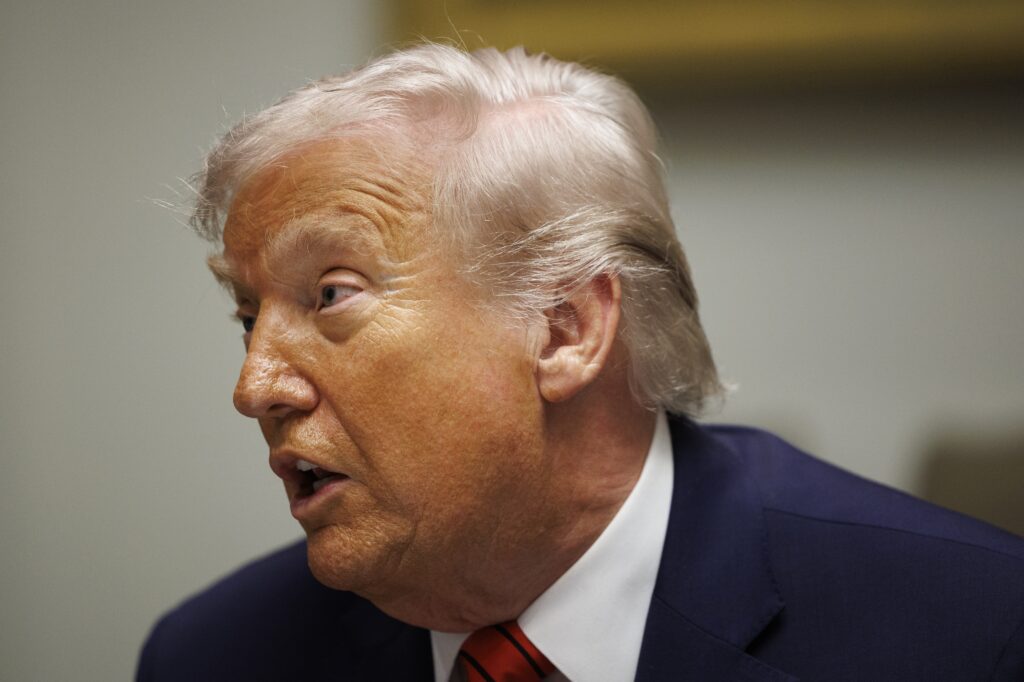
The U.S. House approved a measure overturning President Donald Trump’s executive order eliminating union rights at federal agencies, but the rebuke of Trump’s restriction on public-sector unions is unlikely to pass the Senate because Republicans largely oppose it.
The House voted 232-194 to repeal the order signed in late March, which barred collective bargaining for workers at more than two dozen federal agencies. Twenty-two Republicans broke with their party to support the measure. In the Senate, at least 13 Republicans would have to support the measure to bypass the filibuster, if all Democrats back it.
The administration argued that restricting union rights was necessary to protect national security, though the order applied at agencies with both direct and indirect links to national security.
“The order was the largest act of union-busting in American history, and it left our federal workforce more vulnerable to unfair treatment and political interference,” Rep. Jared Golden (D-Maine) said in a speech on the House floor.
The order came in the midst of U.S. DOGE Service’s efforts to pare back the federal government, firing workers en masse and shuttering agencies. Federal workers unions mounted aggressive legal campaigns against the layoffs.
“President Trump betrayed workers when he tried to rip away our collective bargaining rights,” said AFL-CIO President Liz Shuler in a statement after the vote. “We commend the Republicans and Democrats who stood with workers and voted to reverse the single largest act of union-busting in American history.”
Trump’s order covered the Departments of Veterans Affairs, Defense, State and Justice, and parts of Homeland Security, Health and Human Services, Interior, Energy and Commerce.
The unions affected sued the administration, alleging that the president’s order was an act of retribution against unions for other litigation they’ve filed against the government, including over cuts to the federal workforce. The unions also argued that the administration targeted agencies with no direct connection to national security.
But in August, a federal appeals court approved Trump’s order, and the administration moved forward to strip union protections, including at Veterans Affairs, where more than 400,000 workers had union protections. That month, Trump signed another executive order cancelling union rights for civil servants at six more agencies.
Golden advanced the bill through the legislative tool of a discharge petition, a way for lawmakers to force consideration of bills that the speaker refuses to bring to the floor. It takes 218 signatures — a majority of the House, which means at least some bipartisan support with the GOP margin so tight.
Sharda Fornnarino, a VA nurse in Colorado and local head of her nurses union, visited the Capitol on Thursday to watch the bill pass, hoping that the restoration of collective bargaining might make her job safer.
Fornnarino said that the union previously provided oversight to make sure her hospital’s equipment was safe and that there was enough staff working to provide sufficient care for patients.
“Those guardrails are abandoned,” she said.
Federal workers already have limited union rights compared with other employees. They can’t strike or bargain over pay. But they are allowed to join unions and bargain collectively — protections that are meant to ensure workers are treated fairly, while preventing activity that could be disruptive to public services or threaten national security.
Meryl Kornfield contributed to this report.
The post House votes to repeal Trump order ending union rights at federal agencies appeared first on Washington Post.