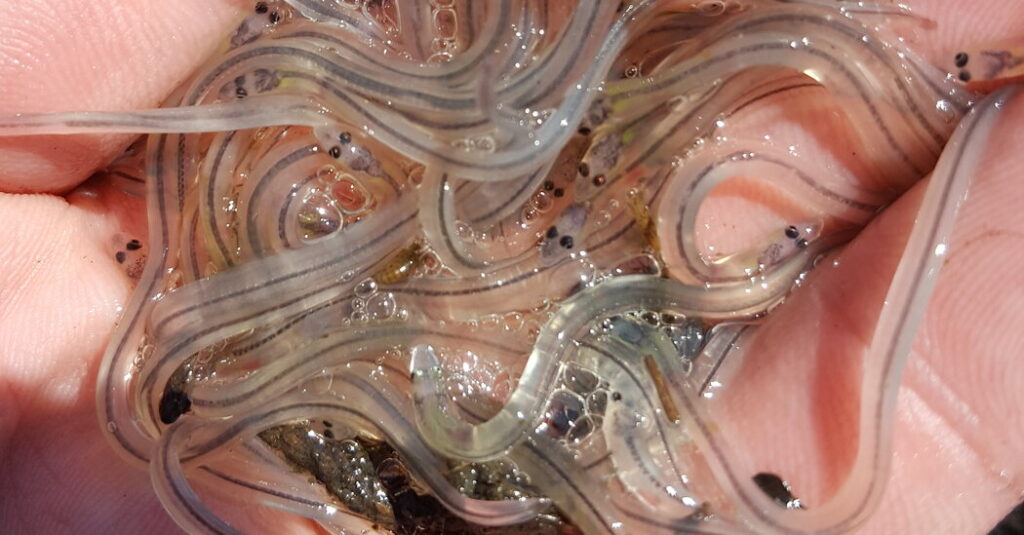
Good morning. It’s Thursday. Today we’ll find out about eels that live in a place you might not expect to find them. We’ll also get details on what President Trump has said about two Republicans who are running for governor.
They wriggle, squirm and dance amid remnants of refrigerators and junked cars in — yes — the Bronx River. “They’re not beautiful, they’re not charismatic, and no one is gone to have one as a stuffed toy for their children,” said Sue Lieberman, a vice president of the Wildlife Conservation Society, whose headquarters in the Bronx Zoo compound is a short walk from the river.
She was talking about American eels, whose population has plunged in other rivers and coastal waterways along the East Coast. The context was a proposal to add protections for them and other species of eels under the world’s leading wildlife trade agreement. She said the regulations would “provide critical oversight to help overexploitation and illegal trafficking.”
Eel populations in Europe and Japan have collapsed in recent years, driving up demand for American eels, with prices exceeding $2,300 a pound, the conservation society says. The different species look alike, she said, so “if you’re a poacher, you can take European eels”— already covered by trade regulations — and “send them to Japan and say they’re American eels,” which are not covered.
So far, trafficking is not a problem on the Bronx River. A conservation society effort to tag and track eels there that began in 2012 has trailed only 530 eels, and when they are young, American eels are hard to spot in the water. But Lieberman is worried that illegal trafficking could drive down even the relatively small numbers of eels that end up in the Bronx River.
To the Bronx, from the Sargasso Sea
How they end up there, and in other rivers and streams from Maine to Florida, is something of a mystery. For reasons no one has figured out, they spawn in only one place, the Sargasso Sea, a huge elliptical stretch of the Atlantic Ocean between Bermuda and the Azores that Christopher Columbus sailed through on his first voyage, in 1492. It’s 1,100 miles from the Bronx.
But “nobody has ever seen American eels spawning” there, said Jake Lebelle, a researcher with the conservation society. “The only hard, physical proof we have is from when researchers in Canada put satellite tags on mature America eels.” One tagged eel made it to the Sargasso Sea, where it died — as males do after they spawn.
The offspring drift for as long as a year before finding their way into rivers as transparent glass eels. Then they become juveniles called elvers, and eventually mature.
In the Bronx River, an eel “spends its time, especially during the day, hidden under anything it can find — rocks, trees, fallen trees, soft sediment,” Lebelle said. “When there’s a lot of heavy rain, the Bronx River floods, the Bronx River Parkway closes” — and storms flush them out, onto paths near the road.
“They’re hardy,” he said. “It takes a lot for eels not to be able to live. They can survive out of the water, as long as their skin is wet, longer than most fish can.” They can handle pollution and low oxygen levels, he said, and are “happy eating just about anything” as they approach maturity. “They’ll eat fish. They’ll eat insects. They’ll eat organic matter on the bottom if they have to.”
The proposal before the global conference, the Convention on International Trade in Endangered Species of Wild Fauna and Flora, would have added eels to a list known as Appendix II, which provides for international oversight for trade and sustainability. Japan and China lobbied against that, said Lieberman, who attended the gathering in Uzbekistan, and the proposal was ultimately rejected.
A spokeswoman for the U.S. Fish and Wildlife Service said the federal government had “strongly opposed” putting eels in Appendix II, in part because a separate amendment requested by the Dominican Republic would have listed them in a different appendix, known as Appendix III, and would “prevent adverse impacts.”
Lieberman said that the Appendix II proposal would have helped ensure that all eel trade was sustainable and legal, while Appendix III was less stringent. “Many countries do not effectively control Appendix III trade,” Lieberman said, “and there is no substitute for Appendix II.”
Weather
Expect a mostly sunny and breezy day, with the temperatures reaching about 35. It will be a partly cloudy night with temperatures in the high 20s.
ALTERNATE-SIDE PARKING
In effect until Dec. 25 (Christmas)
The latest Metro news
-
Judge approves unsealing Epstein grand jury records: Judge Richard Berman granted the Justice Department’s latest request to unseal records from the federal grand jury investigation into the convicted sex offender Jeffrey Epstein. The decision came a day after another judge granted a similar request for files on Epstein’s longtime companion Ghislaine Maxwell.
-
Suit against the Justice Department: The American Civil Liberties Union, the New York Civil Liberties Union and the Center for Constitutional Rights are seeking the release of a secret memo justifying the Trump administration’s boat strikes in international waters. The plaintiffs said that “the public deserves to know how the Trump administration has justified the outright murder of civilians as lawful.”
-
13 charged in gang-related attack: The defendants, members of the “OY” gang, were charged with attempted murder in the death of a 16-year-old in Harlem who prosecutors said was not affiliated with a gang.
-
A new governor inherits a misconduct investigation: Gov.-elect Mikie Sherrill of New Jersey is inheriting an investigation into potential misconduct within the New Jersey State Police that has frayed relationships among law enforcement officials. She has already told the head of the State Police that he will not be reappointed when she takes office.
-
New chief for the Port Authority: Kathryn Garcia, a top aide to Gov. Kathy Hochul and a former city sanitation commissioner, was named executive director of the Port Authority, the bistate agency that runs airports, bridges, tunnels and bus terminals.
-
Democrats in New Jersey abandon plan to curtail corruption watchdog: The Democratic Senate leader in New Jersey plans to halt his effort to weaken a government watchdog. The independent watchdog, led by Kevin Walsh, a former civil rights lawyer, has aggressively investigated fiscal misconduct by state leaders, scrutinized government contracts and exposed Medicaid fraud.
-
What we’re watching: On “New York Times Close Up With Sam Roberts,” Sam Tanenhaus, a former editor of The New York Times Book Review, discusses his new biography of William F. Buckley and how Buckley became a defining New York conservative voice that shaped the modern right. The program is broadcast on CUNY TV at 7:30 p.m. on Fridays, Saturdays, and Sundays.
Trump didn’t clear the way for Stefanik
Two allies of President Trump are running for governor: Representative Elise Stefanik, who has described herself as “ultra MAGA,” and Bruce Blakeman, the Nassau County executive. Trump has not endorsed either of them.
My colleague Grace Ashford writes that Mr. Trump told Blakeman last week that he did not like seeing Republicans run against each other. But he didn’t tell Blakeman to stand down, and on Monday, he was noncommittal. “He’s great, and she’s great,” the president said at the White House. “They’re both great people.”
Trump’s nonintervention on Stefanik’s behalf surprised Republicans who were already committed to supporting her and had hoped to avoid a potentially messy primary fight. They have had their eyes on Albany since 2022, when their candidate, Representative Lee Zeldin, lost to Gov. Kathy Hochul by the relatively slim margin of 377,000 votes, or 6.4 percentage points.
Some Republicans feel that Stefanik is entitled to run, given her continuing loyalty to a president who made her his first cabinet-level nominee when he chose her to be the ambassador to the United Nations. Then he scotched the nomination amid concern that the Republicans could not afford to lose her vote in the House.
But Blakeman and Trump have known each other for years, and Blakeman’s success in marshaling suburban voters’ fears helped him win re-election by more than 37,000 votes, or 11.6 percentage points, in November.
METROPOLITAN diary
Steady Customer
Dear Diary:
When I moved to Manhattan after college, I acquired much of my wardrobe thrift-shopping at Housing Works.
Saturday mornings meant armfuls of castoff cashmere, designer dresses with frayed hems and trousers made for women with legs twice as long as mine. At 5 feet 2 inches tall, I knew most of it would end up at the tailor anyway, so fit wasn’t my focus.
The seamstress at the dry cleaner across from my Murray Hill walk-up became my most reliable relationship. Each week I dropped off another bundle, assuming she appreciated the steady business.
She pinned hems, took in waists, and, when I went too far, offered her single note of disapproval: “Looks very young.”
Otherwise, she kept her counsel. Until one morning, she paused and looked up mid-pin.
“Why don’t you just buy clothes that fit?” she asked.
— Jaquelyn M. Scharnick
Illustrated by Agnes Lee. Tell us your New York story here and read more Metropolitan Diary here.
Glad we could get together here. See you tomorrow. — J.B.
P.S. Here’s today’s Mini Crossword and Spelling Bee. You can find all our puzzles here.
Steven Moity and Ed Shanahan contributed to New York Today. You can reach the team at [email protected].
Sign up here to get this newsletter in your inbox.
James Barron writes the New York Today newsletter, a morning roundup of what’s happening in the city.
The post Eels in the Bronx: Slimy, Hardy and Hungry appeared first on New York Times.