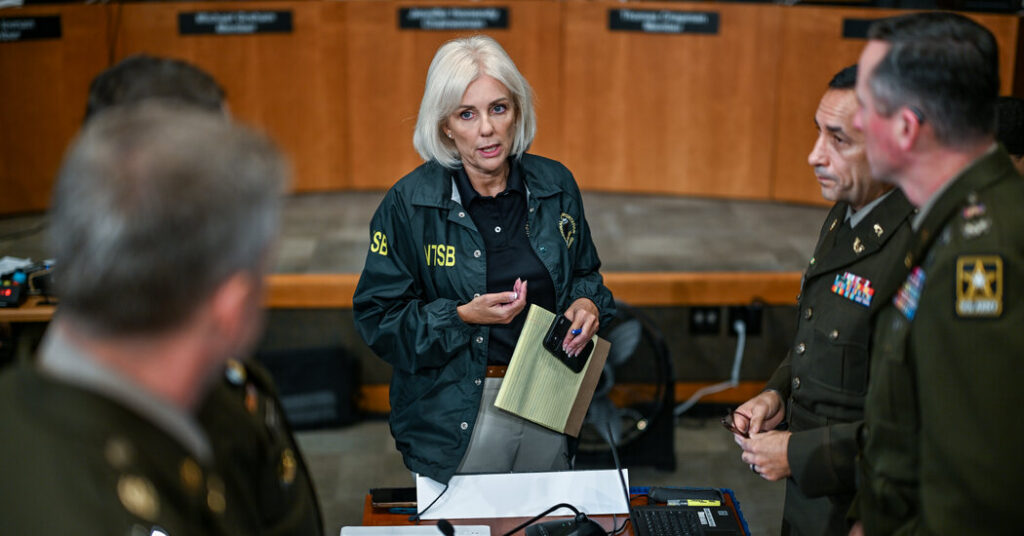
The chair of the National Transportation Safety Board and the bipartisan leaders of the Senate committee overseeing aviation warned on Wednesday that a section in a new defense bill would weaken safety measures around Ronald Reagan Washington National Airport and worsen the risk of midair collisions between military and commercial aircraft.
“This is shameful,” Jennifer Homendy, the N.T.S.B. chair, told reporters, arguing that the provision “essentially gives the military unfettered access” to fly through Washington’s airspace without broadcasting their aircraft’s location to other pilots.
N.T.S.B. investigators examining the Jan. 29 midair collision between an Army Black Hawk helicopter and a commercial jet near the airport that killed 67 people are focusing on the fact that the helicopter was not using enhanced tracking technology.
Ms. Homendy, visibly angry, said that if the helicopter safety provision in the defense bill became law, she would be concerned about the safety of flying in the crowded airspace near the nation’s capital.
“It is a step backward,” she added. “In fact, I would say it’s a safety whitewash.”
The warnings came hours before the House passed the annual defense bill, which will go to the Senate for approval next week. It was not immediately clear whether lawmakers would consider other ways to offset the effects of the bill’s helicopter safety provisions.
The section at issue would create a waiver allowing military aircraft to turn off their enhanced tracking software while flying on national security missions through parts of the Washington airspace, or if the military determines that the flight poses no risk to commercial flights.
The waiver — which the secretary of any military department could grant with the concurrence of the transportation secretary — was included in an earlier version of the defense bill that passed the House in September. It did not appear in the Senate’s version of the bill, which passed that chamber in October.
Since the Jan. 29 crash, the Federal Aviation Administration — acting on the urgent recommendations of the N.T.S.B. — has imposed restrictions around Reagan Airport, changing certain helicopter routes and limiting the circumstances under which military aircraft can operate near the airport without broadcasting their position.
A bipartisan effort is underway in the Senate to support such restrictions over Washington and other busy airports around the country.
Lawmakers behind that effort, led by Senator Ted Cruz, Republican of Texas and chairman of the Senate Commerce Committee, and the committee’s ranking member, Senator Maria Cantwell, Democrat of Washington, urged lawmakers to rewrite the contentious section of the bill, known as the National Defense Authorization Act, or N.D.A.A.
“The N.D.A.A. fails to make the skies safer,” they said in a joint statement that was co-signed by Senator Jerry Moran, Republican of Kansas, and Senator Tammy Duckworth, Democrat of Illinois, who lead the panel’s aviation subcommittee.
“We must act decisively to prevent future tragedies,” they added.
Representatives for the Republican and Democratic leaders of the House and Senate Armed Services Committees — who negotiated the final compromise version of the defense bill — did not immediately respond to questions about the concerns raised on Wednesday.
Senators routinely lament the inclusion or omission of provisions in the annual defense policy bill, considered one of the few must-pass pieces of legislation before Congress each year. But it is exceedingly rare for an N.T.S.B. chair to weigh in on such a measure, especially with the forcefulness that Ms. Homendy showed on Wednesday.
Ms. Homendy, who worked on Capitol Hill before she was named to the transportation safety board, ridiculed the bill’s language on military helicopter safety, which says that a military-issued “commercial aviation compatibility risk assessment” could be grounds for issuing a waiver.
“Nobody actually knows what a commercial aviation compatibility risk assessment is,” Ms. Homendy said. She asked why the bill did not task the F.A.A., which is responsible for maintaining air safety, with conducting such risk assessments, considering that it has more expertise in ensuring safety in Washington’s airspace.
The bill’s authors, she contended, never reached out to the N.T.S.B. for counsel, even as they approved language that would in effect reverse many of the air safety measures the bureau had recommended after the Jan. 29 collision.
“This is exactly what existed at 8 p.m. on Jan. 29, about 15 minutes before the midair collision — this doesn’t improve anything,” she told reporters, adding that in some cases, it rolled safety restrictions “even further back.”
Karoun Demirjian is a breaking news reporter for The Times.
The post Defense Bill Will Make D.C. Skies Less Safe, N.T.S.B. Chair Says appeared first on New York Times.