Singapore is quickly warming to the idea of autonomous vehicles on its roads. In October, the city-state’s Land Transport Authority (LTA) approved trials by superapp Grab and Chinese robotaxi firm WeRide in Punggol, a district in the country’s north.
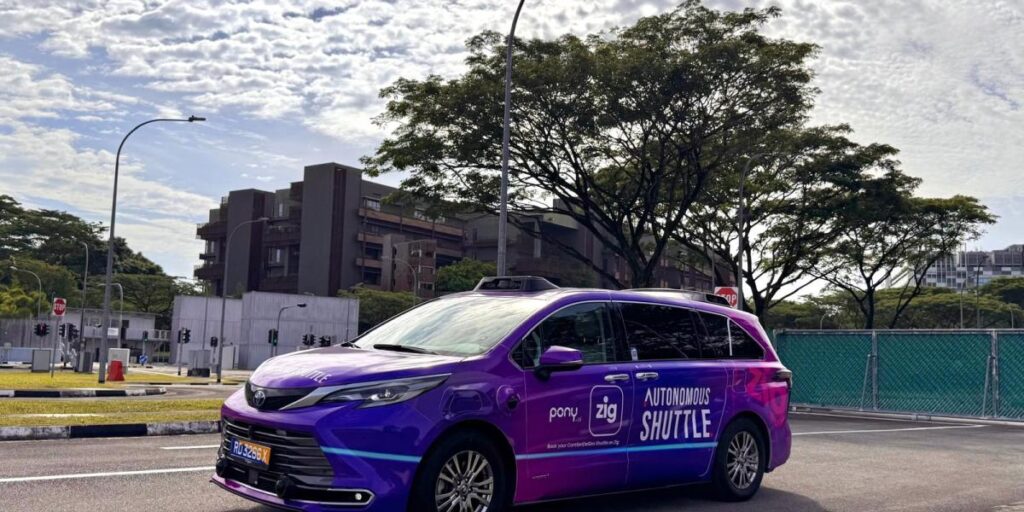
ComfortDelGro (CDG), one of the region’s leading transit operators, is the next company to get the green light to test self-driving vehicles on the city’s roads.
The trials will start with five five-seater autonomous shuttles. CDG plans to roll out rides to the public by next year, through a driverless car option on Zig, its ride-hailing app.
CDG’s first batch of AVs had successfully completed Milestone 1 trials, a crucial approval stage for AVs in Singapore to move from more controlled environments to public roads, it said in a press statement on Dec. 11.
“This achievement meets the stringent standards for autonomous vehicle systems, enabling us to responsibly introduce intelligent transport systems in Singapore,” said Cheng Siak Kian, CDG’s CEO.
Public AV test runs allow vehicles to gather and analyze real-world data to localize their AI driving models. This includes details on road infrastructure, traffic flows, the behavior of local road users and pedestrians, and local weather conditions.
Singapore’s investments in AVs
ComfortDelGro is best known for running part of Singapore’s subway system, as well as buses and taxis. It’s also expanding internationally, with ventures in Australia, Europe, and mainland China.
But perhaps its most ambitious venture is its new partnerships with robotaxi firms.
In March, CDG kicked off a sandbox program in Guangzhou alongside Chinese robotaxi provider Pony AI to begin developing capabilities for operating an AV fleet. Then, last month, the company inked a Memorandum of Understanding (MoU) with Alibaba-backed Hello Robotaxi, to collaborate on large-scale commercial robotaxi deployment in China and other overseas markets.
At the time, CDG’s CEO Cheng called the Hello Robotaxi partnership “a significant step in developing our autonomous vehicle capabilities and securing our long-term position in the future of point-to-point mobility.”
“By creating an integrated intelligent shared mobility network—blending our taxi business with robotaxi services—we are building a robust, replicable, and forward-looking hybrid operating model that can be scaled across our global network,” he added.
Grab, which operates Southeast Asia’s largest ride-hailing platform, is also investing in AVs. The company expects to welcome the first batch of passengers onto its AV fleet—currently ten five-seater cars and one robobus—by early 2026. Grab’s also made strategic investments in WeRide and U.S.-based May Mobility, another robotaxi firm.
Singapore’s government is also eager to move towards introducing AVs on its streets. In July, the country established a 17-member committee to drive the rollout of AVs.
The committee includes representatives from industry, academia, unions and the government, and is chaired by Singapore’s acting transport minister, Jeffrey Siow, who has called AVs a “game changer” for Singapore’s transport system.
Temasek Holdings, Singapore’s state investment company, also bought about 1.4 million shares of WeRide and 14,500 shares of Pony AI in the third quarter of this year. According to its 13F filings released in November, the shares are worth a total of $13.7 million. Temasek has also invested in other AV companies, including Swedish transport firm Einride and Israeli AI mobility firm Autobrains.
In a media interview in June, Siow said that Singaporeans can expect to see many AVs on its roads in the next five years, but added that their rollout would be gradual. The country plans to allow operators to start AV services with fixed routes in residential estates, and later offer rides to places of interest.
“I envision that AVs will be deployed fairly extensively within the next five years, and they will be… a very useful addition to the public transport network,” Siow told Singaporean broadcaster CNA, adding that the vehicles will help to ease the manpower strain in the country’s transport sector.
The post ComfortDelGro joins Singapore’s race for autonomous vehicles with new shuttle trials and public rides by 2026 appeared first on Fortune.