It’s the odd vintage postcard you could never resist at a thrift store.
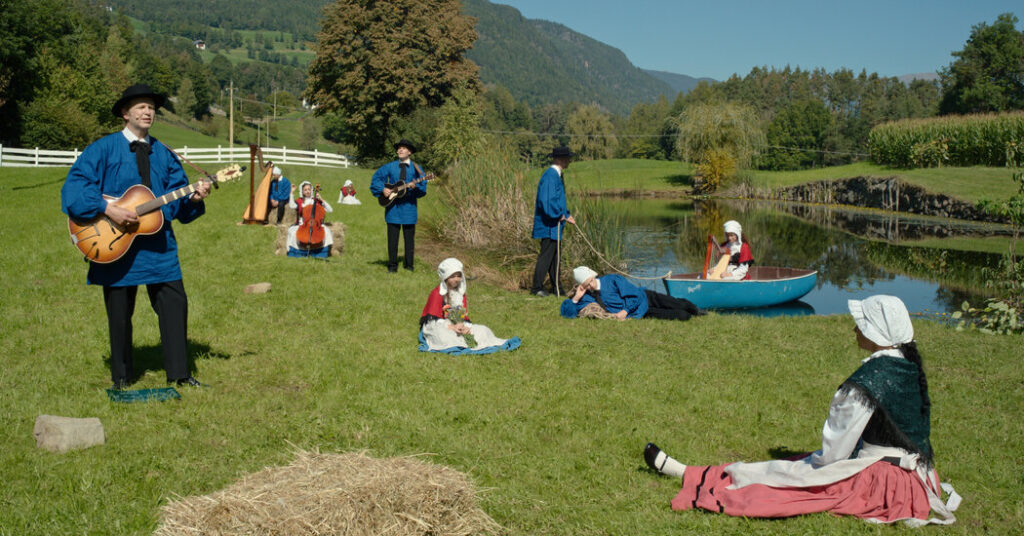
In a field by a lake in some Alpine valley, a little crowd lolls about in period costume. Five men are in the blue smocks of 19th-century artists; four women are in that era’s frocks, shawls and bonnets. A final detail that’s vital: Breaking the chronology — pointing to the photograph’s postwar moment — one of the men is strumming an electric guitar.
That bizarre image has long hung on the fridge of the Icelandic artist Ragnar Kjartansson, and it became the inspiration for his fascinating new video projection, titled “Sunday Without Love,” at Luhring Augustine gallery in New York through Dec. 20.
In a world drowning in irony and cynicism — easy to see why, in our moment — Kjartansson has dared to explore heartwarming sentiment. That makes his piece one of the most unusual, exciting works I’ve seen in a while.
For his video, Kjartansson (his name is pronounced RAG-ner kuh-YART-un-sun) set out to recreate his postcard as a live-action scene, complete with music. Donning a blue smock, the artist himself took on the role of the photo’s guitarist. He put a second guitar, two harps, a cello and a violin into the hands of his other costumed actors.
And he put lyrics into all their mouths.
“You must learn to live, live without love,” they croon, like the refrain in a pop song that comforts the heartsick. “Love is not good for you / Stop all this longing, looking at stars.”
Those phrases, repeated for the video’s full 19 minutes, are set to an irresistibly sweet, lilting melody by the composer David Thor Jonsson, Kjartansson’s frequent collaborator. Jonsson is normally an avant-gardist, but for “Sunday Without Love” he seems to have taken on the persona of a Brill Building songsmith, crafting heartache for B-sides.
By assigning the bromides of romance to old-time besmocked artists, Kjartansson evokes a time when ambitious fine art could still stomach sentiment.
His video doesn’t try to inhabit that Victorian moment by adopting its styles or tropes; that would be a dull rear-guard action, like trying to paint like a Pre-Raphaelite. But it asks us to try romance on for size once again, even though the action we’re watching, like the postcard it’s based on, seems so nearly absurd. It’s actually that contrast, between the silliness of the presentation and the seeming sincerity of the emotion, that gives the piece such power: Kjartansson puts obstacles in the way of its pop clichés, and lets us watch as they work anyway.
That’s a classic move in modern art: Do something that seems ridiculous — break vision into facets; cover a canvas in dripped paint; fill a gallery with Brillo boxes — and show that your work still pays artistic dividends.
A back story gets at Kjartansson’s version of that move. The heartfelt words in his video have been excerpted and translated from the chorus of “Ohne Liebe Leben Lernen” (“Learning to Live Without Love”), a 1996 comic song by the German singer Rocko Schamoni. It’s a cheesy tune, and remaining lyrics (“You have such lovely hobbies / A boat and a pony / And you always liked watching TV”) reveal a take on love and heartbreak that is completely cynical. That underlines how unlikely it was for Kjartansson to try to de-cynicise it, and makes his success more impressive.
In transforming Schamoni, Kjartansson is like a cutting-edge chef who uses Parmesan cheese in a dessert — not because it makes for a better sweet, but because the dessert’s unlikely sweetness takes on extra meaning.
“Sunday Without Love” inevitably invokes another precedent: Edouard Manet’s great painting, “Le Déjeuner sur l’herbe,” from 1863. That work’s well-clad gentlemen and near-naked ladies, picnicking on a lawn by a pool, clearly throw some kind of spanner into the works of romance — as was clear to its first viewers, appalled by Manet’s cynical takedown of how love was supposed to appear in art. A century and a half later, Kjartansson is trying to undo Manet’s work — which, in today’s art world, feels almost as radical a concept as the one behind the “Déjeuner.”
I’m not sure that Kjartansson is truly, madly, deeply committed to the platitudes of romance, any more than Manet was incapable of heartfelt love. Rather, he manages to craft a genuinely romantic work of art, while never denying the deep absurdity of all romance — an absurdity recognized by most of the crafters of sentiment, and by some of their lovesick patrons, from the troubadours to Schubert to the Beatles writing “Yesterday.”
Paradox is at the heart of a lot of good art: Titian’s dead brushwork that stands for live flesh; Cézanne’s flatness that talks about shape; Warhol’s loving attack on consumerism. Kjartansson gives us sentiment that’s absurdly serious, and seriously absurd.
Ragnar Kjartansson: Sunday Without Love
Through Dec. 20, Luhring Augustine Tribeca, 17 White Street, Lower Manhattan, 646-960-7540; luhringaugustine.com.
The post Can the Fine Art World Finally Stomach Sentiment? appeared first on New York Times.