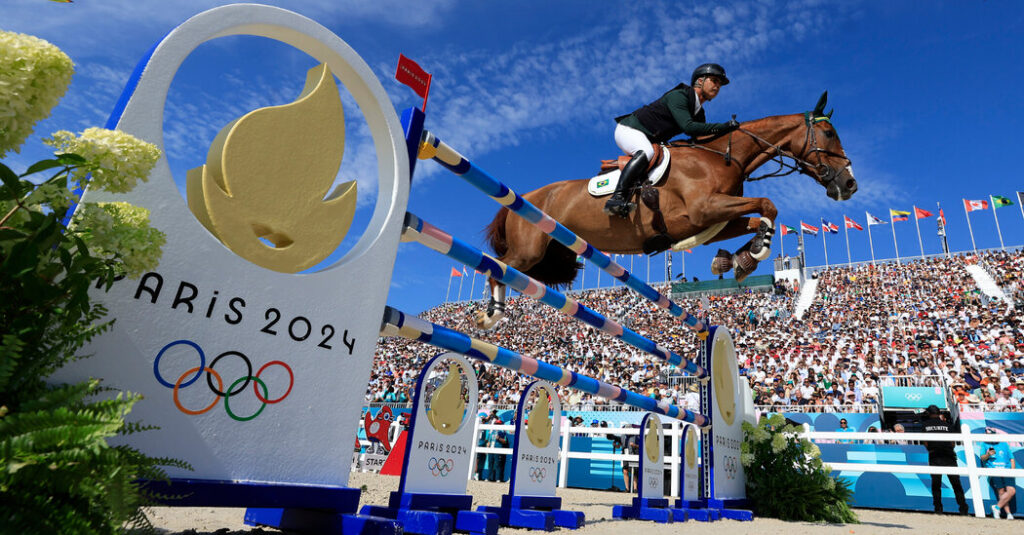
Before a backdrop of Versailles palace, Pedro Veniss, a Brazilian equestrian, piloted his horse Nimrod de Muze Império Egipcio, a warmblood, over a flawless course of jumps in an Olympic qualifier, all but appearing to guarantee his country a berth in the team competition in the 2024 Olympic Games in France.
But when he pulled the gelding up for the routine health inspection moments after, a competition official patted the horse down and drew back a white-gloved hand from the animal’s flank, besmirched with a blot of blood.
The horse had suffered a graze, and was thus in violation of a strict, longstanding rule that disqualifies any rider whose animal bleeds for any reason; Veniss — and by dint the entire Brazilian Olympic team — was immediately cut from the competition.
On Jan. 1, that regulation — known as the blood rule — will be significantly softened for show jumping, after a yearlong review process in which the Fédération Equestre Internationale, or F.E.I., which governs the sport, decided to move from instant disqualification for a bloodied horse to a system that relies on a steward’s discretion, yellow-card-like warnings and suspension for repeat offenders.
“This process has been inclusive, involving consultation with all relevant stakeholders — including athletes, national federations and experts from across the sport,” Áine Power, the federation’s executive director of sport & games, wrote in an email. “The final decision reflects what the F.E.I. strongly believes is in the best interest of the horse and the long-term betterment of the sport.”
The decision, announced earlier this year, has roiled the equestrian world; over 100,000 people have signed a petition to stop it, arguing that the changes are leniency that permits horse abuse. But some of the sport’s top athletes have publicly fought for the change, arguing that the old blood rule was draconian and unfairly treated accidental nicks and scrapes the same as abuse that draws blood.
The rollback of the rule appears to some a contradiction in a sport that has been for years dialing up horse protections after public abuse scandals — Britain’s star dressage rider Charlotte Dujardin withdrew from the Olympics after she was caught on video repeatedly lashing a horse and suspended by the F.E.I., to name one prominent example.
These critics of the rule change accuse the federation of caving to high-profile and deep-pocketed pressure to loosen the rules, and they fear the optics will damage the viability of horse sport in general, coming at a time when the public approval for working animals, from circuses to carriage rides, has declined precipitously.
The change is “a very backward step,” Andrew McLean, an official equine welfare adviser for the F.E.I., wrote publicly, according to Horse Sport, an equestrian publication, saying the F.E.I. went against its welfare group’s recommendation. “For me, never a more bizarre and stupid example of nailing one’s own coffin.”
For others, like the Brazilian Olympian Rodrigo Pessoa, who lost his shot at the Olympic team competition because of what happened to Nimrod, it is a prudent shift, that takes into account the realities of teaming up with equine athletes, and does not tar an accidental injury with the same brush as cruelty.
“Being eliminated from the Olympic Games, it was four years of work, of dedication, of investment that went down the drain,” Pessoa said in an interview. “The consequence was way too big compared to the infraction, it was not equitable.”
Of approximately 340,000 jumping competition starts over the past year ending in October, there were 101 blood-related eliminations, or less than 3 percent, according to data compiled by the F.E.I.; four riders were eliminated more than once.
Allowing show officials to have more discretion to determine if an injury was an accident — for example, to consider whether a cut on the horse’s side was an incidental graze or a wound from the overuse of spurs, or whether in the case of blood on the mouth, it was a horse that bit its tongue, versus one whose rider used a bit harshly — Pessoa said, was not permitting cruelty, but was in the interest of fairness.
“Some people, are saying, ‘Oh they went away with the rule so they can hurt the horses’— that is people who don’t understand the sport and don’t understand how these things happen,” Pessoa said.
Claudia Sanders, the editor of Dressur-Studien magazine, an equestrian publication, who created the Change.org petition against the rule change, does not dispute that the old rule treated accidents and abuse the same. To her, that was the point: “We are responsible for the animal — even if it is a small accident, we should stop that because the horses can’t,” she said in an interview.
“The sport’s reputation and its future rely on ethical practices that respect our equine partners and recognize their contributions and limitations,” Sanders wrote in her petition. “Horse sports should not be a blood sport.”
To some riders, the public outcry misses that in some ways the new rules are more stringent, said Eleonora Moroni Ottaviani, the director of the International Jumping Riders Club.
The new rules include a provision that suspends a rider who is a repeat offender, as opposed to simply cutting that rider from a given competition heat. The new rules also call for the ground jury, in consultation with a veterinarian, to clear an injured horse before it can compete again, something that was not required before. (For the disciplines of dressage and eventing, where riders jump natural obstacles, rules regarding blood remain the same.)
“Bleeding and blood must not be in our sport, but we did not consider the sanction proportional,” for show jumping, Ottaviani said. The rule now, she says, takes accidents into account, while being tougher on abusers. “When it is abuse of the horse, we have to prosecute, and the rider has to stay out of our sport.”
For riders who say their horses are pampered and protected professional athletes, treated to massages, acupuncture, dentists, physiotherapists and immaculate grooming, and believe incidental injury should not sideline them from competition, the shift has been a long time coming.
For those outside the sport’s inner sanctum, it appears a baffling retrenchment, particularly when to them, some of the sport’s star riders appear to be OK with some level of harm.
“Unfortunately, the reality that every horseman and woman knows is that the occasional injury or mark on a horse’s skin is inevitable,” the equestrian Georgina Bloomberg wrote in an open letter to the F.E.I. in 2017 in favor of softening the blood rule. “Just as any athlete may experience a rub or bruise during play, a small spur mark on a horse’s side is a consequence of high-level competition; it is not abuse.”
But Sanders, the petition organizer and the editor of Dressur-Studien, said that either way, the public perception of rolling back a rule designed to keep horse’s from harm, could have serious consequences.
“The horse is part of the culture for thousands of years,” Sanders said. “And we are going to ruin this because we are not careful enough.”
Sarah Maslin Nir, a staff reporter for The Times, is the author of four books on horses.
Sarah Maslin Nir is a Times reporter covering anything and everything New York … and sometimes beyond.
The post A Rule Disqualified Equestrians Who Bloodied Their Horses. Top Riders Fought It. appeared first on New York Times.