If a plant wants to reproduce, there are a number of tricks it can use to lure a pollinator insect. It can display gaudily colored flowers to catch their eyes, or appeal to their noses with sweet or pungent scents.
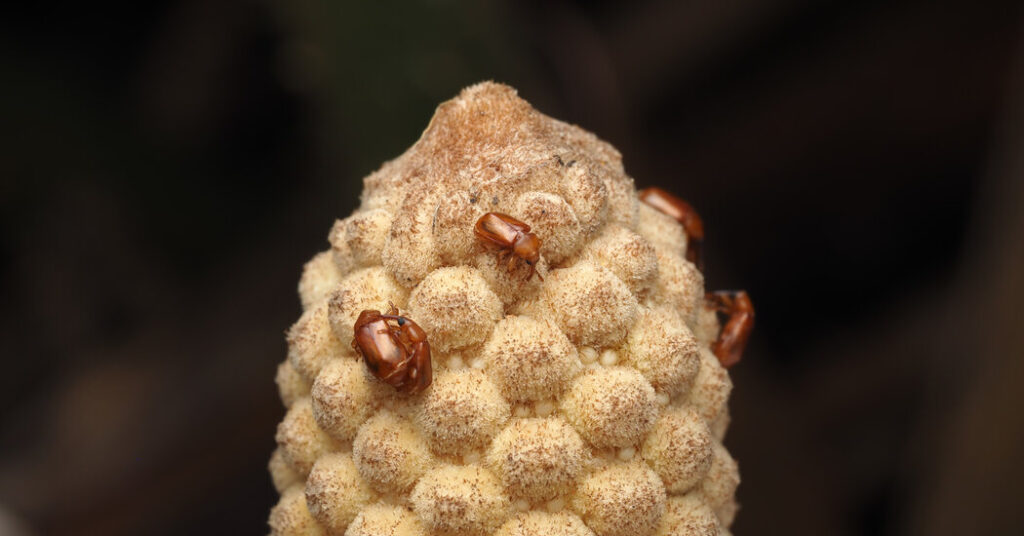
Then there are the cycads. These 250-million-year-old tropical plants look like palms and reproduce with structures resembling pine cones. And to secure their next generation, they get hot.
Their warm glow at dusk tempts beetles with unique infrared-sensing antennae in a relationship so ancient it may be at the basis of all pollination as we know it, according to a study published Thursday in the journal Science.
“If you think about how the ancient planet looked when plants and animals first started to communicate, there were other signals that were important,” said Wendy Valencia-Montoya, an evolutionary biologist at Harvard University and an author of the study.
Some plants, including the pink lotus and the titan arum, can heat up to temperatures of 60 to nearly 90 degrees Fahrenheit above their surroundings, especially when it’s very cold outside.
Botanists mainly thought this helped these plants boost the potency of their scent signals or offer pollinators a cozy refuge.
But Dr. Valencia-Montoya had a hunch that heat could be a beacon in itself. She tried enticing beetles with fake 3-D-printed temperature-controlled cycad cones — with no cycadlike scent, color or texture — in the wild, placed next to real cycads. The dupes attracted hundreds of pollinators.
Cycad cones aren’t always hot. Instead, they follow daily cycles of heating and cooling: Pollen-laden male cones produce a big burst of heat in the late afternoon, and then ovulating female cones warm up about three hours later, cooling by sundown.
This push-pull pollination guides beetles through the steps of plant reproduction, from male to female.
And, as it seems as if different parts of the cones heat at different times, the temperature change also shepherds the beetles in how to enter the cones. “Somehow these signals are helping you get very fast where you have to go,” Dr. Valencia-Montoya said.
But the signaling is not just the warmth emanated by the cones. It is also the heat’s infrared signature, which is invisible to human eyes but can be sensed by a beetle’s antennae. Dr. Valencia-Montoya replicated the experiment of the 3-D-printed cone in the lab by covering the cone with a thick but transparent material; the beetles couldn’t feel the heat, but they could see its infrared signal.
In fact, when the team analyzed the antennae of two beetle species that pollinate different cycads, they found that they were full of the same genes that allow snakes and mosquitoes to hunt down prey by sensing body heat.
The sensors of the two kinds of beetle are tuned in slightly different ways to detect the specific signatures of their preferred cycad species.
“Now I’m going to start looking for this in other beetles,” said Bruno de Medeiros, assistant curator of insects at the Field Museum in Chicago, who was not involved in the study. He wonders if other pollinator insects detect heat differences in plants they prefer.
Because cycads make up half of all plants that warm up, and because most of these lineages are among the most ancient to be pollinated by animals, this newly discovered signal exchange might be a primal secret of how plants and pollinators initiated their relationship millions of years ago.
“It’s just not a signal that we knew, because it’s not one that we experience, of course, and it turns out to be the oldest one that gives rise to the others,” said Nicholas Bellono, a molecular biologist at Harvard who worked on the study.
While heat production was likely important for the evolution of pollination and probably predates the evolution of many colorful, patterned flowers, other experts said that was not enough to conclude that it was the original form of pollination.
“I disagree with the idea that this was the character,” said David Peris, a paleontologist at the Botanical Institute of Barcelona who wrote a review in 2024 about the evolution of heat production in plants.
Beetles were among the earliest known insect pollinators before flowering plants evolved, but studies show they were not alone. Fossil records suggest several species of thrips and flies were pollinating cone-bearing plants as far back as 145 million years ago, too. And thrips and moths also pollinate cycads now.
“Does it mean all of them had these infrared detectors until the color evolved? I do not think so,” said Dr. Peris, who was not involved in the new study. Heat’s boost to the scent of a plant, he said, should not be disregarded.
The post A Hot Plant’s Mysterious Signal Makes Beetles Pollinate It appeared first on New York Times.