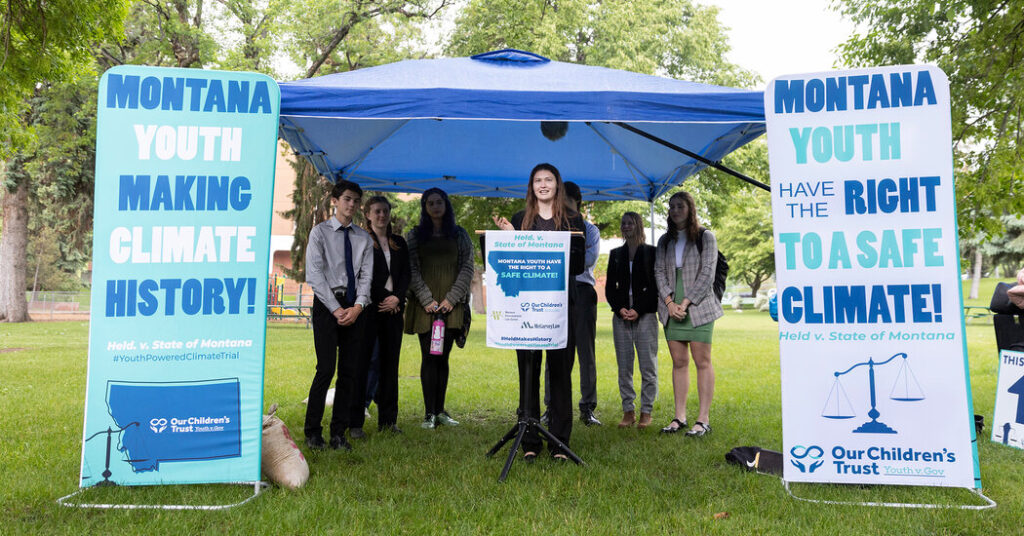
A group of young activists, who in 2023 won a landmark climate change case against their home state of Montana, are asking the state’s top court to prevent legislators from undermining their victory.
The original case, Held v. Montana, took issue with a law that barred the state from considering the effects of climate change when approving fossil fuel projects. The plaintiffs argued the law violated the right to a stable environment guaranteed by the state’s constitution. A judge ruled in their favor after a trial in 2023, and the decision was upheld by the Montana Supreme Court the following year.
But since then, state legislators in Helena have passed new laws aimed at undercutting the decision, including revisions to Montana’s Environmental Policy Act. In May, Gov. Greg Gianforte, a Republican, signed a suite of bills, saying that they would reduce red tape and provide certainty to businesses. The new laws prohibit the state from enacting air pollution rules that are more stringent than federal regulations, and generally limit the scope and power of state environmental reviews.
The young plaintiffs, represented by Our Children’s Trust, an Oregon nonprofit organization, filed their petition at the Montana State Supreme Court on Wednesday. The filing asks the court to declare the new laws unconstitutional and block their implementation. It names the state of Montana, Governor Gianforte and the state’s Department of Environmental Quality as defendants. The governor’s office and the agency did not immediately respond to requests for comment.
Rikki Held, 24, the named plaintiff in the original case, was among those who brought the new petition. She’s the daughter of a ranching family near Broadus, Mont., and recently returned from a two-year stint in the Peace Corps teaching high school science in Kenya.
“It’s frustrating when we’ve already gone to the court system and laid out this evidence, that the government isn’t listening to that,” she said.
She noted that while there are broad disagreements over climate change in the state, people in her community are deeply tied to the land. That’s reflected in the state constitution’s uniquely strong environmental protections, even though Montana remains a major coal producer.
Nathan Bellinger, a lawyer for Our Children’s Trust, said the urgency of the case was clear as Montana considers the expansion of coal and other fossil fuel projects. The organization’s petition says Montana’s new laws are aimed at “re-blinding” state agencies to the full effects of the greenhouse gases generated by fossil fuel projects. For example, under the new laws, state officials would only consider the greenhouse gas emissions from activity at a coal mine, not the emissions created when that coal is burned, he said.
“They’re taking a really myopic view of the actual greenhouse gas emissions that result from various fossil fuel projects,” Mr. Bellinger said. “Because they take such a narrow review, they come to the conclusion that the greenhouse gas emissions are insignificant, and then they decide to continue to approve the projects.”
The petition also argues the matter is urgent, because the harms created by pollution and climate change are cumulative. “Every ton of greenhouse gas emissions matters, is what the courts agreed with our experts on,” Ms. Held said.
A separate case filed by Our Children’s Trust in Montana federal court was dismissed in October. In that case, Lighthiser v. Trump, the plaintiffs asked a judge to block three of President Trump’s executive orders on energy, arguing they were unconstitutional and would hasten climate change. Judge Dana L. Christensen held a two-day hearing in the fall, but ultimately concluded that the harms described in the suit could not be fixed by the judicial branch.
Earlier this year, the most well-known case brought by Our Children’s Trust, Juliana v. United States, ended after a 10-year odyssey through the courts when the Supreme Court declined to hear an appeal. That case broadly contested the federal government’s fossil fuel policies, arguing they endangered children and teenagers who would one day suffer the greatest effects of pollution and climate change.
Karen Zraick covers legal affairs for the Climate desk and the courtroom clashes playing out over climate and environmental policy.
The post Youth Climate Activists Ask Montana Court to Block Some New Laws appeared first on New York Times.