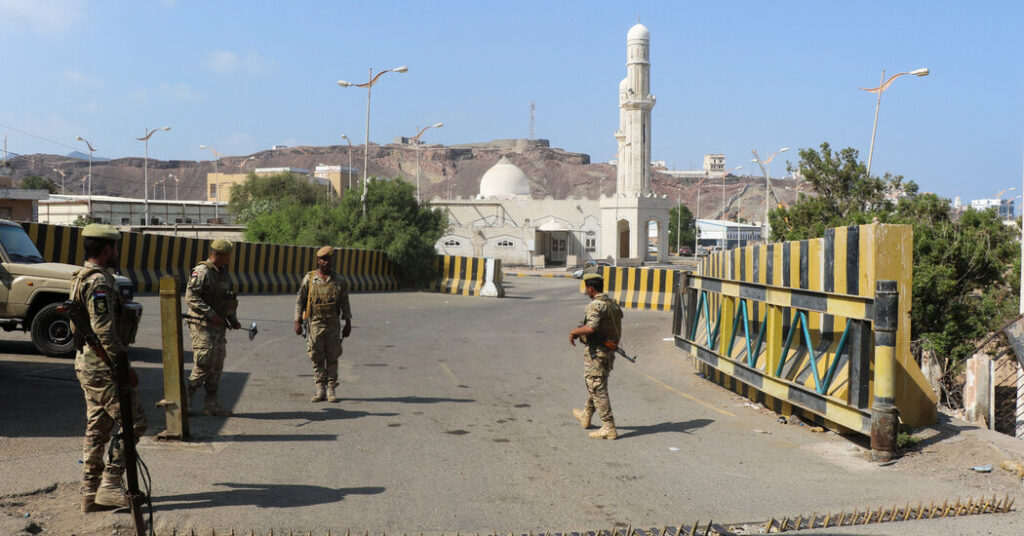
The leader of an Emirati-backed separatist group that has taken control of parts of Yemen over the past week said on Wednesday that its next objective should be the capital, Sanaa.
That move threatens to intensify Yemen’s civil war, which began in 2014 when the Houthis, a militant group backed by Iran, seized Sanaa. The war has killed hundreds of thousands of Yemeni civilians and caused one of the world’s worst humanitarian crises.
The remarks by Aidarous al-Zubaidi, the leader of the Southern Transitional Council separatist group, were published on the group’s website on Wednesday. The Houthis, which still control Sanaa, have not yet responded.
Mr. al-Zubaidi’s forces last week took control of parts of Hadramout, an oil-rich province in the couth, and of al-Mahra, an eastern province, in a lightning offensive that faced little resistance. The S.T.C. said it made the advances to cut off a Houthi smuggling hub for weapons, money and fighters.
On Wednesday, the S.T.C. website cited Mr. al-Zubaidi as saying that “the next goal must be Sanaa, peacefully or through war, until justice returns to its people and aggression is defeated.”
Since Yemen’s civil war settled into a stalemate a few years ago, the north has been ruled by the Houthis, while southern Yemen has been under the administration of the internationally recognized government, known as the Presidential Leadership Council, which is backed by Saudi Arabia.
The south is effectively controlled by a patchwork of competing armed groups, the most powerful of which is the S.T.C., which was founded in 2017 with significant financial and military support from the United Arab Emirates.
The S.T.C. is ostensibly part of the Presidential Leadership Council, but its latest moves mark a decisive shift in Yemen’s fractured political landscape. The separatist group has long agitated for the creation of an independent southern Yemeni state.
The S.T.C. website cited Mr. al-Zubaidi as saying on Tuesday that there would be a period of institution building for a future “south Arabian state,” solidifying its breakaway ambitions in the areas it now controls.
On Friday, Rashad al-Alimi, the chairman of the P.L.C., left Aden for the Saudi capital, Riyadh, for urgent talks with officials there. Days later, he condemned the separatists’ advance as “unilateral measures.” His office did not immediately respond to questions about Mr. al-Zubaidi’s comments.
Mr. al-Zubaidi has been openly building a parallel state structure. In recent days, he has convened high-level meetings at the Presidential Palace in Aden, acting with the authority of a de facto ruler.
In a seemingly symbolic move, photographs released by the S.T.C. on Tuesday showed that the national flag of the Republic of Yemen was absent from Mr. al-Zubaidi’s meetings at the palace.
On Tuesday, a Saudi delegation met with tribal leaders in Seiyun, a city in southern Yemen that was seized by S.T.C. forces, and called for the group to withdraw.
Ismaeel Naar is an international reporter for The Times, covering the Gulf states. He is based in Dubai, United Arab Emirates.
The post Yemeni Separatists Set Sights on Houthi-Controlled Capital appeared first on New York Times.