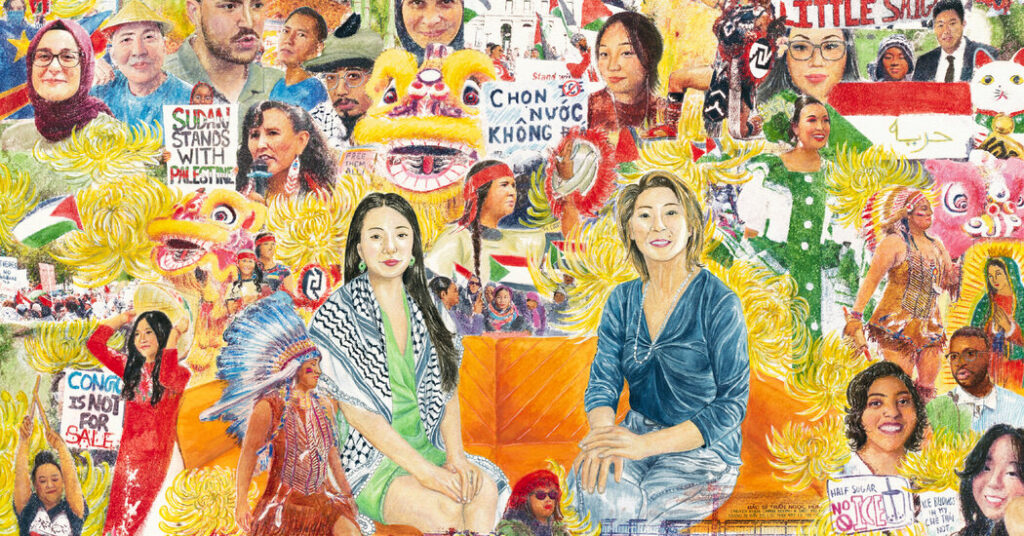
For a museum exhibition about the Little Saigon neighborhood in Denver, a local artist was commissioned to paint a portrait of a Vietnamese immigrant and her daughter, with chrysanthemums, dried squid snacks and Lunar New Year lanterns in the background.
The final version included images of people detained or deported by Immigration and Customs Enforcement and political messages like “Sudan Stands With Palestine.”
But when History Colorado Center, a state museum, pulled the artwork days before the exhibition opened in October, it did not mention either of those contentious topics. Instead, it said the painting might violate the state’s Fair Campaign Practices Act, which prohibits state agencies from contributing to political campaigns or influencing voters.
Among the dozen people that the artist, Madalyn Drewno, included in her collage was Senator John Hickenlooper, with green dollar signs over his eyes. Red hands were slapped on Gov. Jared Polis’s face. Capital letters framing Senator Michael Bennet’s face said he “funds genocide.”
“Exhibiting this piece could be considered a violation of that act and expose the institution to legal risk,” Joie Ha, the executive director of Colorado Asian Pacific United, the nonprofit coalition that commissioned the artwork, wrote in an email informing Drewno of the decision.
That rationale has riled free speech groups, who call it censorship. The museum denies that accusation, pointing to a state law that hinges on words like “contribution,” “donation” and “expenditure.”
“This wasn’t a violation,” Drewno said, “and is actually a violation of my First Amendment right.”
The American Civil Liberties Union, the National Coalition Against Censorship and the Foundation for Individual Rights and Expression agreed, sending a joint letter to the museum condemning the decision.
Elizabeth Larison, the director of arts and cultural advocacy for the National Coalition Against Censorship, called the campaign finance concerns ludicrous.
“An artist’s private political expression and the poetic expression of that within an artwork is not the same as a contribution to the campaign of a specific candidate running for office,” Larison said in an interview. “That’s really easy to see if you take a look at the work.”
The History Colorado Center, which sits a few blocks away from the State Capitol, falls under the purview of the Colorado Department of Higher Education. Jason Hanson, the museum’s chief creative officer, said in a statement that it was “frequently reminded of our obligations to not use state funds or resources to campaign (or be perceived to be campaigning) for candidates, parties or ballot measures.”
Last month, a Fair Campaign Practices Act complaint was filed against the City of Englewood, accusing the Denver suburb of publishing a voter guide with endorsements on its website. A complaint was filed against a state representative in August, accusing him of spending campaign contributions at a barbershop, cigar shop and upscale hotel.
The museum said it had turned to professional organizations like the American Alliance of Museums for guidance. That group’s online guide about election-year activities discusses space rental, volunteering for campaigns and monetary donations but not artwork itself.
Drewno’s painting was commissioned for the museum’s exhibition “Big Dreams in Denver’s Little Saigon,” which commemorates nearly five decades of the neighborhood that was founded after conflict in Southeast Asia.
Colorado Asian Pacific United, the nonprofit coalition led by Ha, solicited artwork from local Asian American, Native Hawaiian and Pacific Islander artists that explored “the vibrant history, culture and resilience of Little Saigon.” The guidelines were loose. Artists were encouraged to explore themes such as migration, intergenerational dialogue, tradition and modernity, cultural resilience and community pride.
Drewno’s proposal was for three paintings inspired by an oral history from Ha’s mother, Ivy, who emigrated from Vietnam. The first sketch played on memories of her family leaving by boat, and the second centered on opening a store in Denver.
Drewno’s sketch for the third painting, which was ultimately titled “None of Us Are Free Until All Of Us Are Free,” showed Ha and her mother sitting on chairs. The idea was to “represent their contributions and connections to the Little Saigon district and to reflect on its current landscape and future possibilities,” Drewno wrote in the conceptual design submitted to the museum.
As she worked, the painting took a different direction. Drewno, who is a Chinese American adoptee, said its ultimate purpose was to show “what it looks like to have an expansive solidarity and to recognize our interconnected struggles, so that would include Palestine, Congo, Sudan, as well as the ICE abductions.”
The dollar signs on Hickenlooper’s eyes, she said, were a nod to political contributions from pro-Israel lobbyists like the American Israel Public Affairs Committee.
The politicians, who are Democrats, said they had no idea they were part of such a debate.
Polis has not seen the painting and was not involved in its removal, according to his office. A spokeswoman from Bennet’s office said that it was a dispute between the museum and the artist but emphasized that the senator “believes in an artist’s First Amendment right to self-expression.” Hickenlooper’s office did not respond to a request for comment.
Drewno’s case is only the most recent culture clash in Colorado. President Trump demanded that his portrait be removed from the State Capitol in March, calling it “truly the worst.” In August, the town of Vail settled a lawsuit with the state’s A.C.L.U over an artist residency that was abruptly canceled after a painter posted a piece on social media that reflected her views on the war in Gaza.
“It is unfortunate that this trend is something that I’m now also directly impacted by,” Drewno said, “but in some ways it does feel empowering to take this risk and to speak out and to receive support from people in my community.”
After Drewno was notified that the History Colorado Center would not display her painting, she pulled her other two artworks as well. She has researched campaign finance laws and thinks there was no component of her painting that could be considered a political contribution.
Amy Werbel, a professor of art history at the Fashion Institute of Technology who is developing a book on art and censorship, said the museum’s legal argument was one she had never seen before.
“It’s a real dangerous slippery slope to start asserting laws like that,” she said.
To remove paintings that include political messaging is in direct opposition of constitutional values, said Werbel, who has focused on the strength of political speech dating back to the American Revolution.
“If we started to say that, ‘No, that could be censored,’” she said, “then we really are just kneecapping the whole meaning of the First Amendment.”
Michaela Towfighi is a Times arts and culture reporter and a member of the 2025-26 Times Fellowship class, a program for early career journalists.
The post When Is a Painting a Campaign Finance Violation? appeared first on New York Times.