Marc Lamber is a Phoenix-based personal injury attorney with the law firm Lamber Goodnow.
In 34 years representing car-crash victims, I’ve heard the same story over and over, with varying details — the driver at fault was texting, had consumed “just two drinks,” fell into a late‑night doze. But the outcome is consistent: a life cut short or changed forever.
From that vantage, I propose a simple test for driverless robotaxis: Do they reduce harm compared with human drivers?
Driverless robotaxis are no longer a science project. Waymo, for one, operates and is expanding in Phoenix, San Francisco, Los Angeles, Austin and Atlanta. Yet public debate often remains mired in fear. A single high‑profile incident can prompt calls to regulate the vehicles county by county.
We treat every robotaxi error as a verdict on the entire technology, while the daily carnage of human driving fades into the background. That is backwards. We are grading machines against perfection and grading ourselves on a curve.
Consider that seat belts and airbags did not eliminate car crashes; they made survival more likely. Robotaxis deserve to be judged against the same standard — not a fantasy of zero risk but a defensible comparison to humans.
The emerging industry data makes a strong case on behalf of robotaxis. Across roughly 96 million rider‑only miles, Waymo reports that its vehicles caused 91 percent fewer serious‑injury‑or‑worse crashes versus human benchmarks in similar conditions, 92 percent fewer crashes involving pedestrian injuries, and about 79 percent fewer air-bag‑deployment crashes.
Those are not just numbers; they are a scorecard of lives not shattered. And they are a strong argument for expanding the use of these vehicles nationwide.
We should not hold autonomous vehicles to a zero-risk standard that human drivers fail every day. What we should do is demand transparency and continuous improvement. We should build on the crash reporting framework introduced in the National Highway Traffic Safety Administration’s 2021 Standing General Order and pass the AV Safety Data Act to require standardized federal reporting of miles driven, collisions and unplanned stops so the public can directly compare robotaxis to human drivers, apples to apples.
Even with safer cars, however, accidents involving humans and pets will happen. National protocols should guarantee immediate human contact for anyone affected and preservation of relevant video and sensor data, followed by rapid, independently reviewed fixes when failures occur.
Moreover, access to robotaxis must be equitable from day one. If a city grants public trust to a new mode of transportation, the benefits cannot be limited to the wealthy or well‑connected. This means setting coverage and response‑time floors in transit deserts, requiring wheelchair‑accessible deployments, protecting against algorithmic redlining, allowing cash or prepayment for those without credit cards or access to online banking and capping price spikes where alternatives are thin.
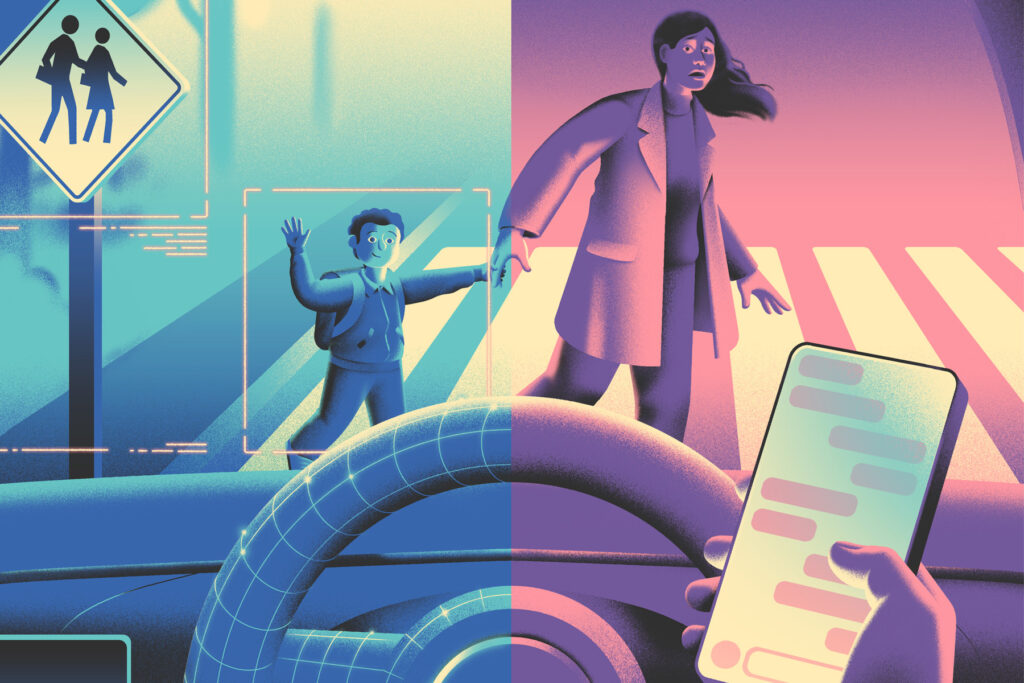
Early deployments show another robotaxi advantage that rarely makes headlines: consistency. Robotaxis don’t “just check a text” or speed up to beat a yellow light. They are never accused of sexual assault. The software follows the same rules at 2 p.m. as at 2 a.m.
Some critics may say my position is too generous to technology. I would say it is, instead, appropriately generous to human life. For generations, we have accepted a level of violence on our roads that would be intolerable in any other public system. If robotaxi technology demonstrates a consistent upward safety trend, we have a duty to let its use expand. If it fails to, we have a duty to slow or stop its adoption until it does.
For lawyers like me who see the aftermath of road violence up close, fewer catastrophic cases would be a civic achievement, not a loss.
The public standard is clear enough for a middle‑school civics class: Judge by outcomes.
Count the injuries that never happen. Count the parents who make it home to their children.
The post Think driverless taxis aren’t safe? Here’s a simple test. appeared first on Washington Post.