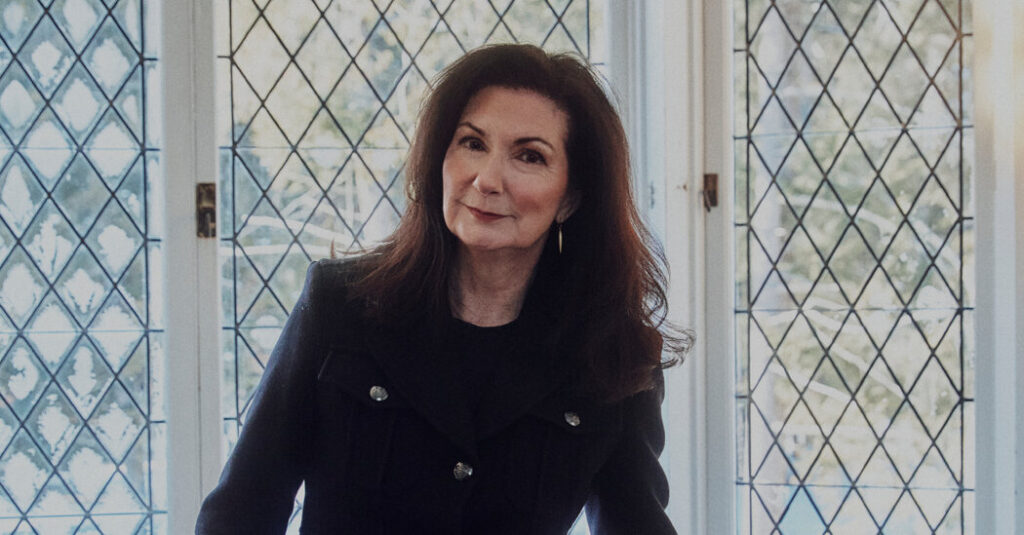
Elaina Richardson sipped from a cup of tea in her office in a converted stable in Saratoga Springs, N.Y.
To her left stood a gilt mirror layered with snapshots, postcards, paintings, sketches and invitations that attested to the 25 years she has spent as president of Yaddo, one of the country’s oldest and most prestigious artist retreats. To her right was a poster about the sustainability campaign that is, Richardson said, her “swan song.”
“It’s been the job of a lifetime,” Richardson said during an interview before announcing today that she will step down from her role. “But staying too long at the party is never a good idea.”
Over the past 25 years, Richardson, 64, has increased Yaddo’s endowment from $8 million to $38 million and overseen significant upgrades to the 400-acre former summer home of Spencer and Katrina Trask, a financier and a writer who, after the deaths of their four young children, bequeathed their estate to artists seeking respite from the demands of everyday life.
Richardson, Yaddo’s fifth president since its founding in 1900, has steered the nonprofit through the financial crisis and the pandemic; worked to increase applications and enrollment; started an organization-wide sustainability campaign and a podcast (“Shadow Yaddo,” after the correct pronunciation of the name); and navigated all manner of shifting priorities, from choosing whether to offer residents Wi-Fi to ensuring that artists from every walk of life have seats at the retreat’s dining tables.
None of the above has been easy, especially as some creative pursuits in the United States have been devalued to the point of endangerment (see: funding for the arts). Others, such as poetry, are perceived as luxuries.
“In times of the greatest need, we tend to remember that art is essential,” Richardson said, with the persuasiveness of a person born to raise money without asking for it. “Remember just a few years ago when the things that kept you sane were books, films, music and bingeing on Netflix? The easiest way for people to understand the need for retreat is to imagine the world without any of that.”
Each year, Yaddo hosts up to 275 writers, composers, choreographers, filmmakers, and performance and visual artists for two weeks to two months, in cohorts of 30 or so guests, granting them time and space to launch new projects, mull future ones and bounce ideas off one another. Solitude is acceptable too. Room and board are free.
Yaddo residents publish hundreds of books per year and, among them, have won 88 Pulitzers, 72 National Book Awards, 11 Oscars and a Nobel Prize in Literature. The many notable alumni include Langston Hughes, Sylvia Plath, Leonard Bernstein, Truman Capote, John Cheever and Jennifer Egan, who won the 2011 fiction Pulitzer for “A Visit From the Goon Squad.”
“There were a lot of landmark moments there,” said Egan, who first went to Yaddo in the late 1980s and is now a board member. Among the standouts: becoming unstuck on her fifth novel, “Manhattan Beach,” and meeting Ruth Danon, a poet who is now a member of Egan’s writing group. “So many things that started for me at Yaddo are still an active part of my writing life.”
James Hannaham, a writer, visual artist and fellow board member, made his inaugural pilgrimage to Yaddo in 1999.
“Back then it had a reputation for being elite, white and stuffy,” he said. “Elaina’s been devoted to turning that idea on its head. The days when one would be the only person of color at Yaddo are over.”
In 2000, Richardson left her plum job as editor in chief of Elle magazine and moved to Saratoga Springs with her husband and 9-year-old daughter, Caitlin. Upon entering the front gate and winding her way up a long wooded driveway to the main house, her first thought, she admitted, was, “How stupid were you not to come see the place before you took the job?”
The Trasks drafted their own blueprints for Yaddo, and their collaboration yielded an imposing 55-room behemoth of stone, stucco, brick, beams, odd angles and porches that give the building a beetle-browed look. Its sprawl is reminiscent of Manderley, the estate from Daphne du Maurier’s “Rebecca”; its height and sideways stance, viewed from the driveway, evoke the haunted house in “The Amityville Horror.”
“I don’t believe in ghosts,” Richardson said, “but I do feel certain architecture holds the history of what’s happened.”
Upon arrival, Richardson’s first order of business was to upend Yaddo’s tweedy reputation. “We behaved a little too much like a history museum, and not enough about the present moment,” she said.
She came up with a master plan. She oversaw upgrades to the electrical and plumbing systems, modernized a dark room for photographers and added seven new studios, including one for choreographers.
On her idea board, Richardson posted a quote from Lyndon B. Johnson: “Somehow, the scientists always seem to get the penthouse, while the arts and the humanities get the basement.” At Yaddo, Richardson explained, artists get a turn in the penthouse. “You don’t have to pick up the kids. You don’t have to clean. You don’t have to make dinner.”
And no, it’s not like summer camp for artists, which Richardson said is a common misconception: “It’s a chance to escape into work.”
To sustain such escape, meals are provided. Artists can grab breakfast from the kitchen or graze from their own kitchenettes. Lunch is parceled out in old-fashioned steel boxes to be enjoyed in the privacy of one’s work space. A recent menu featured quinoa with roasted chickpeas, local squash and cucumbers, plus a dash of inspiration via a quote from Nietzsche: “You must have chaos within you to give birth to a dancing star.”
The evening meal, on the other hand, is a communal affair, followed by readings or musical performances. And, as Hannaham appreciatively noted, the food, which Richardson said she nudged in a healthier direction over the course of her tenure, is “incredible.”
She moved through the grand house both comfortably and proudly, as if she’d grown up there. As we walked, she pointed out Tiffany windows, a mosaic fireplace and the Trasks’ many books, silver serving pieces, paintings and old photos.
In fact, Richardson grew up in a housing estate in Glasgow where, at age 10, she narrowly avoided an attack by a man believed to be the serial killer known as Bible John. He pounced while Richardson was sitting on a hill behind her apartment building, painting and reading.
“Very fortunately, I was a tomboy and a fighter,” she said. She clobbered him with her father’s transistor radio, but not before he tore out fistfuls of her hair.
Richardson laughed softly when I pointed out that, in her moment of terror, she was surrounded by the arts that would become her life’s work.
“My little Yaddo,” she said. “I hadn’t thought of it quite like that. But also, that’s safety. And the idea of Yaddo is safe.”
The retreat has been the backdrop for Richardson’s times of “greatest joy and grief,” including her divorce, the loss of her parents and watching her daughter grow up.
Remarried now, Richardson no longer lives on the grounds, but has a home nearby and still finds the setting “completely magical.” She’s bullish on the importance of Yaddo, even as A.I. chatbots are embarking on their own artistic pursuits.
“You can feel that people have focused here for centuries,” Richardson said. “You walk around in whatever condition your little heart is in, and there’s a protectiveness. It’s like, you’re OK. The world can’t get you right now.”
It is a sentiment Richardson apparently shares with Katrina Trask, as evidenced by a verse she wrote and had etched on a door in her bedroom, “Here shall no cares invade/All sorrows cease/And every heart find/Sympathy and Peace.”
Richardson will remain at Yaddo until a search committee names her replacement. After that, she plans to plans to travel, spend time with her grandchildren and do some writing of her own.
Janice Y.K. Lee, who, with Peter Kayafas, is co-chair of Yaddo’s board, called Richardson “the most diplomatic person I’ve ever met,” adding that she’s been the ideal person to usher Yaddo into the 21st century.
Perhaps its location is a metaphor for the next chapter. On one side is Saratoga’s storied track, where horses race in circles; on the other is Interstate 87, a straight shot toward New York City, the Adirondacks and the wider world. Yaddo sits in the middle, providing space for inspiration.
“Most people now understand ‘retreat’ in a personal way,” Richardson said. “They think of it as meditation or going to the gym, something that counts for ourselves. Yaddo is a demonstration of why it counts culturally.”
Elisabeth Egan is a writer and editor at the Times Book Review. She has worked in the world of publishing for 30 years.
The post The End of an Era at One of America’s Most Famous Artist Retreats appeared first on New York Times.