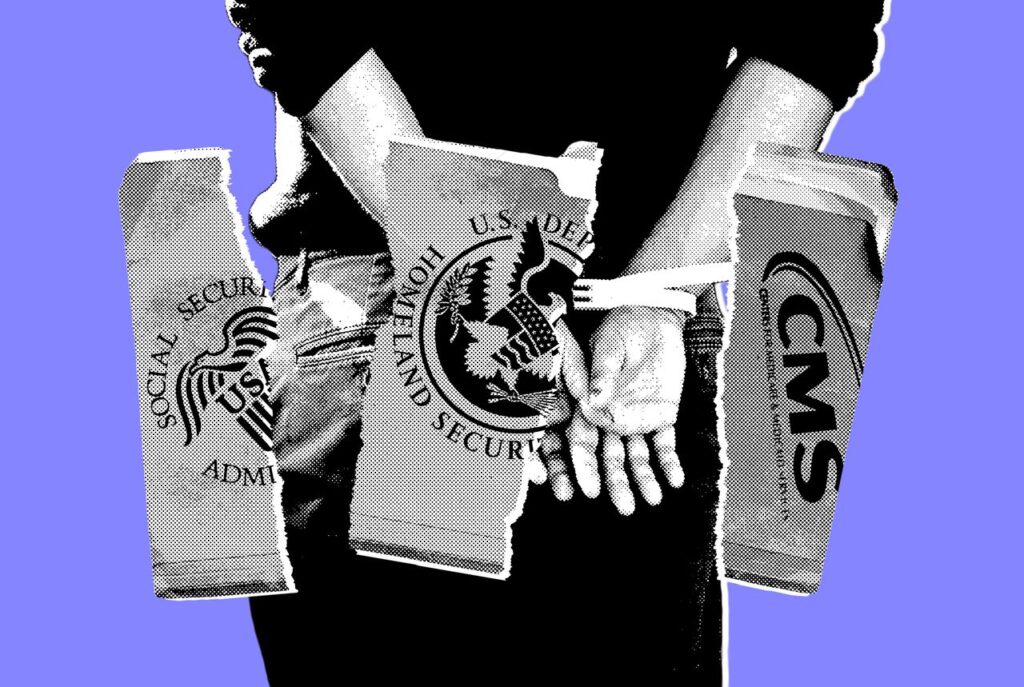
As immigration raids have swept the country, it’s not just immigrants who have been kidnapped and detained. American citizens have also been caught up in the Trump administration’s draconian policies.
Leonardo Garcia Venegas, a US citizen living in Alabama, was forcibly detained in May by immigration authorities while at a construction worksite. When confronted, Garcia Venegas told authorities that he was a citizen and showed them his Alabama REAL ID, his lawyers claim. But that didn’t stop the authorities from tackling Garcia Venegas to the ground and putting him in handcuffs, they allege. In a court filing, Garcia Venegas says that he was kept handcuffed in the back of a car “in the hot Alabama sun” for over an hour.
Less than a month later, Garcia Venegas says, he was detained again at a worksite. While he wasn’t handcuffed this time, immigration authorities ignored the fact that Garcia Venegas told them he was a citizen and again presented them with a REAL ID, his lawyers claim.
Garcia Venegas is now suing the government. In his court declaration, Garcia Venegas says that an officer told him his ID was “fake.”
“I think that if you fit the demographic profile that they’re targeting and you are a citizen, [authorities] view the 30 minutes or three hours or three days that you spend in custody as just a necessary cost of the current enforcement system and the quotas and the bonuses and everything that goes along with that,” says Jared McClain, senior attorney at the Institute for Justice, which is representing Garcia Venegas.
“Allegations that DHS law enforcement officers engage in “racial profiling” are disgusting, reckless, and categorically FALSE. What makes someone a target for immigration enforcement is if they are illegally in the U.S.—NOT their skin color, race, or ethnicity. Under the fourth amendment of the U.S. Constitution, DHS law enforcement uses “reasonable suspicion” to make arrests. There are no “indiscriminate stops” being made. The Supreme Court recently vindicated us on this question. DHS enforces federal immigration law without fear, favor, or prejudice,” assistant secretary for public affairs at DHS Tricia McLaughlin tells WIRED.
Cases like this one are unfortunately not unique. According to reporting from ProPublica, at least 170 US citizens have been detained by immigration authorities through the first nine months of 2025. And this could all get much worse: The US government is rapidly combining data across federal agencies that could put a lot more people, including US citizens, in the crosshairs of its harsh immigration policies.
WIRED first reported in April that the Trump administration had been pooling data from across the government in its push to surveil and track immigrants, and it’s only continued from there.
Over the past few months, several federal agencies have issued system of records notices (SORNs), which are public notices that outline changes to how data collected by an agency will be used or shared. These SORNs are harbingers of what’s to come: In October, a SORN issued by DHS officially transformed the Systematic Alien Verification for Entitlements (SAVE), housed in US Citizenship and Immigration Services (USCIS). The revised database will now include voter registration and verification. A few weeks later, WIRED reported, the Social Security Administration (SSA) issued a SORN that would officially allow the agency to share data with DHS for the purpose of immigration enforcement. Though this specific effort had been underway for months, the SORN makes the data sharing official and allows for public feedback. (The SSA SORN has already received more than 10,000 comments, including, “No, absolutely not. This is so dangerous.”)
Experts told WIRED the SSA’s move was unprecedented, particularly because SORNs are supposed to be published before the government makes the change. Then, just before Thanksgiving, the Centers for Medicare & Medicaid Services (CMS) issued a SORN agreeing to share “citizenship and immigration status, location, and phone
numbers” with DHS and Immigration and Customs Enforcement (ICE). The SORN also says that CMS may also share “Medicaid information or data shared with CMS by states.”
(A Department of Health and Human Services spokesperson tells WIRED, “Several federal laws authorize CMS to make certain information available to DHS. Under the Immigration and Nationality Act, ‘any information in any records kept by any department or agency of the Government as to the identity and location of aliens in the United States shall be made available to’ immigration authorities. The data-sharing agreement between CMS and DHS does not apply to U.S. citizens and lawful permanent residents.”)
“All these tools and databases, they weren’t set up in the past year. This has been a long time coming. The immigrant rights community has been warning about this kind of stuff for a long time,” says Jennifer Ibañez Whitlock, senior policy counsel at the National Immigration Law Center.
As part of its crackdown on immigration, the Trump administration has sought to cut off various avenues of government support for immigrants. From housing benefits to food stamps to health care, the government has placed increasing restrictions on the type of support immigrants can access—which were already heavily restricted.
Combining data from different agencies providing benefits with the aim of ensuring immigrants aren’t accessing them could lead to even further surveillance. With state voter data also part of the mix, “that can include party affiliation and voting history, so there’s a concern that they might surveil people” based on their political affiliations, says Nikhel Sus, deputy chief counsel at Citizens for Responsibility and Ethics in Washington. CREW is helping represent several plaintiffs, including naturalized citizens, that are suing the government, claiming it is unlawfully sharing sensitive data across agencies.
Among the concerns is that data is not easily isolated. When data are collected and tracked—say, to make sure someone is (or isn’t) getting food aid—it’s likely that other, related data, like immigration status, is going to be collected but may not be consistently updated. Data collected at the local or state level may also differ from data collected at the federal level, causing mismatching or other errors. “Whenever data is used for a purpose other than it was collected for, there can be mistakes in the data, or it may just not be up to date,” says Sus. Drawing on inaccurate data could mean that people who should be eligible for government benefits might be shut out or that eligible voters might be removed from the voter rolls.
McClain adds that even if the technology the government is using works well and the data are accurate, there is no longer a guarantee that authorities will abide by it. In a declaration filed as part of Garcia Venegas’ suit, an immigrant says that although she showed officers paperwork confirming her legal right to work in the US and was subjected to what she believes was a facial recognition tool to confirm her identity, this was still not enough to keep her from being detained, zip-tied with “shackles around [her] legs” for several hours. “At first, they seemed satisfied,” the declaration reads. “But another officer (who appeared to be a supervisor) said that they could not trust my paperwork because ‘the Biden Administration made a lot of mistakes.’”
People particularly at risk for a data mishap or surveillance are naturalized citizens, according to Sus. That’s because, for instance, when someone is issued a social security number for them to be allowed to legally live and work in the United States, that number remains the same, even if they eventually become a citizen. This means someone who is now a citizen might still be listed as an alien in SSA’s database.
These issues have already come up. In a declaration filed by one of the naturalized citizens represented by CREW in their lawsuit against the government, a plaintiff wrote, “I applied to the Social Security Administration (SSA) and received a social security number (SSN) in or around 2001. At the time I applied for an SSN, I was a lawful permanent resident. Currently, my data stored with SSA, and therefore the information pooled by DHS in the SAVE system, does not correctly reflect my status as a U.S. citizen. SSA records instead (incorrectly) describe me as a non-citizen, as I was when I first interacted with SSA.”
There isn’t a system to address these issues, either. “I’m not hearing any conversation from this administration about how somebody would go about ‘clearing’ their social security number. How could they, for example, get a protective order against DHS coming to them once they’ve naturalized?” says Ibañez Whitlock.
The risks of getting the data wrong, though, may not just extend to things like government benefits or voting rights. “The rapid nature of this is you get put in the back of a van, you might be four states away in a couple of hours and put in a facility where the records aren’t even updated online,” says McClain. “You’re getting pushed through removal proceedings a week later before anybody has figured out where you are or has figured out how to put together the resources to help you.”
This is an edition of the Inner Loop newsletter. Read previous newsletters here.
The post The DHS Data Grab Is Putting US Citizens at Risk appeared first on Wired.