Europe, stranded between the United States and Russia, faces its second, epoch-changing event of the past few years.
The first was the full-scale Russian invasion of Ukraine, the first major land war on the European continent since World War II. The second is the United States’ abandonment of its commitment to the continent’s security, European officials and experts said.
They argued that President Trump’s main goal is not peace in Ukraine but rapprochement with a Russia that is actively trying to undermine NATO and the European Union, which would jeopardize Europe’s security.
And while Mr. Trump’s dismissiveness of what he called a “decaying” Europe has drawn much attention, it is only part of the problem facing European leaders. They are also confronting challenges that include budget shortfalls, worsening public opinion and the far right as they try to maintain their security and help Kyiv.
“For the first time since the end of World War II, America is not on our side on a matter of war and peace in Europe,” said Norbert Röttgen, a senior legislator in the conservative party of Chancellor Friedrich Merz of Germany. “It has sided with the aggressor against the interests of the attacked country, Ukraine, and against European security interests in general. It wants to mediate between NATO and Russia, which means the U.S. no longer defines itself as the leading member of NATO and defines Europe as a strategic target.”
The future of Ukraine is at the heart of the debate. Mr. Trump is pressing for a settlement to the war on largely Russian terms, and the Europeans see Ukraine as crucial to their own security and are encouraging Kyiv to fight for a better deal.
European leaders, who met again this week with President Volodymyr Zelensky of Ukraine, are relieved that so far President Vladimir V. Putin of Russia is unwilling to cash in his chips and continues to resist Mr. Trump’s effort to end the fighting. That means Ukraine will need to continue the war, with European support.
Given the stakes, Europe has much to do to be a credible counterpoint. As one weary European official said, outrage is enjoyable, but not a policy.
Washington’s enmity aside, Europe is facing other pressing challenges.
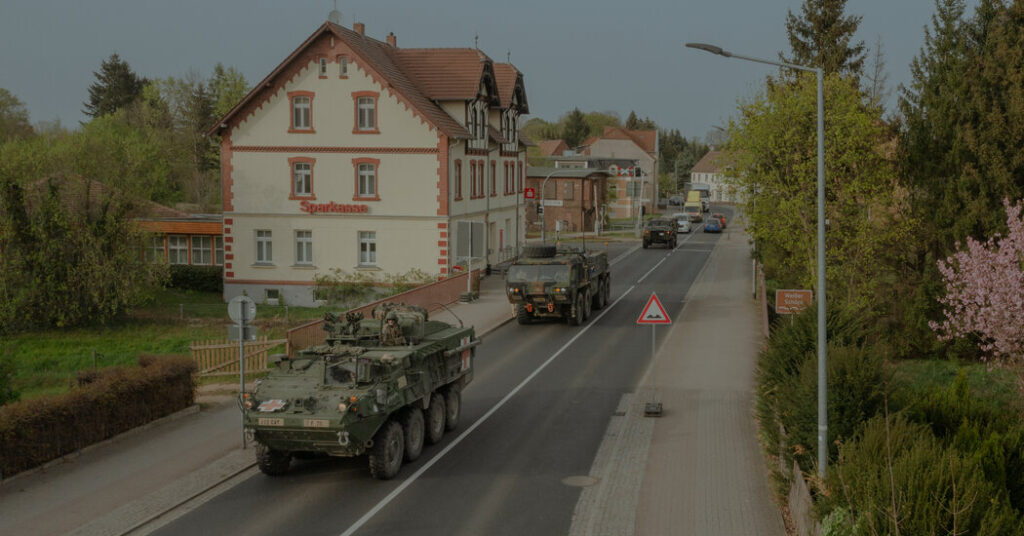
NATO commanders consider 2029 a deadline for developing credible conventional deterrence against Russia, but worry that Moscow may test the alliance’s cohesion before then.
So European leaders must quickly find the money to support Ukraine and simultaneously build up their own defenses, replacing crucial American military technologies when national budgets are tight and debts are high.
They understand that they have to convince European voters that defending Ukraine is worth the price and that fending off a militarized, imperialist Russia requires more military spending and larger armies, including new forms of conscription.
And they need to do more to confront the challenge of the populist, nationalist far-right parties that the Trump administration, in its new national security strategy, explicitly says it will support in Europe.
The highly ideological document accuses mainstream European governments of subverting democracy and inviting “civilizational erasure.” The strategy signals the administration’s determination to “cultivate resistance” in Europe by working with its political soul mates across the continent, from France’s National Rally and Reform UK to the Alternative for Germany.
Mr. Trump’s own annoyance with the Europeans came out bluntly in a widely shared interview with Politico released on Tuesday, calling some leaders “real stupid” and asserting that because of immigration, “many of those countries will not be viable countries any longer.”
A key moment in the struggle with Washington over Ukraine and European security is coming next week at the year-end summit meeting of the European Union’s leaders. There they must decide how to come up with the roughly $200 billion necessary to fund Ukraine for the next two years and keep it in the fight.
The argument over whether and how to use roughly 210 billion euros ($245 billion) in frozen Russian assets in Europe is complicated. Most of them are held in a Belgian company, and Belgium’s government, faced with Russian threats, is reluctant to risk these assets. American officials have encouraged Belgium to resist because Washington sees the return of Russia’s assets as part of its proposed Ukrainian settlement. And finance ministers and the European Central Bank have expressed worries that the credibility of Europe and the euro itself as a safe repository may be at risk.
Mr. Merz and President Emmanuel Macron of France have pressed Belgium, saying that other European countries will provide sufficient cover for Belgium.
“It’s a moment of truth for Europe,” Mr. Röttgen said. “The technocrats don’t like it and for good reasons, but this is a moment of political will to stay relevant, not of legal niceties. If we fail, we will make ourselves irrelevant and the plaything of others.”
If the assets cannot be used, major European countries, including Britain, will have to confront the prospect of coming together outside the bloc to create a loan sufficient to fund Ukraine. That is an expensive and politically fraught possibility.
As much as the Europeans vow to support Ukraine, they have no strategy of their own to end the war without more American economic pressure on Russia, which Mr. Trump has been reluctant to provide.
Even more important, European officials say, is the quality of any security assurances Ukraine would receive in any negotiated outcome. A robust security guarantee is the best incentive for Ukraine to agree to give up some of its territory, but so far, these officials say, the United States has refused to commit in any detail to one or to backing European forces that might try to enforce it.
And Mr. Putin has repeatedly rejected the presence of forces from NATO countries in Ukraine even after a settlement, making the plans of the “coalition of the willing” seem hollow.
European leaders are hoping to slow down the Trump push on Mr. Zelensky by proposing a meeting of Ukrainian, European and Americans to hammer out a joint peace proposal to present to Russia. Mr. Zelensky told reporters that Ukraine would likely send its peace plan to the United States on Wednesday.
Senior NATO officials have sought to be reassuring. While the Trump administration has announced the withdrawal of 3,000 U.S. troops from Romania, 79,000 are still in Europe — a total larger than the entire British army. But they also acknowledge that Europeans cannot easily replace key American military capabilities, such as satellite intelligence, air defense, long-range missiles, and command and control. And they certainly cannot do so by the 2029 date that European militaries regard as a deadline to deter a Russia battle-hardened in Ukraine.
Europe must prepare to fight a war on its own because Mr. Trump may decide not to support it, a senior European official said.
Ukraine is Europe’s line of defense against Russia, “but we don’t follow through on what that means and what it costs,” said Anna Wieslander, director for northern Europe for the Atlantic Council. “The Russian assets are absolutely necessary for Ukraine to stay in the fight and to change the Russian calculus. We need to take higher risks or pay a higher price later.”
Steven Erlanger is the chief diplomatic correspondent in Europe and is based in Berlin. He has reported from over 120 countries, including Thailand, France, Israel, Germany and the former Soviet Union.
The post The Challenges to Europe’s Security Go Beyond Trump’s Lack of Support appeared first on New York Times.