A Democratic activist pinned a bold declaration at the top of his X page last December, believing that his home state had crossed a tipping point toward competitive races.
“Texas is the future of U.S. politics,” wrote Luke Warford, a 2022 candidate for state railroad commissioner.
That prediction remains debatable over the long term, but Monday’s filing deadline for congressional races has split the Texas political system deeply along ideological lines. Next year’s contests seem destined to produce a delegation of staunch conservatives and liberals.
A series of moves by Democrats and a standoff among Republicans have all but assured that the state’s potentially key Senate race will remain a race to the ideological and stylistic fringes of both parties. And a mid-decade redrawing of the state’s maps for its 38 House districts has almost obliterated competition for the general election, meaning each party’s primary voters will prove decisive in almost every race.
And unlike in traditional battleground states, the general-election nominees will have trouble blunting some of the sharp edges that help them win primary contests.
To be sure, both parties continue to view the other as being more extreme. Democrats look at the Republican primary in the Senate race — pitting the four-term incumbent, Sen. John Cornyn, against state Attorney General Ken Paxton and Rep. Wesley Hunt — as a race that will leave an opening for Democrats.
“They’re all trying to out-Trump one another,” Warford said in an interview Tuesday.
Cornyn, 73, who came up in the Bush family wing of Texas politics, has yet to win the endorsement of President Donald Trump amid a political makeover emphasizing his more conservative positions. He spent months focused on highlighting allegations against Paxton, 62, who in 2023 was impeached by the state House on corruption charges and later acquitted in a state Senate trial.
In recent weeks, though, the incumbent has been trying to fight off Hunt’s entrance into the race.
Hunt, 44, in his second term, has focused his attacks on Cornyn’s long history in state politics and his past as a trusted Senate dealmaker.
With all three definitely in the race, and public polling showing no one close to 50 percent support, there’s a strong likelihood of the top two finishers in the March primary advancing to a runoff in late May. Those runoffs have traditionally drawn out only the most loyally conservative voters, a lower turnout model that does not lend itself to Cornyn’s political strength.
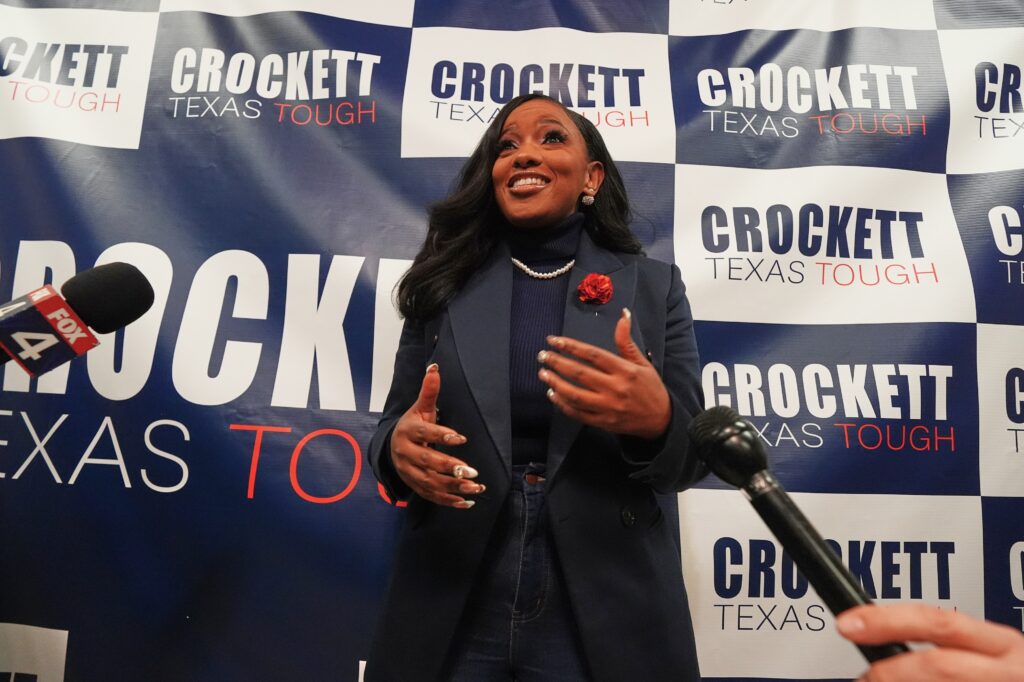
But Republicans in Washington rejoiced at the entrance of Rep. Jasmine Crockett (D) into the Senate race, helping nudge former representative Colin Allred out of another statewide bid and into a campaign again for the House. That left Crockett, whom the online left admires for her pugnacious, theatrical style of challenging Republicans, up against state Rep. James Talarico, who emerged earlier this year as a young fighter against the Trump administration.
Republicans in particular believe that Crockett, 44, in her third year in Congress, has honed an image that will alienate centrist voters and culturally conservative Latino voters in South Texas who are key to any chances Democrats have of winning statewide for the first time since 1994.
“She is way out of line and out of touch with where mainstream Texas is, and John Cornyn is absolutely in touch with mainstream Texas,” said Sen. Steve Daines (Montana), who as chair of the Senate GOP campaign committee in 2024 helped steer Cruz to reelection over Allred by a comfortable margin.
Daines made clear he is “100 percent behind John Cornyn” but suggested that Crockett is “so far out” of mainstream Texas politics that any Republican could defeat her in November. “I just don’t see a path to victory for her in Texas,” he said.
Operatives with the National Republican Congressional Committee have already built a database to monitor how often two Democratic targets, Reps. Henry Cuellar and Vicente Gonzalez of South Texas, have voted the same as Crockett. The duo are the state’s most endangered Democrats, in part because of the redistricting move.
Warford and other Texas Democrats believe that Crockett and Talarico, 36, a Presbyterian minister whose presence on podcasts and social media served as a rebuke to Christian nationalism, are not out of the ideological norms for most Democrats.
Instead, the pair represent a new generation that is comfortable throwing political punches on all forms of media, appealing to younger voters who want to see their politicians put up a fight.
“What’s happening in the Democratic primary is more about style, not ideology,” Warford said.
Just six years ago, Texas seemed headed closer to the swing-state status that produced more stylistically moderate winners like Sen. Mark Kelly (D) in Arizona or Gov. Brian Kemp (R) in Georgia. Beto O’Rourke (D), a three-term congressman from El Paso, had come within 3 percentage points of knocking off Sen. Ted Cruz (R) in the 2018 race, even as Democrats gained a couple House seats.
In January 2019, Texas sent 23 Republicans and 13 Democrats to the U.S. House. In 2020, Joe Biden would make the state the most competitive it had been in a presidential election since 1996, losing by just 5.5 percentage points.
That’s why an early 2019 memo from the Democratic Congressional Campaign Committee focused on what its operatives believed were emerging pockets to help build a durable majority for years to come.
“One key geographic area where Democrats will go on offense is Texas, home to six of these seats,” Cheri Bustos (D-Illinois), then the DCCC chair, wrote to colleagues.
The DCCC hired full-time staff there to work on those half-dozen races, hoping to even the partisan makeup of the state’s delegation. Instead, they gained no seats that year, and by the time Republicans in Austin drew up the new maps for the 2022 election, the results delivered a 25-13 edge for the GOP.
In 2024, Trump stormed to a nearly 14-point win, with Latino voters breaking against Democrats in historic fashion. This summer, at Trump’s urging, Gov. Greg Abbott (R) convened a special legislative session to draw new maps for the House districts with the goal of gaining up to five congressional seats.
The dust settled Friday with a U.S. Supreme Court ruling allowing the new map to stand — making Republicans all but certain to gain two seats and possibly up to five next November.
Moreover, independent analysts rate just the Cuellar race as very competitive; Gonzalez is in a more GOP-leaning district. Elsewhere in South Texas, depending on how the political winds blow, Democrats hope to have a chance to unseat Rep. Monica De La Cruz (R).
That leaves almost three dozen seats in Texas pretty much in battles among only the primary electorate, far from the types of general-election contests happening in districts in northeast Pennsylvania and central Michigan that will determine the House majority.
Allred — who had run as a mainstream Democrat against Cruz last year and lost by 8.5 percentage points — had been campaigning for months in the Senate primary. Faced with not one but two liberal rising stars in the primary, he opted to jump into a new House district race where he will have to square off against Rep. Julie Johnson (D) in the Dallas area.
The Democratic Senatorial Campaign Committee, chaired last year by Sen. Gary Peters (Michigan), faced some criticism from liberals for never going all in on the Allred race the way the committee poured tens of millions of dollars into races in Ohio, Montana and Pennsylvania.
Now Democrats are trying to figure out how to handle a state where stylistically moderate candidates will be in short supply next year.
“What it speaks to more is just the nature of primaries,” Peters said Tuesday. “That in the primaries the farther right, farther left folks make up a much larger percentage of the electorate.”
The post Texas midterms point to ideological corners, not swing-state issues appeared first on Washington Post.