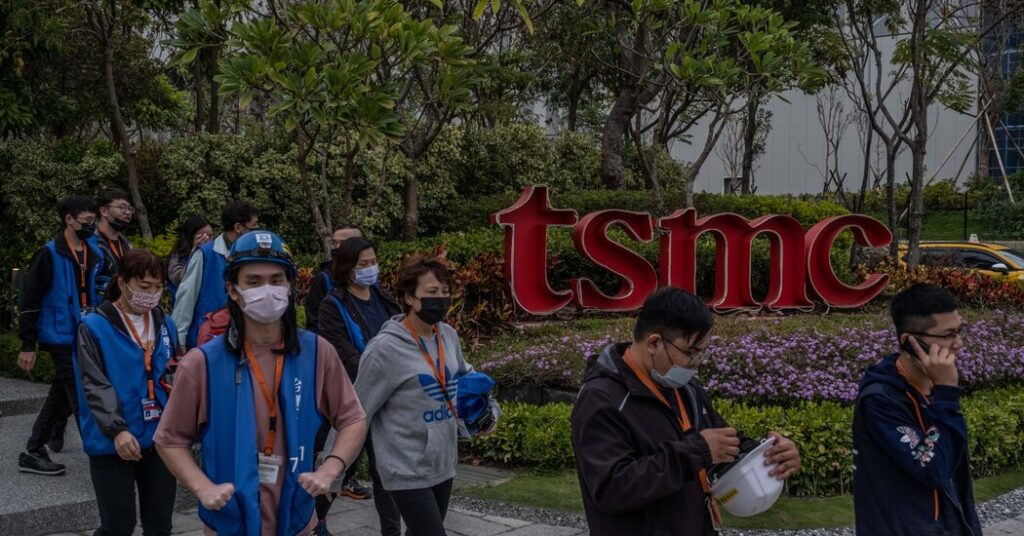
In July, the Taiwanese engineer Wei-Jen Lo left his job after 21 years at the world’s leading computer chip maker, Taiwan Semiconductor Manufacturing Company. He soon started work at one of TSMC’s rivals: Intel, the struggling Silicon Valley chip maker that the Trump administration has wagered $8.9 billion to transform into the U.S. national champion.
Intel said that Mr. Lo’s decision to hop from one job to another was routine in a competitive industry. But in Taiwan, government prosecutors saw it as potential threat to national security and started an investigation. Late last month, officials raided Mr. Lo’s homes in Taipei and Hsinchu, the heart of Taiwan’s chip industry, where they took computers and flash drives. A court also approved the seizure of Mr. Lo’s stocks and real estate.
The case is part of a new push by Taiwanese prosecutors to protect the trade secrets of the island’s world-beating chip makers. Taiwan is the source of most of the world’s advanced computer chips, which are essential to virtually everything from iPhones to cars. But as countries try to boost their domestic chip makers, the authorities in Taiwan are taking a stronger hand in protecting its prized technology.
For the first time, the government is invoking a 2022 law that made chip makers’ trade secrets subject to protection on national security grounds.
On Dec. 2, in a separate case, prosecutors indicted the local unit of one of TSMC’s suppliers, the Japanese equipment maker Tokyo Electron, accusing it of failing to stop a former employee from stealing details about TSMC’s most advanced chips. It was the first time that a company was indicted under Taiwan’s National Security Act over stealing chip trade secrets.
Semiconductor technologies “are the lifeline of our country’s industry,” prosecutors said, adding that their theft threatens the international competitiveness of Taiwan’s chip companies.
Many in Taiwan have long viewed the island’s dominance of advanced chip making as a “silicon shield” to deter military action from China, which claims Taiwan as part of its territory.
The trade war between the United States and China during President Trump’s first term and the Covid-19 pandemic underscored how much the world depended on Taiwan for advanced chips. China, the United States, South Korea and Japan have spent billions to boost their own chip makers, many of which use the same suppliers and have repeatedly recruited Taiwanese engineers.
All this pushed Taiwan’s lawmakers to expand its national security law to cover semiconductor trade secrets, according to Liu Yi-Chun, a prosecutor at Taiwan’s Ministry of Justice.
“It became apparent that Taiwan supplied a significant portion of the world’s semiconductor production capacity,” Ms. Liu said. “Maintaining that competitiveness is crucial.”
After Taiwanese prosecutors opened the national security inquiry into Mr. Lo late last month, TSMC filed a lawsuit against him. TSMC said in a statement that Mr. Lo had told the company in an exit interview that he planned to join an academic institution and had not mentioned Intel.
Intel has said it believes the allegations against Mr. Lo have no merit. The company maintains strict policies that prohibit the use or transfer of third-party confidential information, said Cory Pforzheimer, vice president of communications at Intel. “Talent movement across companies is a common and healthy part of our industry, and this situation is no different,” he added.
In the separate case, Tokyo Electron said that prosecutors had not found that it had directed its former employee to improperly obtain TSMC’s confidential information.
Mr. Lo joined TSMC after 18 years at Intel. In a podcast interview aired in October, he described how he had led an initiative on TSMC’s research and development team to work around the clock under what he called the “Nighthawk Project.” He was also part of several crucial engineering decisions in the development of the company’s most advanced chips. Mr. Lo could not be reached for comment.
TSMC is a giant contract manufacturer. It makes chips that other companies design. Its success depends on keeping secrets.
Among TSMC’s customers are some of the world’s most valuable companies. Apple, which uses the chips in iPhones, and Nvidia, which uses them in artificial intelligence servers. And as the United States and China vie for larger roles for their own chip makers, TSMC is closely guarding the details of its complex production process.
Although rivals like Intel, China’s Semiconductor Manufacturing International Corporation, South Korea’s Samsung and the Japanese start-up Rapidus are spending billions to compete with TSMC, it remains several generations ahead.
The company has strict protocols to protect its trade secrets, including an internal system that tracks which files employees open and print out, and where employees register their engineering breakthroughs. The company follows patent filings by former employees and requires many of its employees to sign noncompete agreements.
For TSMC, the legal case against Mr. Lo compounds an already complicated relationship with Intel, which is not only a competitor but also a major customer. TSMC has been making Intel’s most advanced chips for nearly a decade. Now, Intel and the Trump administration are spending billions on a factory in Arizona where Intel plans to make its own cutting-edge chips in the United States for the first time in years.
But Mr. Trump has also pressured TSMC to do more in the United States. TSMC has already built one chip factory in Arizona and is constructing two more. In March, TSMC said it would invest $100 billion to expand its operations in Arizona, bringing its planned total spending in the United States to $165 billion.
Paul Triolo, a partner at DGA-Albright Stonebridge Group, said, “TSMC is in the difficult position of being both essentially the U.S. national champion now, while the Trump administration attempts to remake Intel into a viable company that can compete with TSMC.”
Amy Chang Chien contributed reporting from Taipei.
Meaghan Tobin covers business and tech stories in Asia with a focus on China and is based in Taipei.
The post Taiwan Invokes National Security Law to Protect TSMC Trade Secrets appeared first on New York Times.