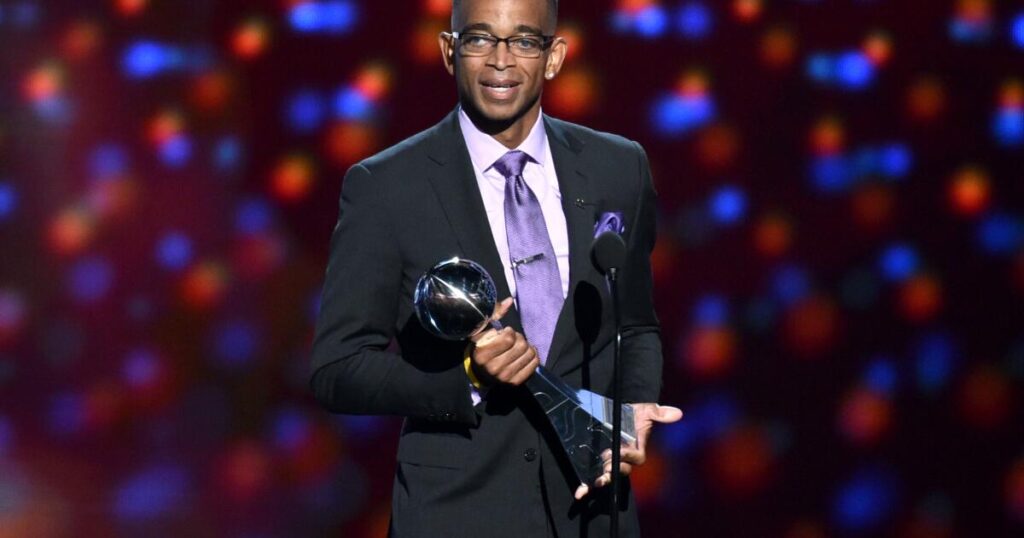
Before Stuart Scott, the phrase “Boo-yah,” was used to express joy. When he made it one of his catch phrases on ESPN, the expression entered the sports vernacular.
Director Andre Gaines explores the impact Scott had on the media landscape in his 30 for 30 documentary for ESPN, “Boo-Yah: A Portrait of Stuart Scott,” premiering Wednesday.
“He can easily be reduced down to a number of different things, maybe his catchphrases, maybe his style,” he told The Times. “All of these types of things are very reductive and have the ability to sort of diminish his legacy, but the reality is that broadcasting, prior to Stu, looked very different than it did after Stuart.”
The Times spoke to Gaines about the emotional journey he had making the film and capturing the “grit and perseverance” that made Scott a staple of journalism. The following interview has been edited for length and clarity.
How did you decide to open the film with a Stuart Scott quote about his dreams?
Gaines: It really had to do with one of the main themes, conceptually, of the film — the fact that Stuart truly believed that you could manifest your own destiny. It was part of his belief when he tried out for the Jets, was part of his belief when he became the icon that he was. It was something that he really saw, and we had this proof of this through his video journals that he kept over the course of his life that we try to showcase very heavily in the film. So, I wanted to start the film off with a quote from him that was exemplary of that.
Why did you decide to use Scott’s voice throughout the documentary?
Gaines: I always try to tell my stories from the perspective of the subject. I don’t want other people dominating the story or telling the story on behalf of the subject. I want the lead character to be the person to narrate their own story, to narrate their own journey, and for Stuart, this proved to be a bit of a challenge, just because he, for so long, was the interviewer and not the interviewee, and there wasn’t, particularly in the early years of his life, there weren’t a lot of interviews to cut a glean from. But after some heavy research, and digging, we were able to find those little gems, either from his own personal archive, of footage that he shot or from interviews that he conducted, or interviews that he was the subject of the interview with other folks, and able to tell that story. I really wanted to give him the platform to carry us through the entire film and be kind of our spirit guide that takes us through his journey and let him be the leader of his own show.
Black sports reporters only make up less than 34%, according to a report by The Institute for Diversity and Ethics in Sports. How do you hope this film changes the landscape of sports journalism?
Gaines: The third of the landscape in the first place, we have Stuart to thank for a lot of that. He was very cognizant of the shoulders of the giants that he stood upon, and understood his place, and once he realized the level of authenticity that he was bringing to a very stilted medium, he took on that burden by just continuing to be himself. My hope is that those numbers just continue to grow. The closer that we get to equity, I think is honoring Stuart’s legacy in the best way possible. Yes, we have this tribute to him. We have this opportunity to see his life in pictures, and really understand his legacy from the ground up, and where it began, but at the end of the day, there’s always gonna be more work to do.
Many athletes want to be rappers, many rappers want to be athletes, Scott managed to smash both worlds together by incorporating some of the language into his reporting. How different is the collaboration between these two worlds because of Scott?
Gaines: What was needed was a glue, something to admonish and recognize both of those realities and how to bring them together. And that was Stuart. That was one of the many things that set him apart. When you look at what Stuart had to endure as a newbie at ESPN 2, and the reason why they ended up hiring him is the same reason why they ended up trying to squash him. The same reason why they were discriminating against him and being prejudiced against him. But he was there as a spirit guide for these two things to come together in such a clear and cohesive and harmonious way. We do have him to thank for so many of the television personalities that we have today as a result of that. He gets a lot of credit for his celebrity. He gets a lot of credit for bringing personality to a very buttoned up and scripted media. But he doesn’t get a lot of credit for being the excellent journalist that he was.
You managed to get a lot of good stories from athletes and his co-workers. What was a story that didn’t make the final cut but still wanted to get out there in the public?
Gaines: There was definitely a really interesting story about a very, very competitive game of pickup basketball between Stuart Scott and Dan Patrick that was pretty incredible, but ended up getting cut for time. There’s another story about a flag football league that they had at ESPN, and they’re playing against some local news stations and guys. Jay Harris tells a story about how Stuart showed up in full pads like this was a real football game. Full pads and goggles and knee high socks and gloves. It was that level of competitiveness that was baked into his soul that showed us what a real fight against cancer actually looks like. He was physically fighting cancer, physically fighting what it was doing to his body, and trying to defeat it through diet and exercise and just a rigorous workout routine. There were a couple of those tidbits that if we had more time, I would love to add in there, but the essence of what those stories are did make the film ultimately.
You really captured his essence in the film. What does he mean to you as a Black filmmaker?
Gaines: For me, he was always a North Star. I started my career in journalism, I should say, went to school for journalism at Northwestern University, and Stuart was also a member of my fraternity Alpha Phi Alpha. There were a couple of the dots that were connected already there for me. So when ESPN called to ask me to do this, it was a thousand times yes. I never got the opportunity to meet him, unfortunately, but I always looked at him as a symbol. It was just an honor to be able to memorialize this incredibly beloved cultural figure in a way that it will live forever, that people can watch again and again, and come back to relive some of the great moments that we all know and love, and learn a whole hell of a lot about the real human being behind it at the end of the day, someone who had trials and triumphs and difficulties and successes just like all of us do. He just had to experience those things on a display as a public figure.
There is an original song by Common in the end-credits. How did that song come about?
Gaines: Common and I have known each other for quite some time. We were working on a TV show several years ago, and he’s just a wonderful human being, an incredible artist, also someone who’s touched so many. I wanted to interview him for the film, because I knew that he had some relationship with Stuart. We talked, and he said, yeah, you know, I’d love to do a song. And I said, you really read my mind. [The song] was just perfectly fitting for what it is that we needed for the end of the film, both solemn and sublime and uplifting at the same time. And that’s a special sauce that he really has among so many musicians.
What do you hope people take away after watching this documentary?
Gaines: I really hope that they’re inspired. I wanted the movie to be so much more than Stuart being defined by the last battle of his life. I wanted it to be defined by his perseverance through his life. Prior to the battle with cancer, he had a series of different challenges that he had to overcome. And so when cancer showed up, I don’t think, uh, he or his family or anybody around him felt that this wasn’t a hurdle that he was going to not overcome, just like he did anything else in his life. But what he showed us all was what real grit and perseverance looks like.
What will be Scott’s legacy in sports journalism?
Gaines: His legacy really should be looked at through that lens as somebody who changed media, somebody who changed broadcasts, news, for the better. Because now we take someone’s having that level of personality on screen, we take that for granted, but that just wasn’t something that existed prior to him.
The post Stuart Scott documentary director Andre Gaines reflects on sportscaster’s legacy appeared first on Los Angeles Times.