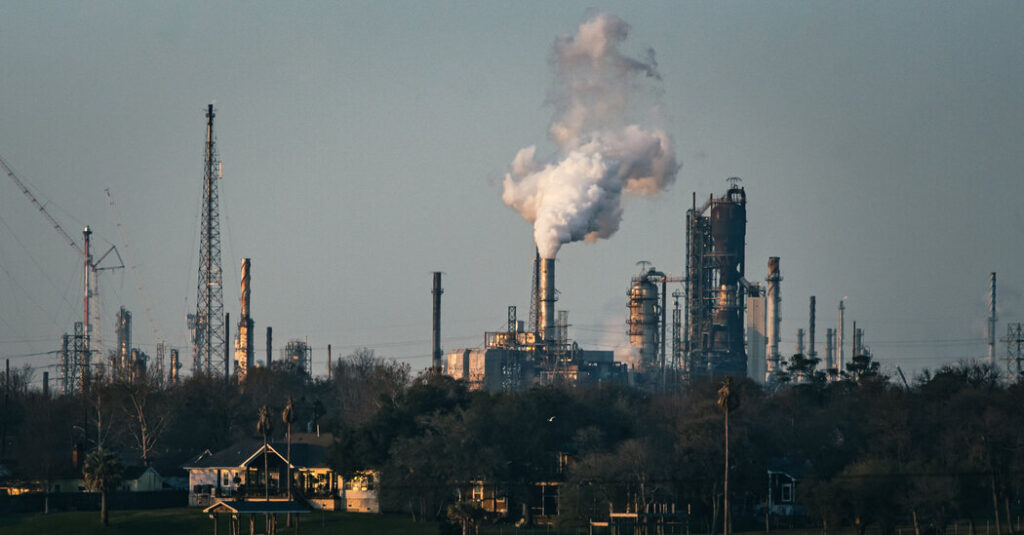
The Trump administration is proposing to almost double what’s considered safe exposure levels to formaldehyde, a cancer-causing chemical found in many consumer products, as part of a broader overhaul of its approach to regulating carcinogens.
The Environmental Protection Agency under the Biden administration had, for the first time, prepared to regulate formaldehyde based on a fundamental assumption: that there is virtually no safe level of exposure for such carcinogens.
But in a win for the chemicals industry, the E.P.A. under President Trump is upending that approach. A draft memo published by the agency this month assumes a safe threshold exists for formaldehyde.
Regulating formaldehyde has been highly contentious because it is used in products as varied as furniture and clothes, so many different industries would be affected by any limits.
The proposed new approach, long called for by industry groups, is moving forward under the direction of two E.P.A. officials who were formerly senior directors at a leading chemicals industry group.
The change would almost double the amount of formaldehyde that is considered safe to inhale, compared with an assessment adopted by the Biden administration, health experts said. In addition to cancer, formaldehyde is linked to severe respiratory problems.
“Within the scientific community, the idea that there is a safe threshold for carcinogenic exposures is not widely accepted,” said David Michaels, a professor in epidemiology at the Milken Institute School of Public Health at George Washington University.
“But the idea of a threshold is a holy grail for industry, because if you can claim a threshold, then you don’t need to protect people at levels below that threshold,” said Dr. Michaels, who headed the Occupational Safety and Health Administration under President Barack Obama.
“It’s a signal of the approach that E.P.A. will take and has consequences for other carcinogens,” he said. “It’s antithetical to the rhetoric of ‘Make America Healthy Again.’ This will do the opposite.”
In a statement, the E.P.A. said it was committed to making decisions based on science and that the Biden administration had used flawed analyses in its initial risk assessment.
The move was the latest from an agency that is working to repeal dozens of the nation’s most significant environmental and health regulations, like limits on pollution from tailpipes and smokestacks.
Much of that is happening under the direction of former industry officials who now hold top positions in the Trump administration. The E.P.A. office that regulates chemical safety is currently led by Nancy Beck, a former senior director at the American Chemistry Council. Her deputy, Lynn Dekleva, is also a former senior director at the same organization.
Dr. Dekleva, in particular, led an effort at the industry group to push back against the E.P.A.’s risk assessments of formaldehyde.
In January, shortly before Mr. Trump’s inauguration, the A.C.C. urged the E.P.A. to “go back to the scientific drawing board on formaldehyde instead of pursuing unaccountable lame duck actions that threaten the U.S. economy.” That same month, Dr. Beck and Dr. Dekleva returned to the E.P.A., where they had served during the first Trump term.
The E.P.A. said both officials complied with federal ethics rules.
“This is something the chemical lobby has been trying to undo for years and years,” said Maria Doa, a former director of E.P.A.’s chemical control division who left the agency in 2021 and is now senior director of chemicals policy at the Environmental Defense Fund, an advocacy group.
“The bottom line is that this is going to have long term effects for other carcinogens, because they’re trying to basically undo how carcinogens are considered,” she said.
That could include, for example, vinyl chloride, a hazardous chemical and known carcinogen released following a Norfolk Southern train derailment in East Palestine, Ohio, in 2023.
In a statement, the A.C.C. called formaldehyde “integral to modern life.” A flawed evaluation of its risks would “lead to regulations that are more restrictive than necessary for this important chemistry, with potential implications for the U.S. economy and domestic production,” it said.
The industry group estimated that products using formaldehyde support more than 1.5 million jobs in the United States.
The group has said it is particularly concerned about stricter workplace limits on formaldehyde that were proposed by the Biden administration, saying they ignored steps that companies were already taking to protect workers, like the use of respirators and other personal protective equipment.
The Biden-era assessment was meant to inform a new rule under the Toxic Substances Control Act, which empowers the E.P.A. to regulate chemicals. The Trump administration is still moving ahead with writing the rule, but its new approach means it would most likely be weaker.
The E.P.A. is accepting public comments on the proposed changes until Feb. 2, 2026.
A colorless, flammable gas at room temperature with a pungent odor, formaldehyde can be released into the air during fires or from furnaces and stoves, car exhaust and even burning candles and cigarettes.
It’s also used in a wide range of industries, to make composite wood products and other building materials, plastics, pesticides, paints and adhesives and even in some hair straightening treatments. According to E.P.A. data, between one to five billion pounds of formaldehyde is produced in the United States each year. Some companies are starting to develop low- or no-formaldehyde alternatives.
But formaldehyde has extensive health effects. Inhaling the chemical can lead to immediate symptoms like watering eyes, a burning sensation in the nose and throat and severe respiratory distress. The International Agency for Research on Cancer at the World Health Organization has concluded that there is sufficient evidence in humans that formaldehyde causes leukemia and nasopharynx cancer.
Hiroko Tabuchi covers pollution and the environment for The Times. She has been a journalist for more than 20 years in Tokyo and New York.
The post Starting With Formaldehyde, Trump Administration Reassesses Chemical Risks appeared first on New York Times.