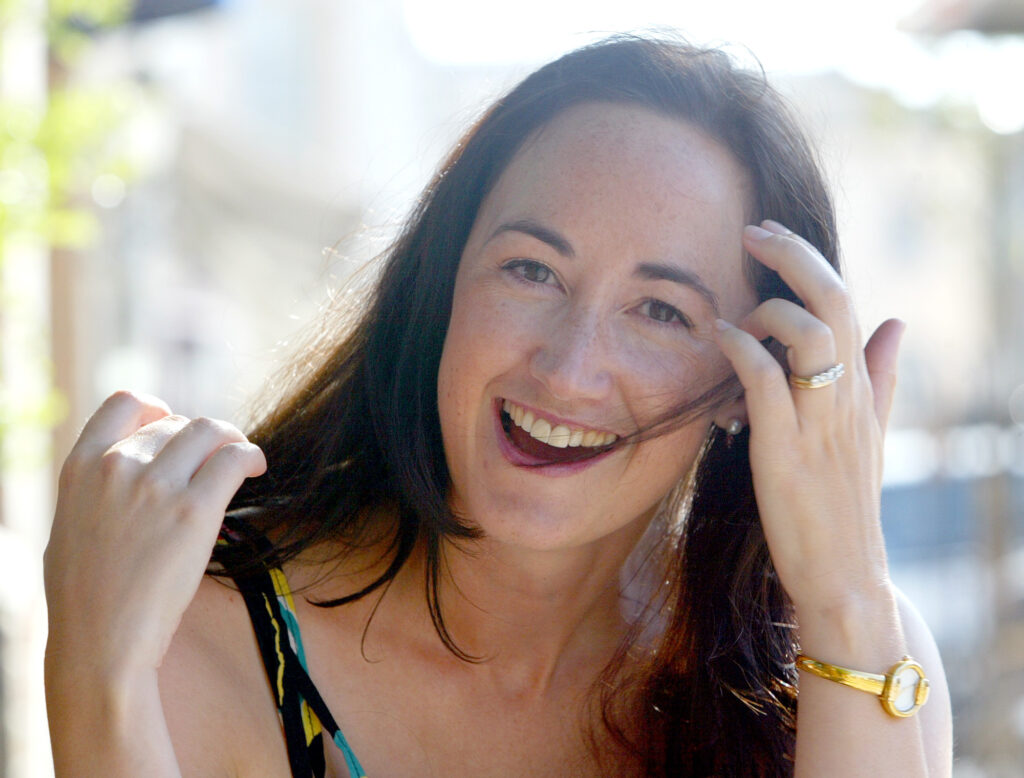
Madeleine Wickham, a wide-ranging British author who splashed onto bestseller lists as Sophie Kinsella, the pen name she used for her “Shopaholic” series of rom-com books about an overspending fashionista, died Dec. 10. She was 55.
Her death was announced in a post on her Instagram account, which did not share additional details. Ms. Wickham revealed in April 2024 that she was receiving treatment for glioblastoma, an aggressive brain cancer.
Like many of the heroines in her more than 20 novels, which sold more than 50 million copies, Ms. Wickham had her share of frustration, missteps and twists of fate on her path to becoming what one reviewer called a “chick-lit goddess.”
She studied music and then economics at the University of Oxford — meeting her future husband on her first day on campus — and drifted into financial journalism by the early 1990s, writing for London-based publications including Pensions World. She knew she wouldn’t last. She took the “longest lunch hours known to mankind,” she once joked, to stay out of the office as long as possible.
She decided to try her hand at fiction, pecking away at a manuscript at work and then at home in the evenings. Under her own name, she published her first novel, “The Tennis Party” (1995), about a group of well-to-do friends spending the weekend at an English country estate, playing tennis, sipping Pimms and sneaking away for trysts.
The plot’s dark side — an attempt to lure others into a shady investment scheme — set the cornerstone for the books that to come: built around money, status, wannabes and smart but often flawed women.
“Personally, when I read books about women who fly around the world, have amazing sex and buy up companies, I never relate,” she toldThe Washington Post in 2012. “I try to write heroines that we relate to. You empathize with people when you feel sorry for them or feel like you’ve been in their place.”
“The Tennis Party” was followed by six novels, all written under her given name, with stories that roamed London’s leafy suburbs and the tensions often hidden behind the successful careers and seemingly perfect lives. Reviewers generally praised the fast pacing, believability of the characters and her sly wit. “Succeeds when it’s silly,” wrotea Kirkus Review on the 2000 novel of breakups, friendships and boozy confessions, “Cocktails for Three.”
Ms. Wickham had hit on a successful formula. She wanted next to take a stab at something different, perhaps with some autobiographical bite, she said. For this book — just in case it flopped — she took the alias Sophie Kinsella, using her middle name and borrowing her mother’s surname. “Writing under a different name meant that it didn’t matter if the book was a disaster,” she told Britain’s Mail on Sunday newspaper. “I could always go back to my other books.”
And so arrived Rebecca “Becky” Bloomwood, the credit card-maxed, fashion-loving, frazzled and unsinkable centerpiece of “Confessions of a Shopaholic” (2000), published in Britain as “The Secret Dreamworld of a Shopaholic.” The book hit a sweet spot, somewhere between the hapless heroine of “Bridget Jones’s Diary” (1996) and Carrie Bradshaw’s brimming closet and streetwise moxie in “Sex and the City.”
The “Shopaholic,” Becky, is a 25-year-old financial journalist who lives in an upscale London neighborhood she can’t afford, treats herself to outfits and shoes she can’t afford, and refuses to face the bills as they pile up. A wealthy — and handsome — public relations executive named Luke comes on the scene. There are ups, downs and finally a resolution as Becky learns there’s more to life (well, maybe) than finding a great sale.
Ms. Wickham told The Post that she aimed for “satisfying” endings, but also tried “to leave heroines in a position where the future isn’t all wrapped up.”
The book, she said, was inspired by her own shock when a big Visa bill arrived one day. She told the San Francisco Chronicle that she stared at the whopping charges, in denial about her financial quagmire. “And once that happened I could see the character,” she recalled, “I could see where it was going, and I could see the potential for comedy.”
A franchise was launched. The sequel, published in 2001 as “Shopaholic Takes Manhattan” in the United States, brings Becky to New York with her boyfriend Luke for his job. The city’s shopping wonders lure Becky back into bad habits. They break up and make up while Becky lands a dream gig as a personal shopper at Barneys New York.
Eight more books were in the “Shopaholic” series, including “Shopaholic on Honeymoon” (2014) and “Christmas Shopaholic” (2019). A 2009 movie based on the early novels, “Confessions of a Shopaholic,” starred Isla Fisher as Becky and Hugh Dancy as Luke.
Ms. Wickham said she planned to stop after the fourth “Shopaholic” book, but fans kept writing. “Where’s Becky? What’s she doing? How’s her honeymoon going?” she once said. “It was like being asked about a mutual friend. So I started thinking, ‘How is she? How’s the honeymoon going? What did she buy?’”
When needed, she came to the defense of Becky’s world. Ms. Wickham fired back at critics — always in her polite, mannered style — who dismissed “chick-lit” as frothy and lightweight. She argued that her readers recognize that women can fight against the glass ceiling and still enjoy a chat about something else with less gravitas.
“They’re not stupid, they’re not retrograde, they haven’t sacrificed their feminist ideals,” she told the Guardian in 2012. “They are real people with a shallow end and a deep end, and I’m just putting the whole picture out there.”
Six months after publicly announcing her battle with glioblastoma, she released the novella “What Does it Feel Like?” as Sophie Kinsella. The book carried deep autobiographical echoes: A character named Eve becomes a celebrated author and then, years later, undergoes aggressive cancer treatment.
Eve’s strategy to deal with the hospital visits is to pretend she’s at a spa. “And when you are asked to change into a gown, pretend it is a fluffy robe,” Ms. Wickham wrote. “And when you’re asked to lie down on a piece of machinery, pretend it’s a high-tech piece of state-of-the-art equipment for facials. (Apparently Gwyneth Paltrow uses it, so it must be good.)”
Eve also sees the paradox for a writer who crafts feel-good fiction. “I can’t invent a real-life happy ending for myself,” she says.
Debt as inspiration
The daughter of teachers, she was born Madeleine Sophie Townley in the Wandsworth district of south London on Dec. 12, 1969. She had two sisters, including fellow author Gemma Townley, and attended the Sherborne School for Girls.
Ms. Wickham showed talent as a pianist and initially studied music at Oxford’s New College. She switched to politics, philosophy and economics for a degree in 1990.
The intersection of money and personal choices became an increasing fascination. She watched how some friends — mostly from relatively privileged backgrounds — obsessed about money as the only measure of success. She also was dismayed about how quickly she could get herself in financial straits by living beyond her means.
“Money is an emotional subject, which affects people’s lives, even though they think it shouldn’t,” she told the Sunday Times of London. “I find that interesting.”
Even as the “Shopaholic” series took shape, Ms. Wickham wrote more than a dozen other books under the Sophie Kinsella nom de plume, including the popular “Can You Keep a Secret?” (2003). The novel begins with a young woman, Emma Corrigan, telling a stranger on a plane how much she disliked her marketing job. The stranger was the company owner. Workplace intrigue, romantic sparks and lessons about honesty ensue. (A 2019 movie adaptation starred Alexandra Daddario as Emma.)
Ms. Wickham branched into the young adult genre in 2015 with “Finding Audrey.” Her 2023 book, “The Burnout,” published after she received her brain tumor diagnosis, tells the story of a woman who looks to recharge at an English seaside town she loved as a child but encounters a man who is even more stressed-out and world-weary.
In announcing her medical condition, she wrote that she and her family had needed time to “adapt to our ‘new normal.’” She had married Henry Wickham, an Oxford classmate who became a school headmaster and managed her business affairs, in 1991. They had five children. Complete information on survivors was not immediately available.
During a 2007 interview with USA Today, Ms. Wickham juggled the reporter’s questions while clothes shopping in Manhattan for her children. She spotted a half-price rack, snagging a pair of designer wool shorts and matching vest for her son.
“Once a bargain queen,” she said, smiling as she took out her credit card, “always a bargain queen!”
The post Sophie Kinsella, hit author of ‘Shopaholic,’ dies of brain cancer at 55 appeared first on Washington Post.