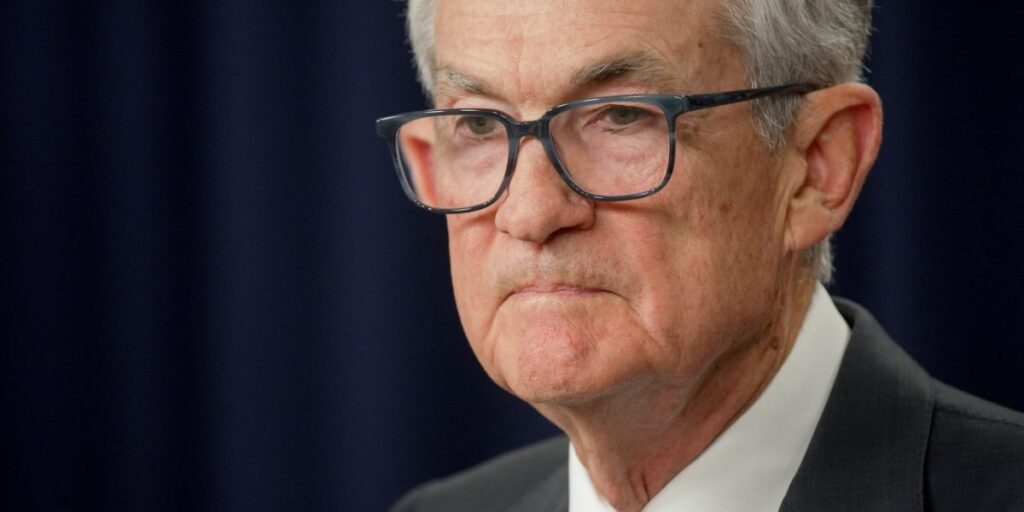
Federal Reserve Chair Jerome Powell on Wednesday described the U.S. economy as “very unusual,” saying policymakers are navigating a rare combination of tariff-driven goods inflation and a labor market that may already be weaker than official data suggests.
The Fed cut interest rates for the third consecutive meeting, a quarter-point reduction Powell framed not as a confident pivot toward easier policy, but as a defensive move meant to keep the labor market from slipping further. He repeatedly emphasized risks to employment have risen “in recent months,” and noted that behind the headline numbers, job creation may already be negative.
Powell made the striking admission the Fed believes the official payroll figures—which have slowed sharply since the summer—are overstating job growth by roughly 60,000 per month.
“Forty thousand jobs could be negative 20,” he said, adding this dynamic is not well understood by the public because unemployment claims remain historically low—something both economists Mark Zandi and Claudia Sahm recently told Fortune could be giving people a false sense of security about the job market.
“I think a world where job creation is negative… we need to watch that very carefully,” Powell said.
It is this weakening backdrop Powell said makes the current moment “very unusual”: Inflation remains elevated, but most of the remaining overshoot comes from goods categories directly affected by tariffs, as opposed to domestic economic overheating, which he said the Fed has worked hard to cool since its 2022 highs; inflation excluding tariff-affected goods is “in the low [two percent],” he said. Services inflation is cooling, wage pressures are easing, and neither the labor market nor business surveys suggest a “Phillips-curve” kind of inflation threat, Powell said, referring to the inverse relationship between inflation and unemployment.
Instead, Powell said, the bulk of the problem is a “one-time price increase” pushing up goods categories as import levies work their way through supply chains. Goods inflation, he noted, should peak around the first quarter of 2026, assuming no additional tariff rounds.
Those crosscurrents have fractured the Fed. Three officials formally dissented from the rate cut on Wednesday, and several others offered what Powell described as “soft dissents,” when an official’s personal projection falls out of what they ultimately voted for. There were six such “soft dissents” this time, during one of the deepest divides inside the FOMC in years, driven by disagreement over how to weigh the risks of lingering inflation against the possibility that job growth is weaker—and much more fragile—than reported.
Powell stressed that policymakers cannot simply choose one mandate to prioritize.
“There is no risk-free path,” he said, a refrain he’s repeated for months. “When both sides of the mandate are threatened, you should be kind of neutral.”
He characterized the current stance as being at the “high end” of neutral, allowing the Fed to “wait and see” how the data evolve.
The post Powell warns of a ‘very unusual’ economy as tariffs keep goods inflation high amid a weakening labor market appeared first on Fortune.