Congress is set to pass its $901 billion defense policy bill Wednesday without including insurance coverage for military families to get fertility treatment, dealing a blow to service members and advocates who hoped President Donald Trump’s support for family-building policies would push the benefits across the finish line.
The proposed language in the annual National Defense Authorization Act (NDAA) — passed by both the House and Senate in earlier versions of the bill — would have expanded the military’s health care program to cover fertility treatments, including embryo transfers for in vitro fertilization cycles and intrauterine insemination for all service members and their families. The provision would’ve matched IVF coverage that members of Congress and other federal employees receive.
But for the second year, House Speaker Mike Johnson (R-Louisiana) scrapped it just before the bill’s expected passage, lawmakers sponsoring the provision said.
The proposal’s supporters said existing fertility coverage for military families is too narrow. It covers IVF and other treatments for families experiencing infertility only because of an injury or illness that happened during active duty — excluding a swath of service members trying to have children under circumstances distinct from most American families.
The lawmakers behind the provision to expand the benefits say its exclusion from the NDAA’s final cut hurts military families who had built up hope after hearing Trump championing IVF coverage.
Johnson axed the provision based on his own views, appeasing antiabortion allies, the sponsoring lawmakers said in public statements. Some conservatives oppose IVF because embryos are sometimes discarded during the process, which they see as ending human life. For decades, Johnson’s home state of Louisiana has banned the destruction of embryos created during IVF, the only state with such a restriction, requiring fertility clinics to ship the embryos out of state.
Asked about the measure’s removal from the NDAA, a spokesperson for Johnson said he had repeatedly signaled support for IVF access “when sufficient pro-life protections are in place.”
“He will continue to be supportive when it is done responsibly and ethically,” his spokesperson, Athina Lawson, said in a statement Tuesday.
Federal and state Republicans have publicly tussled with maintaining an antiabortion position while supporting IVF since last year, when the Alabama Supreme Court ruled that frozen embryos were children and people could face legal consequences for destroying them. Fertility clinics paused their work, and would-be parents worried they would no longer have access to the procedure because of the decision from the conservative court.
In the aftermath, many Republicans came out in support of IVF and the families relying on the procedure to have children. Trump, then a presidential candidate, posted on social media that he supported IVF and pressed Alabama lawmakers to “find an immediate solution.”
Still, conservatives’ competing views made IVF coverage collateral damage in the defense bill, the provision’s backers said.
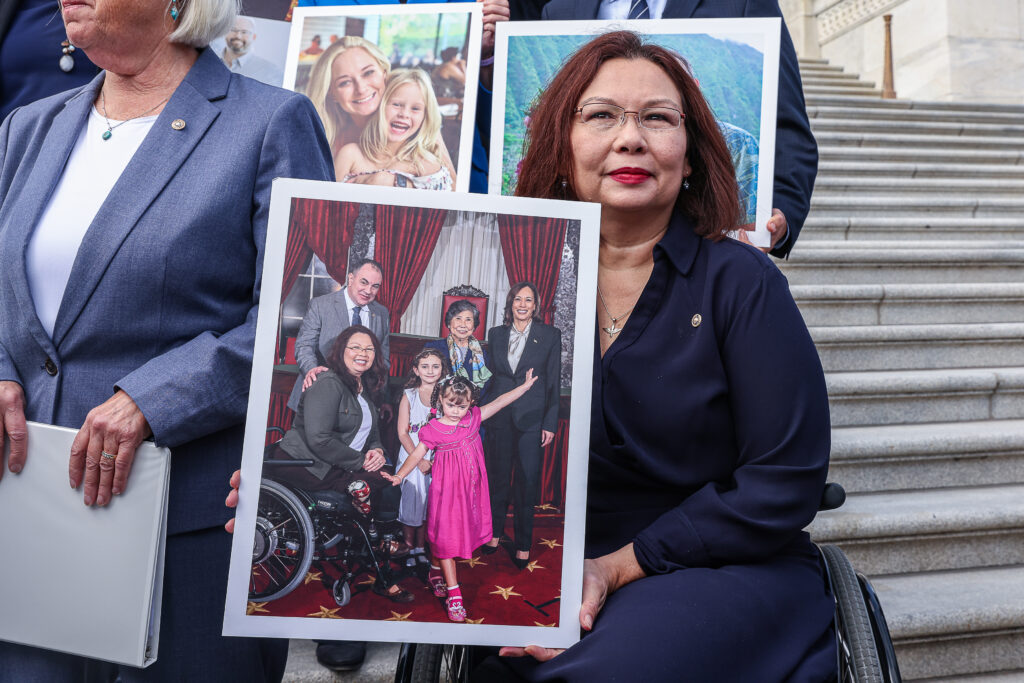
Sen. Tammy Duckworth (D-Illinois), a combat veteran who had two children through IVF and sponsored the provision, said Johnson striking it was another example of Republicans surrendering to “far-right extremists” who don’t support the procedure.
Duckworth also called Johnson “deeply hypocritical” because lawmakers began receiving expanded fertility benefits in 2024. She tried to pass the same provision for troops in the NDAA last year, which Johnson also blocked.
The senator, like many military families, delayed having children because of her career, during which she deployed to Iraq. She gave birth to both of her daughters after her military retirement.
In 2020, half of active-duty service women delayed getting pregnant or starting a family, a study sponsored by the Defense Department found. A third of those women reported that they had restrictions on the job if they were pregnant.
In a letter to members of the House and Senate Armed Services committees last month, 15 military advocacy groups wrote that, among other factors, deployments, frequent duty-station moves and exposure to toxins make building families a unique challenge for service members.
Courtney Deady and her husband Jordan, a member of the Ohio Air National Guard, knew they would have trouble conceiving. Deady’s fallopian tubes were damaged after a surgical procedure she had as a teenager, but she was willing to try everything — medications, surgeries, treatments — to start their family.
The couple first tried to conceive in 2015 and have since completed multiple rounds of IUI and IVF, racking up about $100,000 in medical bills. They still haven’t had a baby and have one embryo remaining for a last IVF cycle.
Deady said she was hopeful that this year, fertility benefits would be extended to families like hers. Trump’s pledge to make IVF affordable for American families made it seem like benefits for the troops had greater odds than last year, she said.
“We had the opportunity, not once but now twice to add this into the NDAA, and it is not there to help people who already sacrifice so much, up to and including their life,” Deady said. “We have to sacrifice all of that, plus now our dreams, our personal dreams.”
Sharon Kozak, whose husband is a U.S. Navy recruiter, was also watching the NDAA closely. After months of negotiations over the bill, both the House and Senate passed it with bipartisan support, including the IVF expansion.
But then, it disappeared.
“I was like, wait, I thought we were getting somewhere,” Kozak said.
She and her husband, who use the military’s TRICARE insurance, grappled with infertility before they had their two children. They did not use IVF, but would have considered it if it was the only way to have a third child.
Now, she said, they won’t able to afford it.
Congressional Democrats who plan to vote for the NDAA condemned the IVF provision’s exclusion, but said they would approve the bill because it had still made strides for service members, namely a nearly 4 percent raise.
In a statement Monday, Rep. Adam Smith (D-Washington), a member of the House Armed Services Committee, scorned the NDAA changes that he said were made without broad agreement from lawmakers, the IVF expansion among them.
“I am disappointed these items were excluded from the final text and will keep working with my colleagues on both sides of the aisle to advocate for them going forward,” Smith said.
Riley Beggin contributed to this report.
The post New IVF benefits for military families cut from defense bill again appeared first on Washington Post.