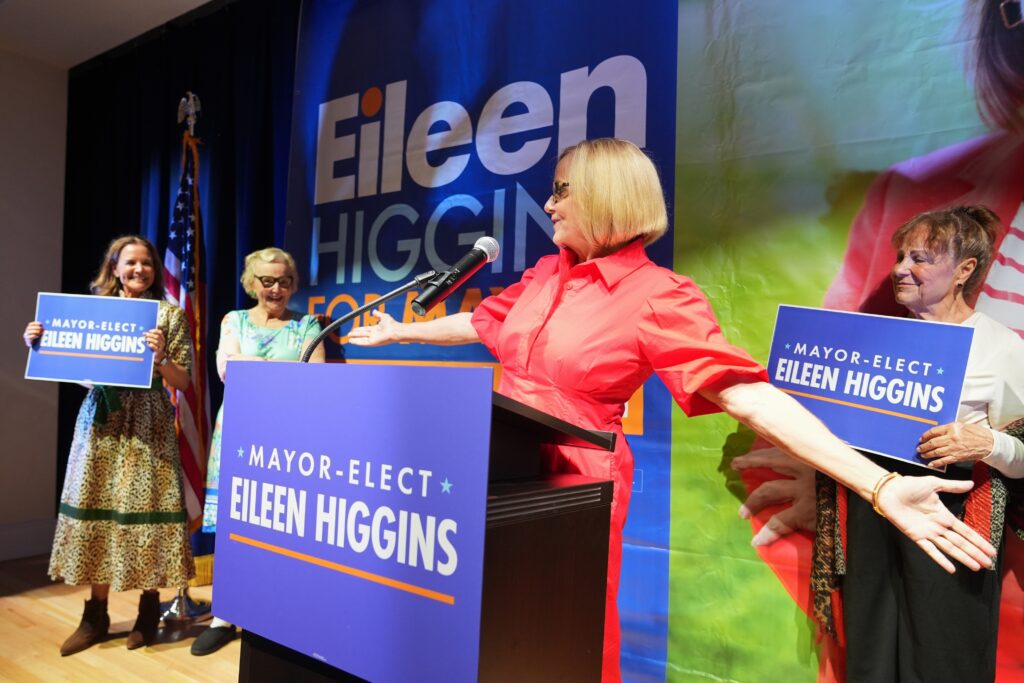
Miami will have its first Democratic mayor in nearly 30 years, after the city elected former county commissioner Eileen Higgins on Tuesday in a contest that attracted attention from President Donald Trump and national Democrats.
With most votes tallied, Higgins had roughly 59 percent in the mayoral runoff, according to unofficial results from the Miami-Dade County supervisor of elections, besting Emilio T. González, a Republican and former city manager, who had nearly 41 percent of the vote and conceded the contest.
Although the race was technically nonpartisan, the political divide was clear. Trump backed González, while the Democratic National Committee and potential Democratic presidential hopefuls supported Higgins. The Democrat will become the first woman mayor in the history of Miami.
Her victory marks a welcome shift for Democrats in South Florida, which has moved to the right in recent elections. It also caps off a successful election year for Democrats across the country, following marquee statewide victories in Virginia and New Jersey last month and over-performances in special elections from Tennessee to Iowa.
For Republicans, it was another electoral setback — this time in an area where they’ve been dominant in local elections — as the party was looking for reasons for optimism headed toward the 2026 midterms.
Local strategists in both parties cautioned in advance of Tuesday not to overread the results as too indicative of broader trends. But operatives in Miami and beyond were watching closely as the returns came in. Here’s what to know about the contest and the Democratic win:
What are Miami’s politics?
Miami, a majority Hispanic city with roughly half a million residents, last had a Democrat for mayor for a brief stretch ending in 1998, even though the party has held an edge in voter registration. Historically, Republicans have tended to do better turning out their voters in the city’s off-year election for mayor, whose powers are limited in Miami.
Higgins will become the city’s first non-Hispanic mayor since the 1990s. Miami politics have been dominated by Cuban American Republicans for decades.
While Kamala Harris narrowly won the city with 50 percent of the vote to Trump’s 49 percent, that was down from Joe Biden’s 19-point win there over Trump in 2020, according to a Washington Post analysis of Florida precinct data.
Last year, Trump became the first Republican presidential candidate in 36 years to win Miami-Dade County, which includes the city of Miami. Trump has long touted his inroads in South Florida and is planning to build his presidential library in Miami.
What was the campaign like?
The contest started to draw attention after city commissioners in June attempted to postpone the November election until 2026 without voter approval. The controversial decision would have effectively given Miami’s elected officials, including its term-limited mayor, Francis Suarez (R), a Trump ally, an additional year in office. However, a judge ruled against it, and the election proceeded as originally planned.
The race largely centered on local issues such as the city’s lack of affordable housing and property taxes. Both candidates were vocal in their rejection of corruption and political dynasties that have dominated Miami’s City Hall for decades.
“Tonight, the people of Miami made history. Together, we turned the page on years of chaos and corruption and opened the door to a new era for our city — one defined by ethical, accountable leadership that delivers real results for the people,” Higgins said in a statement celebrating her win.
Ahead of the runoff, many Florida strategists and leaders cautioned that Tuesday’s results should not be taken as a referendum on Trump’s second term or a clear indicator of expected midterm outcomes in South Florida. But some Democrats said in advance of the vote that they believed the crush of national political figures and groups on both sides wading into the race only served to hurt González by tying him to Trump, whose approval ratings have declined.
Democrats went into the runoff feeling bullish in part because of Higgins’s performance in the Nov. 4 general election, in which she won 36 percent of the vote in a field of 13 candidates, nearly double González’s 19 percent. That was not enough to win the election outright, because she did not secure a majority of the vote.
The party has also been emboldened by a political climate that has been favorable in elections this year. Trump’s low approval rating has boosted its confidence up and down the ballot across the map. Concerns about his immigration enforcement policy have also resonated in Florida and beyond, worrying some Republicans.
After the November election, the Democratic National Committee got involved in the Miami race, recruiting and training bilingual volunteers and hosting phone banking events in support of Higgins.
DNC Chair Ken Martin celebrated the victory Tuesday night as “a testament to what Democrats can accomplish when we organize and compete everywhere.”
“Tonight’s result is yet another warning sign to Republicans that voters are fed up with their out-of-touch agenda that is raising costs for working families across the country,” Martin said in a statement.
Which prominent Democrats got involved?
Potential 2028 presidential candidates sought to leave their mark on the race. Sen. Ruben Gallego (D-Arizona) was in Miami on Sunday to campaign with Higgins. Rahm Emanuel, former Chicago mayor and U.S. ambassador to Japan, joined Higgins in Miami on Monday. Higgins’s campaign on Friday promoted an endorsement video from former transportation secretary Pete Buttigieg.
Higgins said in an interview ahead of the runoff that it was great to see national interest in her race but sought to emphasize local issues.
“People want their local government to focus on them,” she said. “And what we have now, whether it’s in Washington or in Tallahassee, are governments that are talking about things that aren’t productive to our economy, aren’t welcoming to people, and aren’t good for the future of our environment.”
One of Higgins’s takeaways from the November elections in Virginia and New Jersey, she said in the pre-election interview, was that “people wanted moderate voices” who will tackle the issues that matter to them, such as affordability.
What have Trump and other Republicans been saying?
Ahead of the runoff, Republicans in Florida were already downplaying the significance of a Higgins win, and some sought to preemptively rebut any Democratic celebration. They argued that a GOP loss shouldn’t be viewed as a broader sign of erosion of support for Trump and the party, noting that the city voted for Harris in 2024.
Trump repeatedly praised González in the run-up to the election, endorsing him in a Truth Social post and vowing that the Republican candidate would “NEVER LET YOU DOWN.” Trump, who misspelled González’s last name in the post, said González would “fight tirelessly” to strengthen the economy, “Stop Migrant Crime” and cut taxes, among other things.
González thanked Trump for his support, writing on X that “Miami’s future is on the line, and your support sends a powerful message that our city deserves strong, common-sense leadership.”
Trump on Sunday shared another message of support for González, saying that he is “FANTASTIC!” and that Tuesday’s election “is a big and important race!!!”
Florida Gov. Ron DeSantis (R) and Republican Sens. Ashley Moody and Rick Scott also endorsed González. On Friday, Scott campaigned with González, a retired U.S. Army colonel, in a “Keep Miami Red” rally held at Versailles, an iconic Cuban restaurant.
Sen. Ted Cruz (R-Texas), a potential 2028 presidential candidate, waded into the Miami race, endorsing González before the November general election and referring to him as a “dear friend and fellow Cuban-American.”
Republicans sought to paint Higgins as too far left for Miami, while Democrats described González as a MAGA Republican — strategies that follow the playbooks both parties have used in other contests across the country.
Lenny Bronner contributed to this report.
The post Miami will have its first Democratic mayor in nearly 30 years appeared first on Washington Post.