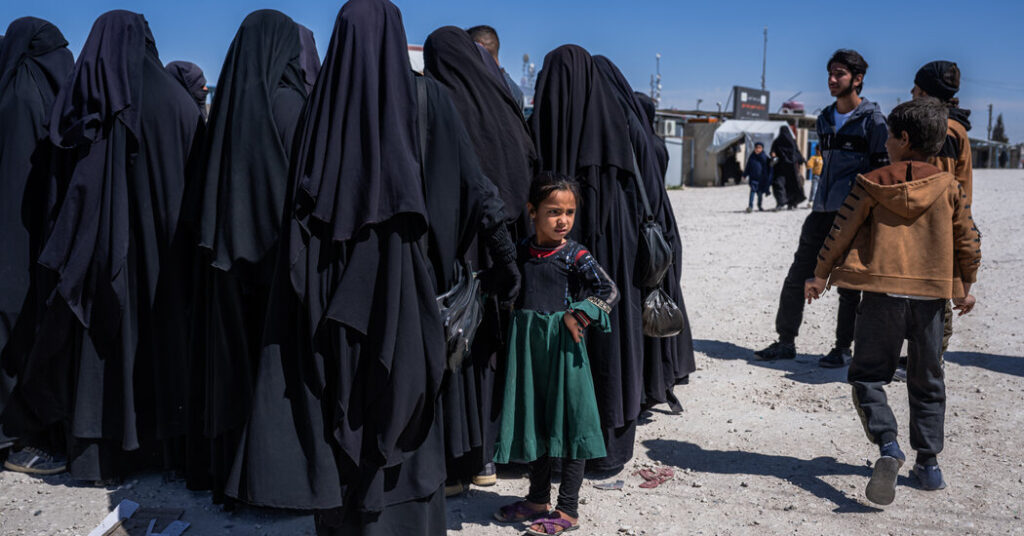
The arid steppes of northeastern Syria stretch almost uninterrupted to the Iraqi border, the emptiness broken only by the occasional oil derrick, until the road comes to a sprawling prison camp.
A chain-link fence topped with barbed wire surrounds the vast compound, and supply trucks line the route for more than half a mile outside the camp’s gates. This is Al Hol detention camp, where most detainees are family members — wives, sisters, children — of fighters for the terrorist group Islamic State, or ISIS. More than 8,000 fighters themselves are in prisons nearby.
For years, ISIS ruled large parts of Syria and neighboring Iraq, brutally enforcing its strict interpretation of Islamic law. As Kurdish-led Syrian forces backed by the United States battled to reclaim that land, they detained thousands of ISIS fighters and tens of thousands of their relatives.
U.S. forces entrusted their Syrian Kurdish allies with guarding the ISIS detainees and families. But now, the Pentagon is drawing down its troops in Syria and there are indications that U.S. officials want Syria’s new government to take responsibility for the prisons and detention camps.
This is part of a larger government effort to merge the powerful Kurdish-led militia, known as the Syrian Democratic Forces, or S.D.F., into the country’s newly reconstituted military as officials try to reunite Syria after a 13-year civil war.
One obstacle to the plan is that many Kurds distrust the government and its commitment to fighting ISIS. The government is led by Islamist former rebels once linked to Al Qaeda, and many Kurds fear they might free some ISIS militants.
The government so far has taken a strong public stand against ISIS. Syria agreed in November to join a U.S.-led coalition to fight the group, which remains active in the country.
The Islamic State, after several years of low-level attacks primarily targeting Kurdish-led forces in northeast Syria, has expanded its reach as well as the frequency and lethality of its attacks in the last year, according to assessments by both the United Nations and U.S. officials. The group targeted a Greek Orthodox Church in Damascus and has staged bomb attack against Syrian government forces.
Camp administrators say that ISIS operatives are still inside the camps, focused on radicalizing the children there.
When I visited Al Hol camp this year, children milled around in groups inside the penned expanse. The younger ones clutched their mothers’ long, black robes. Some of the women hurried their children away from foreign visitors, muttering “kafir” — Arabic for infidel.
Some of the women avoided talking to foreigners, while others crowded around me, pleading to be heard.
For many of the residents, it does not matter who is in charge.
“We want to go home. We are so tired,” Um al-Bara, a woman from the Iraqi city of Hit, told me in the spring. She was dressed, like many, in a black, full-length robe and a black head scarf, her nose and mouth covered. Some also wore long black gloves in deference to the religious strictures of ISIS.
The camp administrator, Jihan Hanan, said in November that she was not sure whether Um al-Bara was still in the camp or if the Iraqi government had taken her back to Iraq along with thousands of other Iraqi women from the camps.
Another woman spoke softly as she held close a little girl with a runny nose. The woman told me her name was Hawla and that she had two daughters and two sons with her.
Her children were suffering because there was no proper school, she said, adding that they had done nothing wrong and were being punished for the deeds of their father.
She and her children were allowed to return to Iraq in the fall, according to Ms. Hanan. Hawla and her children had spent six years in Al Hol.
“I need medical treatment,” pleaded another woman, Lutf al-Nassan, 65, as she tugged my sleeve. She explained that she had heart problems and that her medicine had run out. Camp officials said late last month that they did not know whether she had returned to Iraq.
Al Hol and another nearby camp, Roj, now house more than 27,000 family members of ISIS fighters, according to the camps’ administrators. None of the family members have been charged with a crime. The camps are deep in a northeastern region controlled by the Kurds and secured by the S.D.F.
Camp administrators warn that a new generation is growing up indoctrinated by their mothers in the extremist ideas of ISIS.
“All of the women here are radical. They all stayed with the Islamic State until the end,” Hokmiya Ibrahim, the administrator of Roj camp, said in an interview there. “But the bigger problem is that the mothers are educating their kids according to the Islamic State ideology.”
Nearly 60 percent of the population in the two family camps are under 18, according to camp administrators. Most of those children have spent years in a place where restrictive ideology of ISIS prevails.
The most extreme among Al Hol detainees are primarily from countries outside the Middle East, including Tajikistan, Azerbaijan, France and Russia. They include roughly 6,000 women and children who live in a separate area of the camp that is off limits to visitors because it is considered so dangerous, according to Ms. Hanan.
Conditions in both camps are grim.
Discontent, violence and ill health plague the residents. Weapons are routinely smuggled in, and women and older adolescent boys frequently try to escape, according to the administrators.
Hundreds of vehicles enter daily to bring supplies and can be used to smuggle people out, Ms. Hanan said.
“Every day, people are fleeing, and it seems it is an organized operation,” she added. “They are building hiding places in the water tanks.”
The administrators said they were barely able to hold the camps together and that the situation had worsened since the Trump administration cut U.S.A.I.D. funding this year for basic services such as water deliveries, bread rations and medical care.
While the U.S. State Department soon restarted water and bread distribution in the camps, all medical, child protection and educational services have ceased.
After the cuts, Ms. Hanan said, there was an increase in violence and escapes, and there were protests against the Trump administration’s decision to stop paying some of the groups that help residents.
During this period, Al Hol detainees attacked the offices of aid groups, breaking doors and windows and injuring guards. Some of the female detainees converged on Ms. Hanan’s office with demands for bread, water and medical care for their infants, she said.
Late last year, a couple in Al Hol put on homemade explosive vests and threatened to detonate them when S.D.F. members came to their tent during a security raid. When the couple would not surrender, they were shot and killed, Ms. Hanan said.
Many of those detained in the Al Hol and Roj camps want to return to their homes in Syria, Iraq or dozens of other countries. Some of those countries do not want them because of national security concerns, leaving the women and children in limbo.
Camp administrators say there is an urgent need to reduce the population of the camps.
Iraq and Syria have committed to resettling their citizens, who account for the most of the camps’ residents. About 40 percent of the detainees in 2024 were Syrian, according to the U.N.
Iraq said in September that it had brought back nearly 19,000 of its citizens and aimed to repatriate the rest by year-end. Syria’s government has a similar effort to return its citizens in the camps to their homes, but so far only a few hundred have been resettled.
While some women in the two camps remain devoted to ISIS, others want desperately to go home to their families, said Evelyne De Herdt, 35, a Belgian detainee. She said she had become disillusioned with the movement and just wanted “a normal life.”
Ms. De Herdt explained that she was brought up Catholic, converted to Islam at her husband’s behest and came with him to Syria in 2015.
“He convinced me to come here to live an Islamic life, and I was pregnant by him,” she said, sitting on the floor of her tent in Roj camp in the spring.
Her daughter, Asia, was born the year she went to Syria, she said, and a few months later her husband was killed fighting for ISIS.
In 2019, as fighting intensified between the Islamic State and the international forces backing the S.D.F., Asia, then 4, was killed. Ms. De Herdt was detained in the camps.
Belgium has taken back a small number of women with children from the two camps but turned down women who wanted to return but did not have children.
“Because my daughter is gone, I don’t qualify as a mother,” she said softly. So she waits, like thousands of other women and children, stranded in the desert.
Alissa J. Rubin reports on stories across the Middle East, including ongoing conflicts and long-term problems such as climate change. She is based in Paris.
The post Islamic State Camps Pose a Dangerous Problem for Syria’s Leaders appeared first on New York Times.