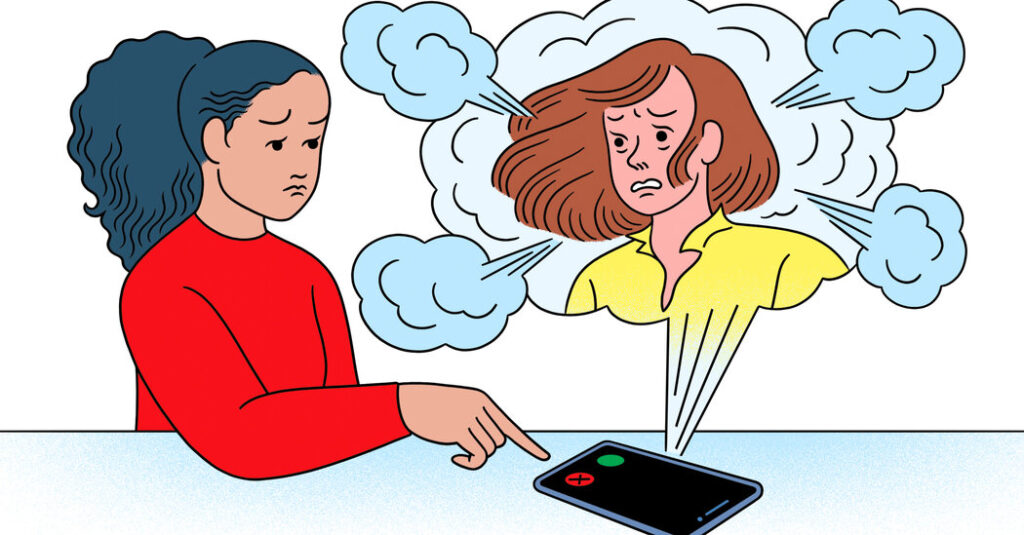
Over the past five years, a close friend has been through a cascade of upheavals: a rushed marriage, two pregnancies, a lost job, a failed move to another state, a move back home, postpartum depression, more depression and constant blowups with her family. She says she’s “very against” medication and can’t afford therapy. Through all of this, I showed up: I flew out to visit, helped prep a nursery, organized a multistate meal train and was available on the phone at all hours. I feel confident in saying that I was a good friend.
This year, she kept pushing me to try an A.I. workout feature on Peloton. I told her I didn’t want to and that it felt triggering to be told when and how to work out, for reasons related to a relative’s eating disorder, something my friend knows well. She blew up, accused me of shaming her and stopped speaking to me for a month.
That month was clarifying. I realized how one-sided the friendship had become, how much it revolved around her issues, how her anger was like an incessant low hum that was always on. Without the nonstop venting and anger — including her daily text rants about her family, her in-laws, the job market — I felt peaceful for the first time in years.
I eventually sent her a thoughtful email, reviewed by my therapist, explaining that the friendship no longer felt reciprocal or healthy. Five minutes later, she sent an expletive-filled text calling me names and blaming me for her suicidal ideation. In a micro sense, that confirmed my decision. But the macro ethical question still lingers.
What do we owe a friend who is struggling? At what point is stepping back self-protection rather than abandonment? How do we weigh someone’s “rough patch” against patterns of behavior that feel toxic? And if her mental health is genuinely poor, does that obligate me to leave the door open forever?
There’s a lot of “choose yourself and set boundaries” advice out there, but as someone who cares a lot about friendships and people, I’m left wondering where those boundaries should be. — Name Withheld
From the Ethicist:
One person can’t will a friendship back to life. Aristotle was on to something when he described friendship as reciprocated good will, and you can’t be friends with somebody unless each of you acts like a friend. Plainly, this person simply hasn’t treated you with the care and consideration that a friend is owed. The problem isn’t that she blew up at you; it’s that she never apologized, never tried to repair the rupture, never treated the relationship as something she was equally responsible for. You’re not the one who has walked away.
To stay in the close orbit of someone with mental illness can be an act of compassion or charity, but when the support and affirmation goes only in one direction, it isn’t an act of friendship. She also seems to have other people in her life, a spouse and family members, who are better placed to do something and who have greater responsibility as a result. You didn’t abandon this person in a storm; during years of bad weather, you showed up, at some cost to yourself. But you can’t be asked to serve both as a shelter and as a lightning rod.
Readers Respond
The previous question was from a reader who found herself at odds with a bully in her social circle, and questioned whether she should remain in the group. She wrote:
I’ve been part of a small circle of friends for decades. … But over time, the deep intimacies we once shared have now flattened. … There is one member of our circle who is witty, generous and charming — but guided chiefly by self-interest. Years ago, when I declined to help her pursue something she wanted, she felt betrayed and has quietly resented me ever since. … Now at our gatherings, I feel more like a bystander than a participant, knowing from experience that any vulnerability I expose will be used by this person. … But that self-protective stance collapsed recently when, in the middle of a discussion about a global crisis, this person leaned over and, sotto voce, used a racist, dehumanizing epithet for the people affected. Stunned, I did the wrong thing: I pretended not to hear, something for which I’ll always be ashamed. … This episode, however, has forced me to reconsider my place in this group. … She is deeply woven into the circle, and staying means continuing as an abridged version of myself. That, in turn, feeds the very shallowness I lament. — Name Withheld
In his response, the Ethicist noted:
Old friendships, like long marriages, rarely sustain the free-form intensity of their early years. … So it may help to distinguish between your general disaffection with the group and the specific behavior of this particular person. About her appalling remark: It’s not unusual to freeze in situations like this, and the intensity of your self-reproach may be related to your own well of anger toward her. … There’s no reason you can’t tell her, calmly and directly, how her behavior has affected you. If you fear she’ll retaliate by turning others against you, consider first confiding your concerns with one or two trusted friends in the group. … If being candid about your experience with this charming, egocentric and vindictive person leads others to be supportive of you, a result could be to reaffirm the value of the friendship circle. If doing so strains the friendships, you’ll have learned something about their limits. … Friendships, like marriages, evolve or end, and even later on in life it’s possible to forge new ones. You deserve friendships that make room for your unabridged self.
(Reread the full question and answer here.)
⬥
I agree with the Ethicist about speaking to other people in the group about your concerns before approaching this friend. I have been in this situation, in which one of the women in the group was extremely antagonistic toward me, and I finally had to end my friendship with her. But I worked very hard to maintain my friendships with the others, and years later we have a great group without the other woman involved. While she still remains friends with the others, I am happy that I can still connect with them without feeling uncomfortable around one individual who does not bring me joy. — Monica
⬥
Involving others in this personal dispute would invite drama and conflict among the entire group. Trust will be broken, sides will be taken and gossip will increase. The letter writer seems bored with the direction of the group. Why stay? Time to wish everyone well and find a new friend group. — Wende
⬥
The sotto voce comment was about drama — this person was hoping to get a rise out of you. Bring it up next time. Talk openly about how you’ve let yourself down by not pointing out the racist comment. Judge how your other friends behave. You might have to make your own drama and exit grandly. Your true friends will seek you out another time. — Lucia
⬥
My advice: Walk away. You should value your own health and well being above anything else. You could try to talk to the others to see who’s on your side and who isn’t, but it appears that the dynamics of this group have rotted at the core. If each time you meet with these people you feel uncomfortable, then it’s simply not worth it. You could keep in touch with one or two members for old time’s sake, but go out there and create new bonds. Each one of us is very capable of finding new friends and expanding our horizons. — Emanuela
⬥
It’s really hard to leave an unhealthy group friendship. It’s a lonely feeling. Give yourself grace for having a moral conscience. This person is a narcissist who delights in making you feel awkward and uncomfortable in the group. Others in the group are aware of this dynamic, yet no one stands up for you. Are they really good friends? — Maria
The post Is It OK to Break Up With a Troubled Friend? appeared first on New York Times.