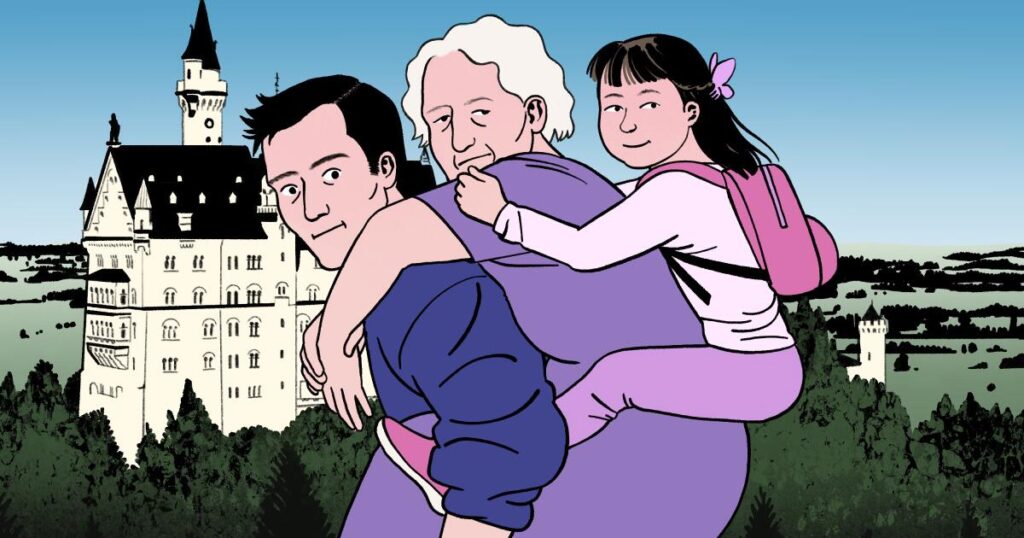
If you’re planning to travel with children and parents this holiday season, may the grace of whatever god you believe in descend upon you with alacrity. May you never grow weary, frustrated or borderline psychotic when your 80-something mom questions your every decision moments after you make it, or when your child loses that wildly overpriced souvenir hours after you finally agree to buy it.
But let’s be real: Being on vacation with a parent and child requires many coping mechanisms that aren’t obvious before you’re deep into the experience. As the sandwich-generation adult responsible for your multigenerational holiday, you need to be part tour director, part therapist and part life coach to everyone counting on you for a vacation of a lifetime.
I know, because earlier this year I spent three weeks in Austria, Switzerland and southern Bavaria with my 81-year-old mother and grade-school daughter. This was a vacation that we’ll each remember, always. It was that good. But it wasn’t easy.
And it required a lot of preparatory work and patience. Here are my Top 10 lessons learned, for anyone who plans to soon or someday travel with a child and an older parent.
No. 1: Think of yourself as an expedition leader and master every logistical detail
For my daughter’s sake, I never left our hotel or Airbnb without a full water bottle and a hard-boiled egg or two from the breakfast buffet. Or a couple oranges or other fruit that wouldn’t get crushed at the bottom of a backpack. Nothing is fun on vacation if your kid gets “hangry.”
The calculation for a parent is different. Because my mom wasn’t interested in managing more than her own aches and pains, I knew I had to be in charge of every move every day, from getting to sites to negotiating purchases to finding places to eat and managing the heat and everyone’s daily moods and energy levels.
No. 2: Create an itinerary that suits your parent’s and child’s needs and personalities
You probably know your parent’s tolerances for everything from how much he or she wants to do to how regularly they need a food or rest break to how much time they need to get up and out the door each day. Some activities that your kid has her heart set on aren’t realistic for an older parent.
In Switzerland, for example, my daughter really, really wanted to go tubing at the top of Jungfraujoch, a massive glacier 10,000 feet above sea level near Interlaken. So she and I trekked to and played in the snow for an hour while my mom had coffee at a glaciertop restaurant.
Similar to how marathoners manage a race, multigenerational family vacations tend to have fast parts and slower parts, based on how draining (or rejuvenating) the previous day was. Monitor parent and child end-of-day energy (or exhaustion) levels. They’re a good indication of how ambitious you should be the following day.
For instance, after a long day of train travel, from Vienna to Interlaken or from Interlaken to Bavaria, I made sure the next day was free of any grand excursion or event. To recharge personal batteries, everyone needs to have their coffees, or play on a playground, or feel the sun on their faces, and spend time not being scheduled.
No. 3: Give your parent and child an idea of what to expect, and ask their opinion
What works for children often works for older parents: Clearly explain well ahead of time what they should expect from the daily vacation experience.
The lovely part of traveling with parents is that, unlike young children, they often have informed, realistic opinions about what they want and don’t want from the experience writ large and on a daily basis. Ask them: What do you want out of this vacation?
For my daughter, who was excited to see Neuschwanstein Castle in Bavaria — the one that is said to have inspired the Disneyworld facsimile — the key piece of advance intelligence I gave her was that we’d be spending three to four hours on our feet with a tour guide.
That helped her pre-set her patience for a lot of continuous listening.
No. 4: Adjust on the fly
As the quote attributed to Mike Tyson goes: Everyone has a plan until they get punched in the nose. On vacation, the punch will be figurative: You miss a train, are too tired to visit that must-see exhibit or natural wonder, or don’t like your hotel or resort as much as you thought you would.
Be willing to adjust your plans based on what will make your parent and child happy and willing to pivot when necessary.
When the June heat in Vienna became a little too much for my mom, we agreed to cut out the walk through an ornate Hapsburg garden and go to lunch somewhere with air-conditioning.
While my mom nursed her post-prandial local beer, my kid and I went for a leisurely stroll through a nearby park. The definition of a vacation win-win.
No. 5: Identify your aging parent’s individual ‘kryptonite’ — e.g., heat, distance, foreign languages or big crowds
For my mom, extreme heat is a major barrier to her ability and desire to venture out of an air-conditioned hotel room. If the temperature is cool, my mom will walk until the hounds of hell stop her, no matter how much pain she’s in; she equates taking a short taxi ride as a moral failure. But if the temperature rises above, say, 75, she wilts within minutes.
So, I checked the weather forecasts and planned strategically.
No. 6: Calibrate daily walking distances and stairs to match your kid’s and parent’s tolerances
Think realistically about exactly how long a walk, how many stairs up and — especially important for older parents! — stairs down.
I carried a small lightweight camping stool in my backpack every day, in case my mom needed to sit with no bench in sight. We used it only once … for my daughter, during the four-hour Bavarian castle tour. (My mom refused to sit down, saying she might not be able to get up again.)
Pro tip: If you’ll be traveling by train, beware the unexpected challenge of many, many stairs at the stations. There may also be stairs up and down a medieval castle tour, where people behind you may grow impatient with an older person’s slow pace. Think about whether to put your parent and child at the back of your tour group during long stair climbs and descents.
No. 7: Diffuse inevitable inter-generational friction and frustration
At some point in your journey, Mom, Dad or child will be as fed up with you as you are with them. Perhaps more so. Usually, it’s the small things that, repeated daily, push family members traveling together to a point of needing to blow off some steam.
Plan regular “steam valve” times when you let your loved ones express whatever is on their mind. (Who knows, maybe it’ll be pure gratitude … but probably it will be a gripe you’re rather familiar with.) It’s like couples therapy sessions, except the “couple” is parent and child on a vacation together. Let them speak their truth, and accept it with a mature, “Thank you for letting me know.”
On our trip, my mom and I made each other howl with laughter by doing imitations of each other. She made fun of my haranguing her for carrying her own luggage off trains, and I poked fun at her for habitually asking whether we were on the right train.
We did this over half-liters of beer, which didn’t hurt.
My daughter added her laugh-out-loud imitations of me being overly bossy or short-tempered, and her grandma’s habit of asking whether we were on the right train and sitting in the right seats.
No. 8: Expect to be exhausted by all the daily planning and guiding
You’re going to be doing the work of two people, caring for your parent and child on a vacation — as well as yourself. That is an hourly emotional and physical load you’ll need to monitor and manage.
Anticipate that tour-leader stress, and give yourself regular off-ramps from it. Maybe it’s a night off that you spend on your own while Dad or Mom stays in the room with your kid, watching cat videos on the iPad. Maybe it’s sleeping in for once, and having morning coffee by yourself.
Like they say on airplanes, put on your own oxygen mask before helping others with theirs.
No. 9: Don’t expect every day to be a thrill or feel like a postcard
Every day of your multigenerational vacation probably won’t be as rejuvenating as you perhaps had hoped. As I told my mom and daughter before our trip: Some days will feel like the best ever; other days not so much. Expect to feel the minor let-downs along with the surprising delights.
No. 10: Offer encouragement regularly (and especially on hard days)
Whether directed at a child or octogenarian parent, a few artfully supportive words from you — “You’re doing such a great job,” “You’re so strong for your age!” or my psy-ops favorite: “Gosh, I think I’m complaining more than either of you are” — will help keep them going through a rough patch.
During the first few days in Vienna, for example, I praised my daughter for holding my mom’s hand while crossing streets or walking over tram tracks. She never missed another opportunity to look out for her Grandma.
Likewise, when my mom’s hip began hurting after two miles of walking, I made the conscious decision to announce, rather loudly on the street, “You’re doing great, Mom!” She said nothing, but I knew she heard me. And she made it back to the hotel.
Think about what words of encouragement from someone else would make you feel great (e.g., “You’re doing an incredible job managing this trip for your mom!”) and do that for them.
And never, ever forget: You’re making big memories for you and your loved ones.
The post How to plan a family vacation with three generations — without going mad appeared first on Los Angeles Times.