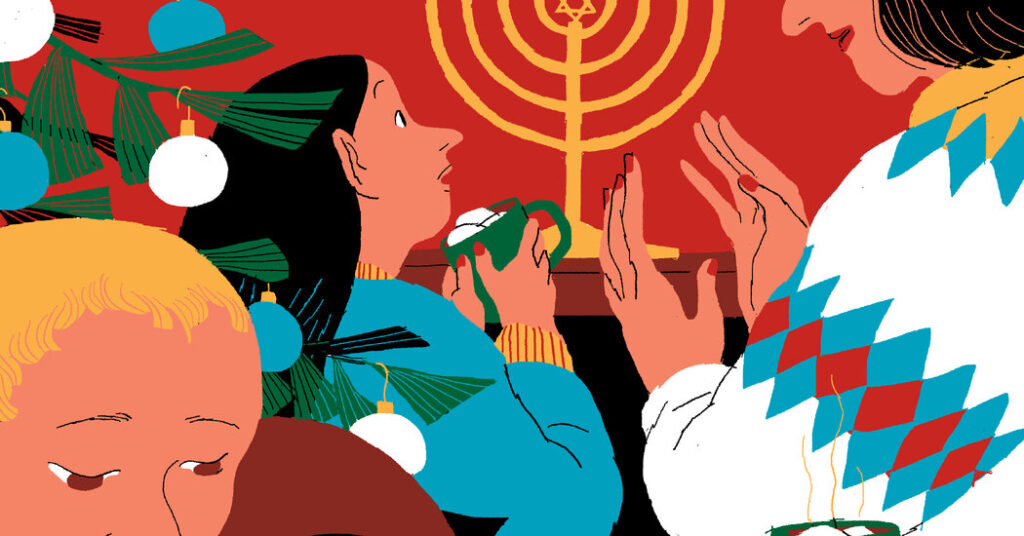
On Sunday night, my family decorated our Christmas tree while “National Lampoon’s Christmas Vacation” played in the background. Earlier in the day, my older daughter was practicing her Torah portion, and my younger daughter was working on a school slide show about the menorah we use every year, which was one of the few things my great-grandmother brought with her when she fled Vienna in the late 1930s.
I surveyed my living room as the movie reached its absurd crescendo, with our twinkling tree, menorah and twerking Christmas cat (don’t ask), I realized that my husband and I had finally integrated our interfaith household in a way that felt satisfying to all of us.
For many years I worried about how we would pass along our religious traditions. I did not want to put my thumb on the scale in favor of Judaism; my family already had home-court advantage since my parents live in New York City and my in-laws don’t, and I was more observant growing up than my husband was.
At the same time, we live in a majority-Christian country, and I knew my children would pick up the rough outlines of Christian ritual without our intervention. I wanted them to know what it meant to be Jewish, but I wanted to impart that in a way that didn’t feel oppressive or a rejection of my husband’s faith.
When our kids were littler, we struggled more with balancing our faiths and our values — their religious knowledge was piecemeal, and sometimes lacked important context. Every family ritual is didactic for the preschool set, and a child’s understanding of something as complicated as belief takes years to blossom. For example, when my older daughter was around 6, she asked me if the nuns in “The Sound of Music” were Jewish because they were working against the Nazis.
For Jews, there’s another layer: Are we a religion, a culture, an ethnicity, a civilization, or all of the above? (A rhetorical question that will absolutely not be resolved by this newsletter).
But as our children matured and became more active participants in our family’s religious observance, blending faiths has become easier, which I hadn’t expected. Our older daughter chose to start attending Hebrew school when she was 10, and has become part of a Jewish community that is welcoming to interfaith families. Her sister is eager to follow in her footsteps.
As my firstborn studies for her bat mitzvah in January, we have been reading passages from the Book of Exodus together. This kind of activity is the backbone of the Judeo-Christian tradition, and it’s not an exercise that we could have shared with any real depth when she was younger.
Putting out the twerking Christmas cat on our fireplace mantle in December isn’t the same as a solemn contemplation of Abraham, Isaac and Jacob, but having silly holiday rituals that we return to year after year, and adding new ones along the way, is something we all look forward to. And it’s the combination of actual religious observance, as well as cherished objects and in-jokes, that borders on magical for us. There is research that suggests that even for secular holidays, family rituals increase enjoyment and feelings of closeness.
When I asked readers for their holiday rituals in a previous newsletter, I loved hearing about all the weird, warm and wonderful ways you were celebrating. Lots of you have a particular movie you rewatch (“Love, Actually,” “The Holiday,” and “The Muppet Christmas Carol” were mentioned). I laughed out loud at this message from Connor Chauveaux, of Opelika, Ala., who told me, “Our rather unusual tradition is that when we decorate the tree, we also watch ‘Silence of the Lambs.’” She reports that she has no idea how this got started but she relishes it nonetheless.
Valerie Hodgskiss of Concord, Calif., has a Christmas Eve tradition that includes church and fondue. “The attendance at church is the ‘gift’ that my kids give me that costs them next to nothing — they are free to arrive there under their own power, in time to sing the carols, and they are free to leave when it’s over. And then we all head home to my house to a late-night dinner that is probably the most relaxed, casual and low-stress gathering I do all year.” She says she cherishes the memories of her four children illuminated by candles at church and dinner all year long.
Many readers had holiday traditions that involved reflecting on the past year together. Ryen Salo of Gladstone, Ore., wrote, “Each year, my mom selects an ornament that embodies something each of our family members were excited about during the year, and gifts it to us on Thanksgiving. For example, when my son was 2, he was really into bubbles, so we now have a bottle of bubbles ornament on our tree.” Salo says that she loves the way her mother is paying such close attention to each family member: “She gives us a way to have a tangible piece of our pasts.”
I hope that as our daughters get older, our holiday traditions continue to evolve. They’ve taught us that we can hold on to those pieces of ritual that are resonant and add elements. As our girls make their own religious connections, they will hopefully learn that they don’t have to abandon any part of themselves for our family to feel whole.
I wish I hadn’t stressed so much about how we were going to make our beliefs cohere when we first became parents. If only I’d had faith in the idea that we’d figure it out together.
End Notes
-
I watched “It’s Never Over, Jeff Buckley,” a documentary about the titular musician who drowned in 1997. The movie, which is now streaming on HBO Max and is considered an Oscar contender this year, explores Buckley’s preternatural talent and creative process, and includes some truly heartbreaking interviews with his mother. I didn’t know very much about him or his music before watching it, though his song “Last Goodbye” was a staple of mixes I made in the early 2000s. Even if you’re not a superfan it’s very much worth watching.
Feel free to drop me a line about anything here.
Each year, The New York Times Communities Fund supports nonprofits. This year, the fund is working with seven organizations that focus on helping people through education, from preschool to vocational training. Donate to the fund here.
The post How My Interfaith Family Figured Out the Holidays appeared first on New York Times.