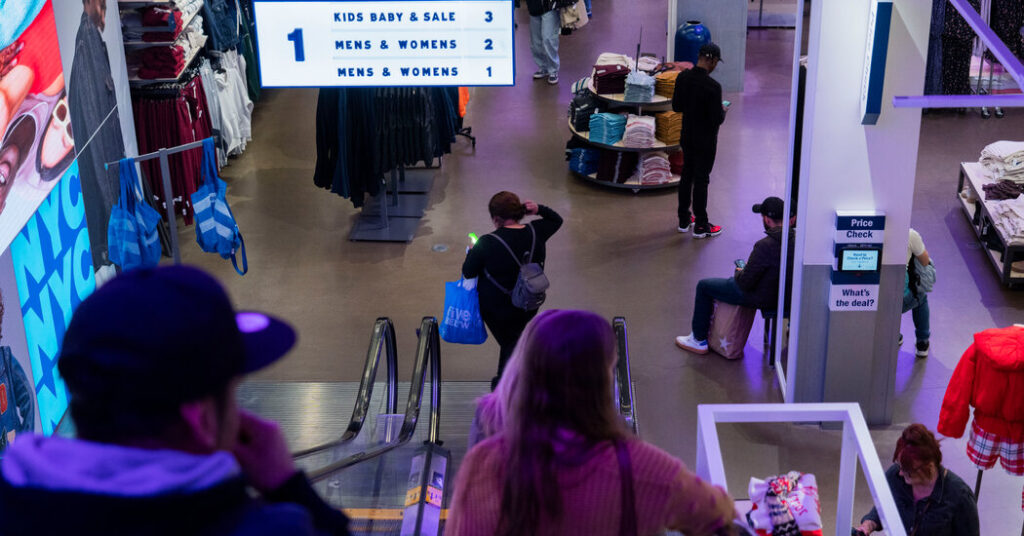
Holiday shopping crowds are back, but the mood this year has shifted.
Low-to-middle-income shoppers are seeking discounts, cutting back on discretionary purchases and turning to value brands at stores like Dollar General and Walmart. While wealthy shoppers are buying luxury brands at Bloomingdale’s, then, across town, those same high earners are sifting through dollar-store aisles for pantry staples.
Confronting an uncertain economy and inflationary pressures, consumers are gravitating toward places that promise what they need most: low prices. And the retailers that can meet them there are reaping the rewards.
“Consumers are eager to find the best deals to wrap up their holiday shopping,” said Natalie Martini, the vice chair and U.S. retail and consumer products sector leader at Deloitte, the consulting firm.
Discount retailers are among the biggest winners. Visits to Walmart, Burlington Stores and Ross Dress for Less have increased this year, according to data from Placer.ai, a data analytics company that tracks foot traffic at stores. Dollar General and Dollar Tree recently reported strong quarterly sales growth, partly driven by high consumer demand for discounted goods.
Both companies said during their recent earnings calls they were drawing in higher-income shoppers hunting for value. Dollar General said the chain saw “disproportionate growth” from wealthier households, while Dollar Tree reported that 60 percent of its three million new customers this quarter earned more than $100,000 annually. Five Below reported double-digit increases in same-store sales, with gains across income levels.
With high costs and economic uncertainty weighing on wallets, shoppers of all stripes are chasing deals. They’re stacking coupons, relying on cash-back plug-ins and using “buy-now-pay-later” services more frequently.
Which is why a record 203 million people shopped over Thanksgiving weekend, searching for the best deals on Black Friday and Cyber Monday, according to the National Retail Federation. More than $44 billion was spent online from Thanksgiving through Cyber Monday, up about 8 percent from last year, according to data from Adobe Analytics.
But the search for discounts isn’t just about holiday gifting. It’s a sign of strain.
While value stores are packed, upscale retailers are holding their own because the country’s wealthiest households continue to spend freely. The top 10 percent of households in the United States account for nearly half of all spending, according to Moody’s Analytics.
Macy’s raised its sales forecast after a strong quarter led by its higher-end store Bloomingdale’s, where sales jumped nearly 9 percent on the strength of luxury brands. Walmart, too, is benefiting from higher-income shoppers trading down for groceries and essentials.
Kailyn Rhone is a Times business reporter and the 2025 David Carr fellow.
The post Holiday Spending Shows Effects of an Uneven Economy appeared first on New York Times.