Josh Shapiro and Spencer Cox know firsthand what happens when political violence comes home.
Shapiro, Pennsylvania’s Democratic governor who is widely expected to run for president in 2028, was asleep with his family when an arsonist set fire to their home. Cox, Utah’s Republican governor, was one of few voices who called for calm and “moral clarity” after the right-wing activist Charlie Kirk was fatally shot onstage at Utah Valley University in September.
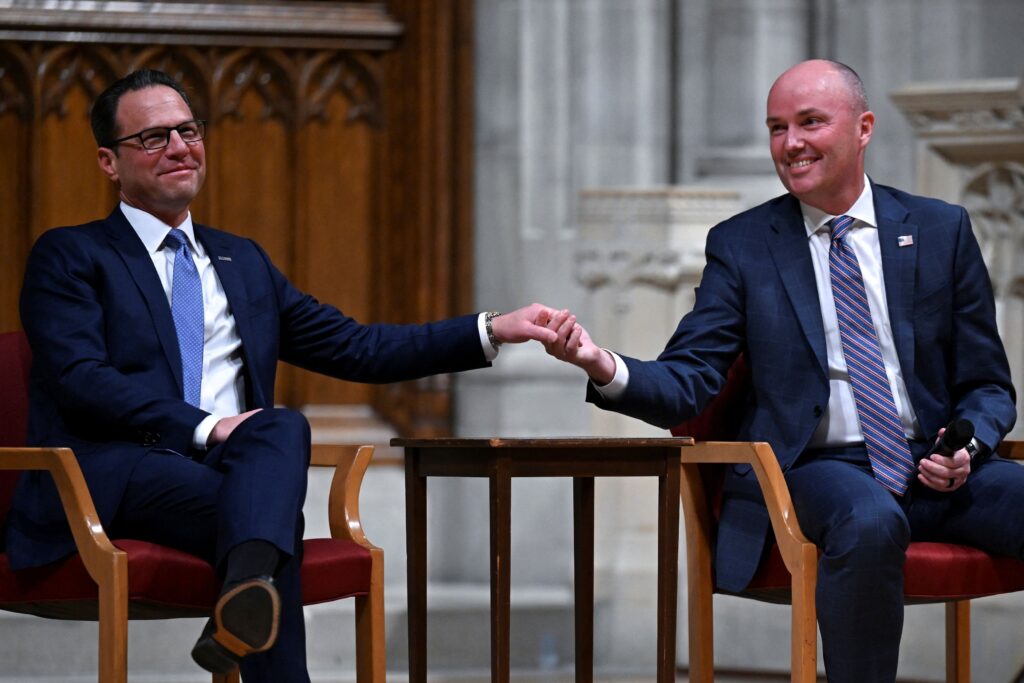
The two spoke together about rising political violence Tuesday at Washington National Cathedral, a rare bipartisan event in a deeply polarized country. Both criticized their parties for not doing enough to cool partisan tensions and condemn political violence when it impacts their opponents.
“Seventy percent of Americans hate what’s happening in politics right now. They’re desperate for something different,” Cox said, growing impassioned. “And yes, you can point to the president, but I’m just here to tell you that neither party is interested in addressing that market failure right now.”
Cox added: “Until one of these parties decides we’re going to do something different, that we’re going to go back to treating each other with dignity and respect … then we’re never going to get out of this.”
The event comes after two especially violent years in politics that have forced many lawmakers to rethink their security and confront new fears about their safety. President Donald Trump faced two attempted assassinations on the campaign trail last year, and two Democratic Minnesota lawmakers were gunned down in their homes with their spouses in June.
As the two governors credited each other with trying to lower the temperature and bridge divides in an increasingly acrimonious political environment, they were interrupted at least four times by protesters, some of whom condemned U.S. support of Israel’s war in Gaza. Shapiro said political leaders need to offer principled leadership when violent incidents happen, arguing that Trump has inflamed divisions.
“We need to begin by saying that all leaders must condemn all political violence — not cherry-pick which violence to condemn and which violence to accept,” Shapiro said. “When you’re a governor, when you’re a president of the United States, you are looked to for that moral clarity. And we have a president of the United States right now that fails that test on a daily basis.”
Cox recounted how Shapiro was the first person to call him after Kirk’s assassination in his home state. He said Shapiro gave him advice that changed what he ended up saying the first time he delivered televised remarks about Kirk’s killing, after the Pennsylvania governor urged him to “speak with moral clarity and speak from the heart.”
“In that moment, we were two Americans who were deeply saddened and struggling, and I’m grateful there’s somebody I can trust, even though we disagree on a lot of things,” Cox said.
Cox brought yet another example of the topic to Tuesday’s event, adding that a man was arrested in Utah two days ago because he said he wanted to shoot the governor in the head. “We agree on this,” he said of Shapiro’s condemnation of such violence.
Cox’s remarks after the Kirk assassination stood out. He was one of the few Republicans of prominence to urge Americans to find common ground with each other and respectfully disagree, rather than jump to conclusions about motive. That stood in stark contrast to Trump and other prominent Republicans, who blamed “radical left” rhetoric for Kirk’s death and vowed vengeance.
Shapiro struck a similar tone after a gunman opened fire during a Trump rally in Butler, Pennsylvania, in July 2024, appealing for more peaceful political discourse from both parties. He said Cox’s remarks after Kirk’s assassination, in addition to his personal experience, have forced him to speak more directly about the dangers of the current political environment.
“I never looked to myself to being any sort of expert on political violence or frankly needing to engage in a national conversation about political violence until I saw Spencer Cox in the wake of the killing of Charlie Kirk handle that matter in the way that he did,” Shapiro said.
An arsonist, Cody Balmer, broke into the governor’s residence in April and firebombed the dining room where Shapiro had hours earlier hosted a Passover seder. Balmer told police he “harbored hatred” for the governor and wanted to bludgeon him with a sledgehammer. Balmer, who pleaded guilty to attempted murder and other offenses, also referenced what Shapiro “wants to do to the Palestinian people” as motivation for the attack, although it is unclear what specifically he was referring to. Shapiro, who is Jewish, is a longtime supporter of Israel.
Shapiro, who is up for reelection in 2026, has spent his political career pitching his broad appeal as a centrist Democrat who can work with Republicans. He beat his Republican opponent in the 2022 gubernatorial race by 15 percentage points — a huge victory in a key battleground state that Trump won twice, in 2016 and 2024.
Cox has had a complicated relationship with Trump, serving as one of the few and most high-profile Republicans willing to criticize the president. He said he did not vote for the president in 2016 and 2020 and initially withheld his endorsement in 2024 because of Trump’s role in inciting the Jan. 6, 2021, Capitol riots. He endorsed Trump after the attempted assassination in Butler, but has continued to call for the president to help calm the political environment.
“It’s harder for us to come on a stage like this, even though we do have amazing security and we appreciate that it’s there. It’s always in the back of your mind, right?” Cox said. “And so if some people now won’t go to a college campus where a rally is happening because of what happened [at Utah Valley University], then we’ve lost a piece of what makes us American.”
The post Governors cross aisle to call for ‘moral clarity’ amid political violence appeared first on Washington Post.