Earlier this year, the National Academies of Sciences, Engineering and Medicine issued a warning about the dangers of misinformation. Social media platforms are now rife with scientific falsehoods — that the Earth is flat, that climate change is a hoax, and so on. Misinformation can lead to large-scale harm, undermining public health and the well-being of the planet, the authors of the National Academies report said.
“The stakes in understanding the origins, spread, and the impact of misinformation about science are high,” they warned.
For some fresh inspiration, misinformation experts can look beyond our species. That’s the advice from a team of Cornell researchers writing on Wednesday in the journal Interface. It’s not just humans who suffer from the effects of misinformation. So do fish, flies and even bacteria.
“I hope we can learn something from these natural systems,” said Andrew Hein, a computational biologist and an author of the new study.
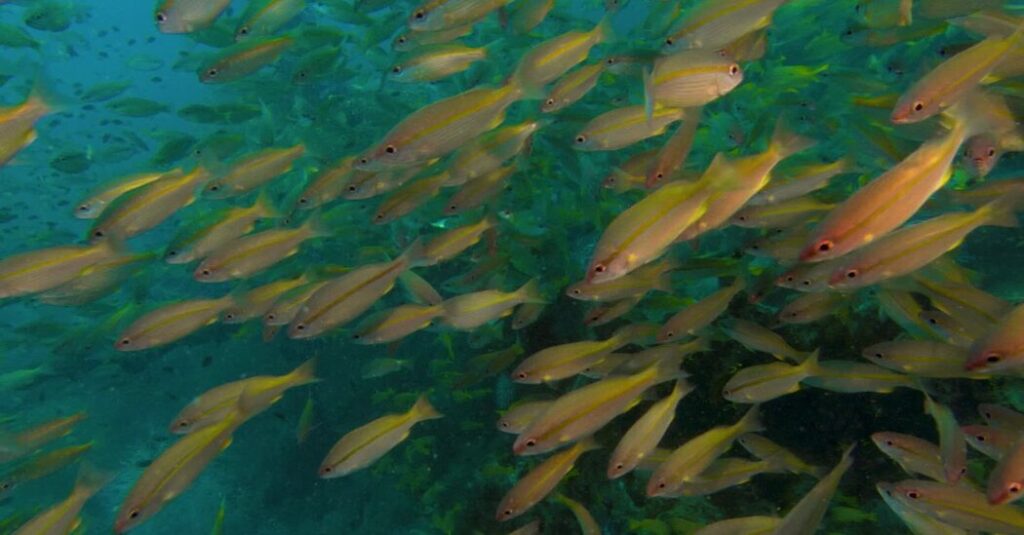
Dr. Hein was drawn to the natural history of misinformation through his research on fish. He and his colleagues observed the movements of schools swimming around the coral reefs off the French Polynesian island of Mo’orea.
By staying in large groups, the fish enjoyed advantages that they lacked on their own. For instance, they could collectively stay alert for predators. When one fish noticed a threat, it darted in a new direction. That information quickly spread through the whole school, which could then escape together.
But Dr. Hein was struck by how often a fish got things wrong. “It’s safe, there’s nothing going on,” he said. “But all of a sudden, it will just flee for its life.”
He then observed how other fish noticed the fish fleeing for no reason, and fled as well. Soon numerous animals were trying to escape together, from nothing.
The observation made Dr. Hein think about all the research on the ways misinformation spreads over the internet. “It just clicked in my mind that that’s what we’re seeing here,” he said. “We’re seeing misinformation cascades happening.”
Dr. Hein and his colleagues went on to survey misinformation cascades among other species. Animals that live in big groups, from baboons to termites, are constantly communicating information to each other — creating the potential for misinformation to creep in.
But animals are not the only organisms that exchange information. Bacteria send signals to each other about their environment, using the information to mount collective defenses against attacks. Inside our bodies, the cells of our immune system stay in constant communication as they ward off diseases.
Yet relatively few researchers have investigated how information in the natural world can turn into misinformation. “It’s a really hard thing to study,” Dr. Hein said. “You can’t ask a bacterium, ‘Did you believe what this other bacterium told you or not?’”
Adding to the challenge is the fact that bacteria and other species live in big social networks. Information flowing through these societies can get distorted along the way.
In their new study, Dr. Hein and his colleagues developed mathematical models for investigating disinformation in any species. Researchers can use them to estimate the accuracy of an organism’s beliefs and the extent to which information from other organisms changes their beliefs.
Exploring these models, Dr. Hein and his colleagues came to the conclusion that misinformation is probably fundamental to all communication systems in the natural world. And it’s a potent threat to their survival.
Previously, some biologists looked at misinformation as a minor nuisance. If a fish darts away for no reason, it loses some time it could have spent eating. But that’s a small cost, outweighed by the benefit of being able to escape predators.
But Dr. Hein argues that overly skittish fish, reacting to too many false alarms, can risk their survival. “The cost isn’t missing one lunch,” Dr. Hein said. “It’s missing all lunches.”
Walter Quattrociocchi, a data scientist at Sapienza University of Rome, who was not involved in the study, agreed.
“It shows that misinformation is not an anomaly or a moral failure, but a structural consequence of communication systems operating under noise, limited context and imperfect decoding,” he said.
The threat of misinformation has led to the evolution of defenses against it. Those defenses may be so effective that they mask the true threat that misinformation poses in the natural world.
In his own research on fish, Dr. Hein found one strategy for stopping misinformation. When the animals swim in small groups, they are keenly sensitive to the movements of the fish around them. But in bigger groups, their brains dial back that sensitivity. It takes the movement of many more fish to get them moving.
This strategy doesn’t eliminate false alarms, Dr. Hein observed. But it does limit their size; the false alarms die out before they can take over an entire school.
“I suspect that there have to be lots of mechanisms for dealing with misinformation in these social systems,” Dr. Hein said. “Otherwise they just would not be able to persist.”
Cailin O’Connor, a misinformation expert at the University of California, Irvine, who was not involved in the new study, said the models that Dr. Hein and his colleagues offered were too simple to capture the complex effects of misinformation.
A single piece of information can affect more than one belief at a time, for example. “If you’re going to say, ‘This piece of information, in a biological sense, is misinformation,’ you’re going to need something more complicated,” Dr. O’Connor said.
Building more complex models of misinformation will be difficult at a moment when the field of research itself is under fire. The Trump administration has accused misinformation researchers of simply wanting to censor free speech. It has canceled grants for ongoing research into misinformation and blocked visas for foreign misinformation researchers coming to work in the United States.
That disruption hit misinformation researchers even as they were fiercely debating the nature of misinformation in society. Some researchers argued that fake news did not represent the biggest threat to society; more concerning was information that was narrowly true but which left a misleading impression.
Without a consensus about what defines misinformation, effective solutions will be hard to come by. Nature might offer some inspiration, Dr. O’Connor said. Too often, she said, researchers think the solution is simply to help people become better judges of what they see online.
“Stop trying to make people smart,” she said. “We’re only going to get so good. What we really need are good algorithms.”
Fish don’t deal with misinformation by getting smart; they don’t fact-check each signal they receive from other fish. Instead, they adjust their sensitivity to any information, true or false.
“We clearly need more ideas for how to cope with this problem as a social species,” Dr. Hein said. “Maybe it’s possible to find some if we look at other species.”
Carl Zimmer covers news about science for The Times and writes the Origins column.
The post For Real, a Natural History of Misinformation appeared first on New York Times.