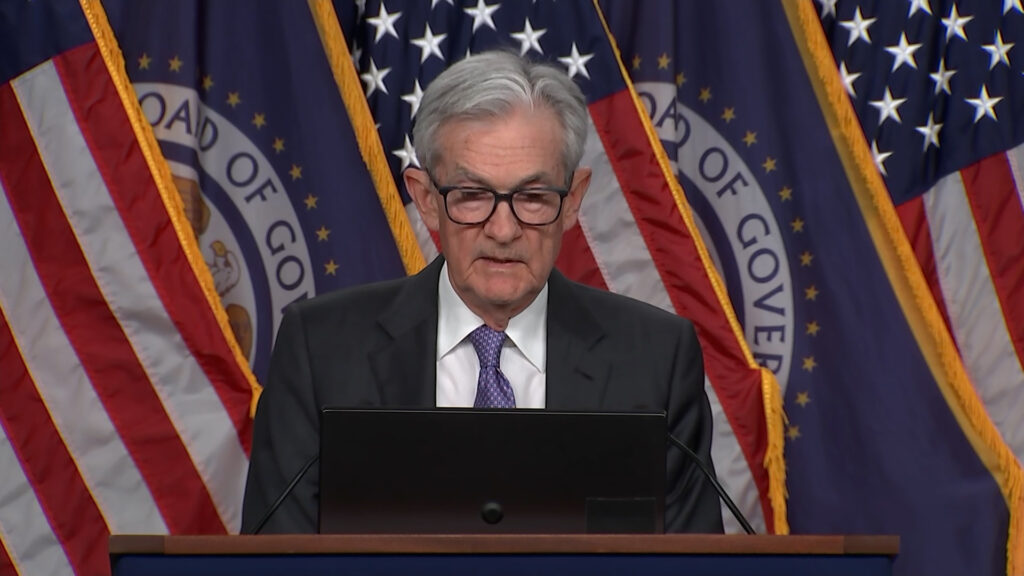
The Federal Reserve cut interest rates by a quarter of a percentage point on Wednesday for the third time this year, seeking to shore up a softening labor market even as inflation builds and leaving the prospect of more cuts next year unclear.
“It’s a labor market that seems to have significant downside risks,” Fed Chair Jerome H. Powell said at a news conference following the meeting.
Though Fed officials tentatively penciled in at least one more rate cut before the end of next year, estimates about where the economy is heading varied significantly and Powell suggested the central bank might wait before returning to any additional cuts.
“We are well positioned to wait and see how the economy evolves from here,” he said.
Wednesday’s widely expected move lowers the Fed’s benchmark rate to a range of 3.5 to 3.75 percent, the lowest level in about three years. But officials remain sharply divided over how to respond to an economy sending mixed signals: Inflation remains above the Fed’s target, which would typically argue for holding rates steady, while slower hiring and a modest uptick in unemployment suggest a case for easing.
Investors cheered the news, with major financial indexes ending the day higher on Wednesday afternoon.
Nine Federal Reserve officials backed Wednesday’s cut while three dissented. Two officials — Chicago Fed President Austan Goolsbee and Kansas City Fed President Jeffrey Schmid — favored no rate reduction, while Fed governor Stephen Miran preferred a larger, half-point cut. It was the most dissent since September 2019.
In another sign of division among top Fed officials, the latest economic projections also released on Wednesday showed seven officials penciled in no additional cuts next year, while 12 favored at least one or more.
Fed policies influence what households and businesses pay for mortgages, credit cards and other loans, and investors are watching closely for guidance on the central bank’s next steps.
The Fed’s job is to keep prices stable and to maximize employment, but it is split on how to navigate what some describe as a light version of stagflation — elevated inflation alongside a labor market that is slowing but far from collapsing. Those divides were exposed at the Fed’s last gathering in October, where officials expressed “strongly differing views about what policy decision would most likely be appropriate,” according to the meeting minutes.
Further complicating the decision, the Fed received far less official data about the health of the economy because of the government shutdown that delayed or canceled the release of reports on the jobs market and consumer prices. Some Fed officials, relying on alternative data or surveys of the business community, argued that progress on inflation had stalled and warned that cuts risked undermining hard-won gains. Others countered that rising unemployment and weakening consumer demand suggested a need for action.
Powell defended cutting rates now rather than waiting for the Fed’s next meeting in late January, when officials will finally have a better sense of the status of economy thanks to a trove of upcoming official reports. Wednesday’s call reflected mounting evidence of a cooling job market, he noted, saying that after readjustments and revisions, job growth may have been slightly negative since spring.
“I think you can say that the labor market has continued to cool gradually, maybe just a touch more gradually than we thought,” Powell said.
With unemployment rising to 4.4 percent in September, the Fed no longer characterized that rate as “low,” in a statement announcing the rate cut.
Former Philadelphia Fed president Patrick Harker said this week that Wednesday’s move is shaping up to be a “hawkish cut” — a rate reduction paired with a signal that policymakers may soon pause further easing. Harker said the Fed’s internal divergence reflects an unusual degree of economic “fog,” with inflation not worsening as much as feared, unemployment claims relatively stable and labor-market signals increasingly difficult to interpret. He noted that monthly job gains below 100,000 would normally be a red flag, but demographic trends and uncertain immigration patterns complicate the baseline.
Those disagreements are unfolding amid unprecedented political pressure from President Donald Trump, who has repeatedly criticized the Fed for not moving quickly enough to lower rates and has threatened to fire Powell. Trump renewed those attacks ahead of this week’s meeting, telling Politico that support for aggressive rate cuts is a litmus test for whoever he taps to succeed Powell, whose term as chair expires in May. The president plans to nominate a successor early next year, though he has already signaled he knows who he is likely to pick.
Patrick J. Toomey, the former senator from Pennsylvania who was top Republican on the Senate Banking Committee, said he is perplexed by Trump’s push for cuts because inflation remains above target and the broader economy continues to expand. The data shows cooling — not collapsing — labor conditions, which wouldn’t normally justify an urgent push for easing rates, Toomey said.
Toomey warned that the president is taking a much bigger political gamble than he appears to realize. If inflation were to spike again, he said, Trump would “completely own” the fallout after pressuring the Fed when “there’s no obvious need to ease.” That makes the campaign for faster rate cuts “surprising,” Toomey said.
Though Powell secured enough board support to approve Wednesday’s cut, future easing would depend on keeping that alliance.
The split appears to pit a “hawkish” coalition of regional Fed presidents focused on preventing inflation from resurging against a group of governors in Washington who see the greater risk in a softening economy. Officials such as Cleveland Fed President Beth Hammack, who said she would have preferred not to cut rates in October, have argued that inflation remains stubbornly above the bank’s 2 percent target and warned that reducing rates too soon could keep prices rising.
Meanwhile, other officials continue to emphasize that a cooling labor market and softening consumer demand call for cuts, to ensure the economy does not slip further.
The post Fed lowers interest rates again amid debate over inflation, jobs appeared first on Washington Post.