The events of the past week have hammered home an uncomfortable truth for European leaders. Despite their best efforts, the heads of Europe’s most powerful governments have little to no sway with the most powerful person on the planet, U.S. President Donald Trump.
[time-brightcove not-tgx=”true”]
This grim reality is particularly unwelcome right now, as the White House seems intent to impose a peace deal on Ukraine that Trump hopes will end the largest land war in Europe since World War II.
For Europeans, the latest peace proposal is an unconscionable capitulation to Vladimir Putin, rewarding him for invading a neighboring country. Trump’s plan would see more Ukrainian land than Russia currently occupies handed to Putin. It would require Ukraine to effectively rewrite the country’s constitution, prohibiting it from joining NATO in exchange for vague security guarantees, should Putin decide he wants to take another bite of the cherry. For Ukraine and those who back it, it is utterly unpalatable.
Read More: Trump’s Peace Plan Is a Wake-up Call for Europe
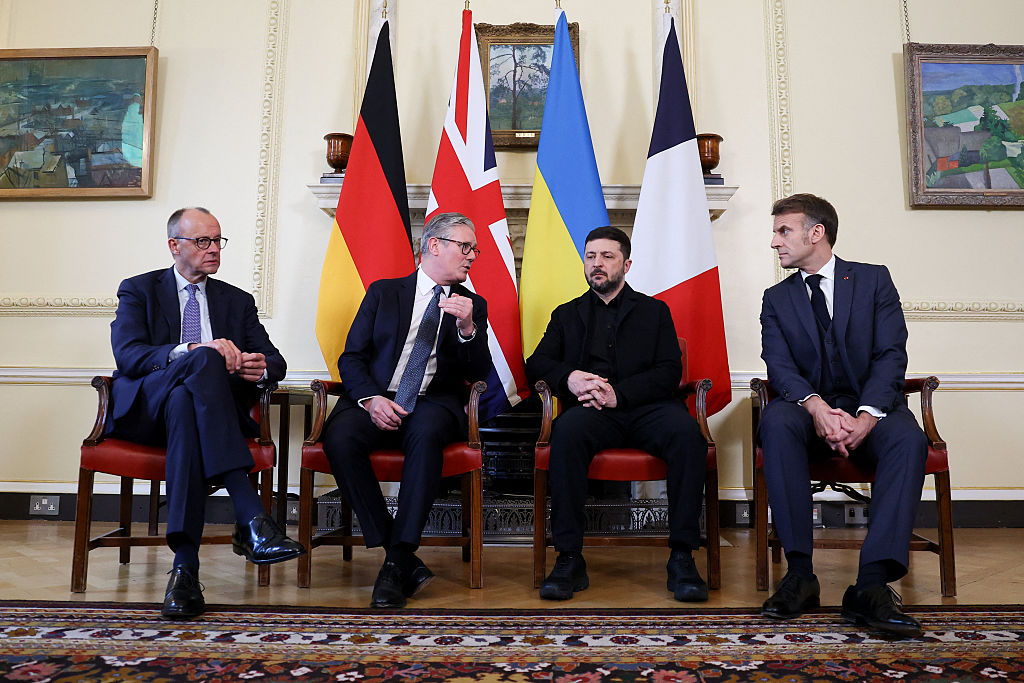
Earlier this week, the leaders of the U.K., France, and Germany met in London with Ukraine’s Volodymyr Zelensky to discuss a number of issues, most notably the release €210 billion in frozen Russian assets and how best to counter Trump’s demands. German Chancellor Friedrich Merz made the most gentle criticism of Trump’s plan, saying: “I’m skeptical about some of the details which we are seeing in the documents coming from U.S. side. That’s why we are here.”
We don’t know whether or not Trump saw these comments, but the U.S. President made his position on Europe and Ukraine perfectly clear on Tuesday morning via an interview with Politico. Trump accused Europe of talking “too much” and not delivering anything. He said that Putin has the “upper hand” and that Zelensky must “get on the ball and start … accepting things,” presumably a reference to the Russia-friendly plan.
Trump’s words will have stung for two reasons.
First, he has largely carved Europeans out of the Ukraine peace process—despite the war’s outcome mattering more to Europe than America—by negotiating over their heads directly with the Kremlin. When you couple that with the growing contempt Trump seemingly has for Ukraine and Europe, as was evident in his Administration’s recently published National Security Strategy, the continent looks completely out of the picture on decisions being made over its own future at the most tumultuous period in its post-war history.
Second, there is very little Europeans can do to push back at Trump. European allies are ramping up defense spending and intensifying their focus on continental security, but are still utterly reliant on the U.S. security umbrella. The U.S. outstrips every other NATO ally in every meaningful metric. The U.S. has the largest army, makes more weapons, uses more sophisticated equipment, and has better intelligence than everyone else to the point it’s almost embarrassing.
This, naturally, affects Europe’s ability to support Ukraine. Even if Europe manages to plug the enormous hole left in Ukraine’s funding since Trump took office, it still needs U.S. equipment and weapons. Even as Europe buys those items for the Ukrainians, a mercurial Trump can still ban Kyiv from using them at any time. The Trump Administration has suspended and resumed U.S. intelligence with Ukraine before. Without U.S. intelligence locating strategic targets inside Russia and warning of incoming aerial attacks, Ukraine’s job of defending itself becomes much harder.
A time may come in the future when Europe has built up a defense industrial complex, armed forces, and security capabilities that mean it is no longer reliant on the U.S. But the threat from Russia is here right now. If Ukraine is forced into a bad deal, Putin’s power within Europe will undoubtedly grow. That would further embolden Russia as it already uses hybrid warfare to test European allies. That is why Ukraine’s fate is so important.
For now, Europe’s leaders face the enormous challenge of propping up Ukraine while keeping Trump onside at a time when he seems closer to Russia’s way of thinking than ever. Russia went so far as praising Trump’s National Security Strategy, saying it was “largely consistent with our vision.”
Read More: The Man Who Wants to Save NATO
For those who need reminding, that document lays bare the U.S. Administration’s view that European nations are on an economic and military path to no longer being “reliable allies,” while promoting “strategic stability” with Russia.
These are terrifying times for Europe. Between the frontline pressures in Ukraine, Russian incursions into European airspace, and the White House warming to the Kremlin, the only option leaders now have is to ride two horses at once, hoping they don’t get bucked off. Europe’s fate is no longer in its own hands.
The post Europe Has Lost Trump’s Ear on Ukraine appeared first on TIME.