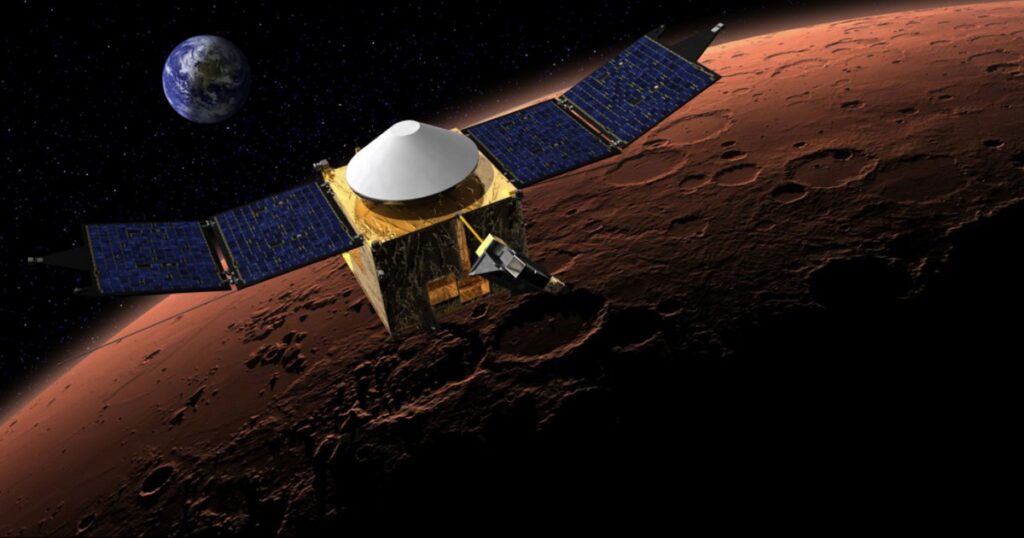
There are currently seven spacecraft orbiting Mars, three of which belong to NASA. They’re designed to study the hostile planet’s geology, atmosphere, and radiation, while also supporting missions on the surface from just over 100 to tens of thousands of miles away.
But keeping up with spacecraft across a vast distance of tens of millions of miles is no easy feat. Case in point: in a Tuesday update, NASA admitted that it had lost signal of its MAVEN (Mars Atmosphere and Volatile EvolutioN) spacecraft.
It was expected to send telemetry back to Earth on December 6, but it was never picked up by NASA’s Deep Space Network, a global system of massive radio antennas built to keep in touch with interplanetary spacecraft.
“The spacecraft and operations teams are investigating the anomaly to address the situation,” the agency wrote.
The Maven spacecraft launched in late 2013 and arrived at the Red Planet roughly a year later. It’s designed to study the Martian upper atmosphere and how particles from the Sun interact with it.
It also has the extremely important task of relaying communications between missions on the Martian surface and Earth. As Scientific American points out, it’s one of four spacecraft that do this job, alongside the European Space Agency’s Exomars Trace Orbiter, and NASA’s Mars Reconnaissance Orbiter and Mars Odyssey.
Worse yet, MAVEN is technically the youngest out of the four, raising the possibility of more trouble for NASA ahead.
A new Red Planet orbiter, called the Mars Telecommunications Orbiter, designed to provide next-generation communications with Mars, was recently revived in president Donald Trump’s “Big, Beautiful Bill” act, which allocated it a budget of $700 million. However, it’s unclear when the project will launch, let alone wrap up development.
It’s not the first time MAVEN has failed to phone home. In 2022, the spacecraft spent three months in safe mode after its Inertial Measurement Units (IMUs), which are critical sensors for keeping orientation in space, “began exhibiting anomalous behavior,” per NASA. The team “switched the spacecraft to rely on stellar navigation instead of the IMUs,” allowing MAVEN to be taken out of safe mode.
For now, we’ll have to be patient and wait for further updates.
“More information will be shared once it becomes available,” NASA promised in its latest updates.
More on MAVEN: Mars’ Magnetosphere Suddenly Tripled in Size Last Christmas Day
The post A NASA Spacecraft Orbiting Mars Just Mysteriously Went Offline appeared first on Futurism.