In February 1941, The Chicago Tribune announced the arrival of the year’s cinematic “Cinderella Girl”: another actress freshly plucked from the wholesome shadow of obscurity — in this case Lake Placid, N.Y. — by an enterprising producer who knew a star when he saw one. The game, the paper said, was to find someone striking, not just beautiful; an ability to act “couldn’t hurt.” This particular Cinderella had been scouted before, signed up for acting classes and taught to “enter a room with a book on her head, walk down steps with her chin up and talk in time with a metronome.” After she was officially “discovered,” she was run through the Hollywood gantlet, with tabloids speculating about her marriage and the odds of her signature vampish locks achieving the 1940s equivalent of virality. There was also the matter of her name. She needed something more glamorous than the one she was born with (Constance Ockelman) and less girl-detective than the one she’d been using (Constance Keane). The producer said her eyes were “calm and blue like a lake,” and just looking at her shiny, swooping hair gave you a “cool feeling” — so he rechristened her Veronica Lake.
Lake was just one of many stars to be reverse-engineered by Hollywood in this way. Actors had their hair dyed, their manners and accents retrained, their names and stories and even ethnicities rewritten. This wasn’t just a matter of Norma Jeane Mortensons becoming Marilyn Monroes. One studio head, hoping to transform the South Asian actress Merle Oberon into an Anglophile’s upper-crust dream, had her bleach her skin. Around the same time, a dancer named Margarita Cansino was undergoing painful electrolysis to alter her hairline; her dark curls were dyed a fiery auburn and her name Americanized to Rita Hayworth. Others were made more exotic — like the big-band singer Mary Slaton, who became Dorothy Lamour, wrapped in sarongs and starring in “Jungle Princess” and “Moon Over Burma.”
The entertainment industry’s irrepressible impulse is not just to produce movies or television or pop songs. It is also to produce people — especially women. The industry determines, through some combination of data and vibe-divination, which kinds of humans the public will most eagerly slap down cash to see. Then it finds a way to supply them.
Elsewhere she tends to be received as a kind of Wagnerian uber-babe.
It was probably inevitable, then, that our first artificial-intelligence performers would take the form of the ingénue. This fall, a Dutch producer named Eline van der Velden claimed that high-profile talent agencies were interested in her A.I. creation, an “actress” called Tilly Norwood. (She might have been better off with the kind of free-association naming process that produced “Veronica Lake.”) Norwood is far from the first artificial young woman built to entertain you; she is part of a lineage that includes digital pop stars like Hatsune Miku and “virtual” social media figures like Lil Miquela. Most of those projects have been treated as banal novelties, but A.I.’s encroachment on creative work is now less of a laughing matter, and real actors were quick to denounce Norwood. Emily Blunt called the idea “terrifying.” Whoopi Goldberg called it “scary.” The SAG-AFTRA union said Norwood wasn’t an actor at all: “It has no life experience to draw from.”
Still, A.I. does seem like one natural path for an industry that has long sought to mold young women — pinching and prodding, bleaching and teaching — into whatever make and model of femininity the public desires. Moviegoers may not want to watch digital faces imitate emotion and feign personality, but Hollywood’s history makes it easy enough to imagine a future in which we do it anyway. Look past the obvious cinematic time and money savers of A.I., like filling in crowd scenes or ginning up B-roll; just imagine the convenience of not needing to find and change real people! Why bother figuring out whom the glass slipper fits when you can build Cinderella from scratch?
Two months before Tilly Norwood’s debut at a conference in Zurich, the clothing retailer American Eagle released a fall denim campaign that memorably exploded internet discourse — the one featuring the “Euphoria” actress Sydney Sweeney, Veronica Lake’s successor in bombshelldom. Sweeney is fair-skinned, blond-haired and blue-eyed; she still plays a teenager on TV, but elsewhere she tends to be received as a sort of Wagnerian uber-babe. The ads showed her peering under the hood of a Mustang or pawing seductively at herself, but the endless online discourse was sparked by her monologue, which seemed written by a high school biology student: “Genes are passed down from parents to offspring, often determining traits like hair color, personality and even eye color.” A male narrator helpfully informed the viewer that “Sydney Sweeney has great jeans.”
The culture-war hooks were obvious. Some people lamented that the ads had racist or eugenicist undertones; others cheered what they saw as the birth of an anti-woke pinup girl. (When a GQ interviewer asked Sweeney to discuss the implications of the ads, her answer did not sound entirely unlike A.I.: “I think that when I have an issue that I want to speak about, people will hear.”) Barrels of ink were spilled in trying to articulate what, exactly, Sweeney represented, and one common theory was that she signaled the return of a red-blooded American male gaze — a country remembering, both culturally and politically, that it likes old cars and young blondes, not fretting about chauvinism.
Both sides of the debate seemed to take for granted that the actress was being deployed mostly as an idea, the epitome of a product viewers desired. But American Eagle’s gag only worked because Sweeney is in fact a human, with actual genes and personality — not just her Aryan sheen, but also any number of mannerisms that an A.I. would be unlikely to assign to a digital ingénue, like her apathetic smirk, dark eye-rolling and air of smug ennui. Such idiosyncrasies are entirely absent from Norwood’s toolbox, as made clear when her creators released their own take on the American Eagle ads. In that version, Norwood has exactly the bright, bland, eager-to-please affect you’d expect. “Genes are passed down from parents to offspring,” she repeats — but “not mine. I’m built on everything that came before me.” She mimics the way Sweeney fingers the fly of her jeans; her top is unbuttoned to show a poreless midriff; there’s a robotic attempt at a come-hither look. The buttons are convincing, and the jeans look like jeans — but the character, the Sweeney, is gone.
It turns out that even when we think of an actress as the product of libidinous market forces — a product crafted, with great effort, by an industry scrambling to provide what we want — she still exerts her human life force on each role. More than in almost any other art, A.I. acting reminds us of its own shortcomings. If anything, it makes you crave more of the grit and quirk found even in the beefcakes and the bombshells we see as pure Hollywood constructs.
It could be that a future awash in A.I. slop leads us to seek out and defend flashes of humanity, thrilling at all the unlikely quirks that make stars themselves: Emily Blunt’s eloquent eyebrows, Whoopi’s rasp, all the things a machine can imitate but would almost certainly not invent. It could also be that an A.I. future just lowers our standards until we’re pleased with even the most meager scraps of soul. For now, though, it can make you wonder how much Hollywood’s star-molding ever mattered in the first place — how much Constance Ockelman was always the crucial thing beneath the surface of Veronica Lake.
Jane Ackermann is a research editor at the magazine and a former actor.
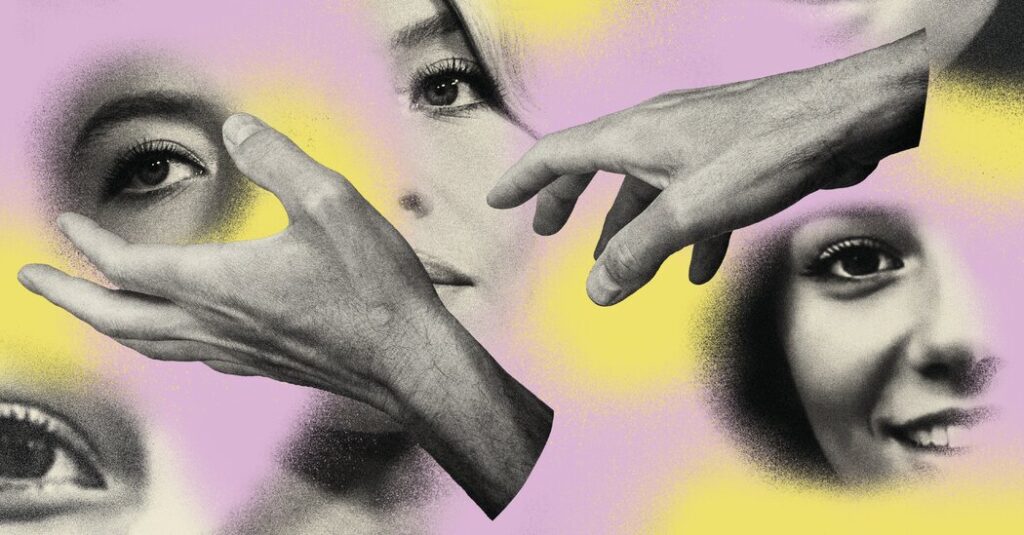
Source photographs for illustration above: Gilbert FloreVariety, via Getty Images; Valiantsin Suprunovich/istock, via Getty Images; screenshot from Instagram.
The post A.I. Actors Might Change Your View of Human Ones appeared first on New York Times.