This personal reflection is part of a series called Turning Points, in which writers explore what critical moments from this year might mean for the year ahead. You can read more by visiting the Turning Points series page.
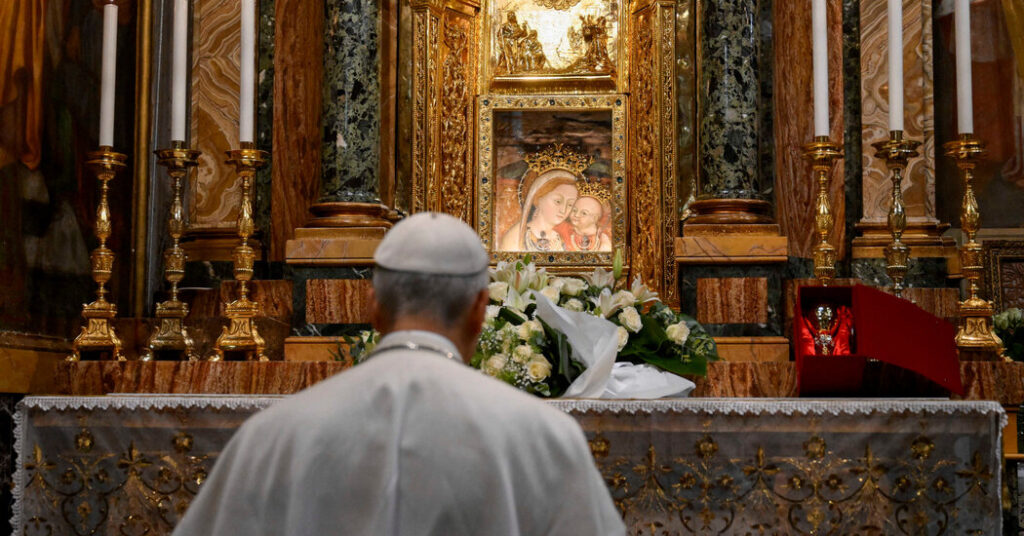
Turning Point: In May, Cardinal Robert Francis Prevost, who chose the name Leo XIV, was elected the 267th pope of the Roman Catholic Church.
In Rome, under frescoed ceilings, executives from Google, Meta, OpenAI and Anthropic sat not with regulators, but with priests. They had come to the Vatican’s Conference on Artificial Intelligence in June. To most, it looked like optics. But after 15 years of working at the intersection of security, health and development, I saw something else: Even the architects of our future were looking for meaning.
During the Covid-19 pandemic, when some public health systems collapsed, it was not algorithms that saved us. In Michigan, mosque parking lots became drive-through vaccination sites. In rural Alabama, a Baptist church hung a sign that read: “Free Testing, All Welcome.” Faith leaders from Nigeria to South Dakota helped overcome vaccine hesitancy where government messaging failed (or was deliberately obscured). These acts weren’t stopgaps; they reveal something deeper about how humans navigate crisis and uncertainty.
In the West, the decline of formal religious affiliation has not just been about the erosion of belief. It also has been about the erosion of anchor points. Faith once offered purpose, rituals and communities that cut across many divides. Without those shared touchstones, people are left navigating uncertainty without a compass.
For me, faith is not just belief, it is possibility. Faith offers the conviction that we have value beyond productivity. That sense of worth and agency is what so many are searching for now. Although today faith isn’t marching back with fanfare, I believe this is why long-empty pews are starting to fill again.
I grew up Muslim, the daughter of immigrants, in the Canadian prairies, where Muslims made up just 0.12 percent of the population. My father was a physician, so I spent my childhood in hospital halls. My relationship with faith began there. (I argue that hospitals hear more prayers than any mosque, church or synagogue.)
In 2011, I created Voice of Libyan Women in revolutionary Libya, drawing on Islamic scripture to advance women’s rights and security. Of course, religion is not always a force for good. It has been weaponized to exclude — particularly women and marginalized people. But in times of upheaval, you can’t reach people with theory. You reach them where they already are. For billions, that place is faith.
This phenomenon isn’t unique to times of violence and political uncertainty. In Kenya, studies show that patients suffering from depression improve when engaged in faith-based mental health programs run by imams and pastors. In Colombia, Morocco and the Philippines, faith-rooted initiatives advance peacebuilding and health access where traditional systems struggle. Faith groups led one of the largest climate marches in history, reframing ecology as a sacred duty. When the United States Agency for International Development froze funding, faith-based groups, from Catholic Relief Services to local mosques and churches, kept services running and people alive.
Faith isn’t just theology; it’s scaffolding. This infrastructure is not only the brick-and-mortar mosques, churches and temples that provide health care, meals and child care, but also the network of trust and values that sustain them. It’s what I call sacred scaffolding: deeply embedded networks of meaning that hold communities together when other systems fail.
In Seoul, 20-somethings trade résumés in church basements between hymns. In Rio de Janeiro’s favelas, Pentecostal churches dish out hot meals and promise safety when the state won’t. In Gaza, families gather in bombed-out courtyards to pray before bread is divided, ritual becoming ration. In Kampala, women pool coins in mosque courtyards to buy textbooks and sewing machines. In the United States, gospel still underpins voter drives, baby showers and rent funds. For many Black communities, churches were the original social safety net. Faith doesn’t just live in belief; it lives in the showing up, the sharing, the rituals.
Ask any teacher, manager or friend, and they’ll tell you that focus is fraying. Psychologists call distraction and declining conscientiousness the defining traits of our era (across generations, but especially among millennials). We are losing the ability to commit to one another in real life. Faith communities counter this erosion, insisting on presence, obligation, community and ritual as forms of care.
I experience this in my own multifaith women’s circle. The strength, laughter and fierce care from our members have taught me everything from how to parent with intention, lead with accountability and care for aging parents with grace.
This scaffolding extends into politics, where leaders across the spectrum draw on faith to claim moral authority. Senator Ted Cruz, Republican of Texas, credits the Bible for shaping his foreign policy. Representative Alexandria Ocasio-Cortez, Democrat of New York, cites Catholic values when fighting for health care and climate justice. “All people are holy,” she has said. At a time of institutional distrust, faith is a powerful source of legitimacy.
I saw this embodied in former President Jimmy Carter, with whom I worked on women’s leadership in peacebuilding and global health. I met him when I was 25, and I owe him much of my own ability to show up as a person of faith in a world of policy. He spoke of women’s leadership as a sacred obligation, moving seamlessly from Sunday school to peace talks, from blistered hands on Habitat for Humanity sites to global health campaigns. For him, faith was a blueprint — both deeply personal and profoundly political, shaping not only belief but also the scaffolding of care and dignity at scale.
Polling from the Edelman public relations firm reveals that trust in government and media has flatlined at around 50 percent. For more than half of Gen Z, the breakdown of trust runs so deep that they see disinformation or violence as acceptable tools to bring about change when institutions fail them. Surveys call it distrust; I call it grief: the grief of broken trust and lost agency. And yet, after decades of decline, religious affiliation in the United States has stabilized. Eighty-three percent of Americans believe in God or a universal spirit, and more than 70 percent of Gen Z believes in something beyond the natural world. Younger generations are remixing faith, creating a spiritual charcuterie board, sampling across traditions in search of community and purpose.
This recognition of the need for meaning is spreading across sectors. Business schools pair purpose with profit. Military planners, faced with A.I.-enabled warfare, grapple with moral frameworks. Spiritual care is no longer fringe; 90 percent of American medical schools now teach it, up from just 3 percent in the 1990s. More than 70 percent of patients want their doctors to address spiritual concerns during serious illness, according to studies.
This growing acceptance of the importance of faith is why Pope Leo XIV’s message to Silicon Valley hit differently this time. A.I. must consider not just material well-being, but spiritual, the pope told the tech leaders at the June conference. As A.I. accelerates and systems outpace our ethics, technology feels increasingly out of our control. In the pursuit of perfect rationality, we risk building systems that can process everything except what makes us human.
In a world where tech feels extractive and politics unstable, faith offers something rare: a durable, human scale system of care. The deepest conflicts of our time are not between civilizations or between faith and reason; they are between systems that optimize for efficiency and frameworks that protect dignity. In our rush to build the future, we are rediscovering what has always been true: Being human requires community, agency and meaning. As systems grow more mechanical, people are reaching for sacred scaffolding to hold onto what makes us fundamentally human. The scaffolding of care doesn’t ask for an ID or login.
In Rome, Silicon Valley executives looked for the sacred under frescoed ceilings. But in Rio’s kitchens, Seoul’s basements, Gaza’s courtyards and Atlanta’s pews, it’s already there. The question is not whether faith belongs in our future, it is whether we can build one without it.
Alaa Murabit is a physician and global expert in health, sustainable development, inclusive security, innovative financing and girls’ education.
The post When Silicon Valley Seeks the Sacred appeared first on New York Times.