Canada’s Northwest Territories got lucky twice.
At the turn of the 20th century, an epic gold rush established the capital, Yellowknife, and brought development to the vast, sparsely populated region dominated by boreal forests and Arctic tundra.
Then a hundred years later, just as underground gold reserves in the ground were depleting, prospectors found diamonds.
The Territories, with a surface area more than three times that of California,became the world’s third-largest exporter of diamonds.
Now that era is coming to a messy end.
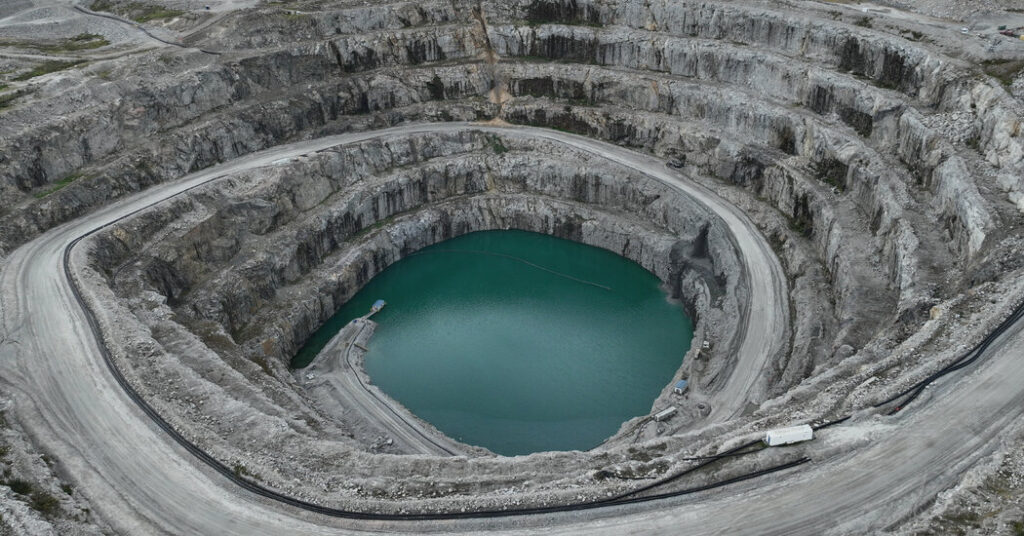
The three diamond mines that have brought significant revenues and employment to the Northwest Territories, particularly among Indigenous people who became an integral part of the boom, are all planning to permanently close by the end of the decade, with the first one, owned by the mining giant Rio Tinto, being shuttered in March.
The demise of diamond mining has been hastened by the collapse of demand for natural diamonds because of the availability of cheaper, environmentally friendly lab-grown gems.
And President Trump’s tariffs on India, the world’s biggest diamond-processing hub, have wreaked havoc on the hobbled industry. Many mining companies polish, cut and prepare their diamonds for use in India, and then export them from there to the United States. The tariffs have made the finished gems more expensive.
“We have a resource economy in Northwest Territories for the most part, and it’s always been that way,” the region’s premier, R.J. Simpson, said in an interview.
“We’re at a point now,” he said, “where we know the diamond mines are winding down, and the question has been: ‘OK, well, what’s next?’”
Boom to Bust
George Betsina, 55, remembers putting up stakes to mark territory for prospecting for diamonds in 1992, right after deposits were discovered at a remote location, 186 miles northeast of Yellowknife.
A member of the Dene First Nation, Mr. Betsina was one of many young Indigenous men from communities in and around Yellowknife who left the dying gold mines to see if there was a future in diamonds.
He began working at one mine, Ekati, in 2000, and over the next quarter-century, he built a life and a family. His two brothers operated equipment at the mine, too, which provided good paychecks, but also required weeks on end away from home, flying in and out of workers’ camps just below the Arctic Circle.
“Half my boys’ lives, I was in the mines,” Mr. Betsina said, speaking inside a wooden shack behind his home on the banks of the Great Slave Lake, as he expertly carved up a moose he and his sons had hunted.
Then in July it all came to an abrupt end. “They just called and said, ‘George, that’s it,” he said.
All three Betsina brothers were laid off, alongside hundreds of others. Mr. Betsina said that, at its height, Ekati employed more than 1,000 people, but fewer than 300 were left when he was laid off this summer.
The owner of the Ekati mine, a small Australian company named Burgundy Diamond Mines, is losing money in part because of Mr. Trump’s tariffs on India. Like many diamond miners, Burgundy’s gems are processed in India. The 50 percent tariff on Indian exports makes them more expensive in the United States and crushes the already subdued demand.
In September, Burgundy suspended trading on the Australian stock exchange where it is listed, and requested a loan from a Canadian government fund intended to relieve the impact of tariffs on companies that operate in Canada.
The company has been slashing or even failing to make severance payments to workers it laid off over the summer, according to the workers’ union. Burgundy declined to comment or offer executives for an interview for this article but, in public statements, has acknowledged serious financial problems and pledged to eventually fully compensate workers.
Ekati’s struggles exemplify the problems the industry is facing, which have grown so severe that they may expedite the day of reckoning for diamond mining in the Northwest Territories. The mine is scheduled for closure in 2030. Now that five-year horizon seems optimistic.
All That Sparkles
Mining built up the economy of the Northwest Territories and depended on Indigenous skilled workers who became an integral part of its growth.
“It’s kind of a scary situation,” said Chief Fred Sangris, who leads the Yellowknife Ndilo community of the Dene First Nation. “Where do we go from here? What’s the next project? If we don’t align ourselves with the government and come up with another big project, then this work force might be sitting idle, and it’s not going to be good for the communities.”
Until recently, more than 3,000 Indigenous workers were employed at the three diamond mines, Indigenous leaders said, while others were employed in supporting industries such as construction, catering and aviation. The population of the Northwest Territories is about 45,000, half of it Indigenous.
Annual salaries for skilled workers such as people operating heavy equipment or drilling underground could surpass six figures, in large part to compensate for the harsh conditions.
Leaders across the Territories are banking on the hope that the ground holds yet more precious secrets. Smaller mines and new exploration efforts are focusing on rare earths and critical minerals.
These ores are vital for electronics, artificial intelligence and the defense industry, but China has a stranglehold on their production and trade, causing frustration and fear over supplies in the United States and the rest of the Western world.
The United States Defense Department has invested in one rare earths mining project in the Northwest Territories as part of a Biden-era program aimed at securing a supply.
“There is such interest in critical minerals, which are used for everything we need for modern life, and we have an abundance of those in the Territories,” said Mr. Simpson, the premier.
But more mining, particularly of hard to extract minerals like rare earths, can be environmentally damaging. The Northwest Territories was the setting for one of the worst environmental contamination cases in Canadian mining history, at the Giant gold mine, which left behind a devastating amount of toxic arsenic when it closed in 2004.
And it is unlikely that the rare earths and other smaller mining projects will grow large enough soon enough to fully supplant the revenues and jobs lost by the closure of the diamond mines.
Mr. Simpson said another source of growth could come from Canada’s investment in major infrastructure projects and its focus on Arctic defense under Prime Minister Mark Carney, which residents and local leaders say are desperately needed in the Territories.
“It feels now like a bit of a transitory phase, in which other projects will be coming online in the future,” Mr. Simpson said. A major road infrastructure proposal for the Northwest Territories, however, was not included in Mr. Carney’s recently released list of projects selected for fast-tracking.
New Beginnings
The mine owned by the multinational giant Rio Tinto, named Diavik, has long been scheduled to close in March and workers have been in a company-sponsored retraining program to prepare them for the future.
Melanie Rabesca, 38, credits Diavik with the most important changes in her life. At 18, she was years into substance abuse when she decided to take an underground drilling course, lured by the good salaries the diamond mines were offering. She loved it.
She started working at Diavik in 2010, and the long stints she spent sober helped her break her addictions. In the depths of the mines, she met her future husband, who also works there, and together they built a coveted life: two children, 14 and 7, and a home in a pretty suburb of Yellowknife.
Both Ms. Rabesca and her husband, Charles, are retraining as large vehicle operators, which will allow them to drive trucks.
Ms. Rabesca would like to eventually work in mental health, and the retraining is giving her the confidence that she will continue to have an income until she figures out her next steps.
But leaving mining life behind will be hard, she said.
“It’s exciting and scary. This is all I’ve ever known since I was 22,” she said, as she sat in her living room while her 7-year-old son played.
Harder to replace than her income, she said, will be the community she found at the mine.
“I liked the diversity,” she said. “You got old, you got young, you got people from the North, you got people from the South, like engineers are coming from Australia.”
“I’ve loved meeting so many people along the way,” she said
Matina Stevis-Gridneff is the Canada bureau chief for The Times, leading coverage of the country.
The post When Diamonds Are Not Forever appeared first on New York Times.