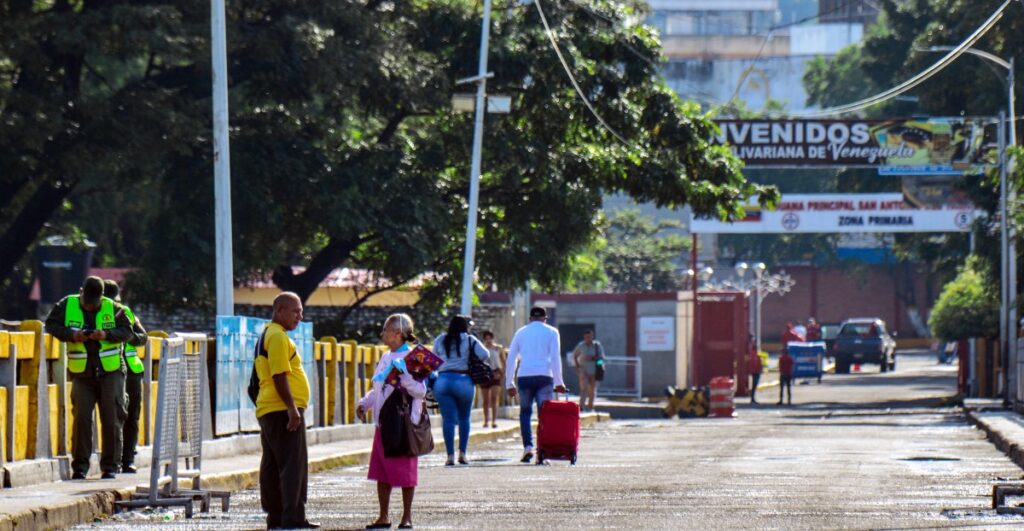
Across Venezuela, residents wonder how long they’ll be waiting.
Venezuela has experienced a severe decade of economic and political crisis, led by Nicolás Maduro. Now, as the threat of US intervention looms, Venezuelans are going through a cycle of anxiety and uncertainty. How long will this standoff last? Who would replace Maduro?
In the meantime, they still need to afford groceries, go to work and try to keep their lives moving.
Ana Vanessa Herrero is an investigative reporter with the Washington Post and based in Caracas. She’s a native Venezuelan and has been speaking with her community throughout her time reporting there. She tells host Noel King about daily life in Venezuela, what residents are thinking, and how they’re preparing for a possible war.
Below is an excerpt of the conversation, edited for length and clarity. There’s much more in the full podcast, so listen to Today, Explained wherever you get podcasts, including Apple Podcasts, Pandora, and Spotify.
The US has been attacking boats, alleging that these are drug traffickers bringing drugs from Venezuela. How are people in Venezuela responding to these attacks at sea by the US?
The reaction is not a unified reaction. The situation, for example, in Sucre, the coast region where all the boats are allegedly coming from, they’re scared. They don’t feel safe that they’re not going to be attacked somehow. But outside of Sucre, the situation is absolutely different. So Venezuelans are really not focusing on the attacks, on the vessels, but focusing on the economy.
Everyone has PTSD right now. Everyone is getting ready just in case we’re going to have to suffer like in 2016, 2017, or 2018 again. In those years Venezuela experienced hyperinflation of over a million percent. And that is well deep inside our memory.
Now the diplomatic tension is not as important, it’s a little part of the conversation. Most of the conversation revolves around if I’m going to have enough money to buy food. And every threat affects the markets and affects all investments.
But remember the economy was collapsing and last year it started seeing some small changes for the better. Those were because of the cash flow on the streets and because of small investments. It doesn’t mean that the economy was thriving, but we did see some changes. But now every person who has some money to invest is really insecure of doing so because you don’t know if tomorrow the US attacks Venezuela. How can you survive without that money? People are trying to save the money that they have just in case something happens and that is affecting the day-to-day economy.
I can understand how the story of the men in boats becomes small given a broader economic crisis. I wonder about something else though. President Trump recently suggested that the United States might start land strikes in Venezuela. Do people there fear a land war?
Just to be clear, my conclusions come from the many conversations I’ve had with people here on the ground. But, of course, I haven’t spoken to everyone. From the people I’ve interviewed and small conversations I’ve been part of, they do fear something is going to happen. Some of them think it’s going to be like a small precise attack against some of the Venezuelan political leaders that are now in power. Others think that they might come in and attack Venezuela on the ground.
“Because of the censorship and the harassment that the government has put upon the population, no one dares to speak up.”
But everyone agrees on one thing: If any of those happen, they do believe it’s going to be really quick. This is not going to be a war that is going to last for five years because Venezuela doesn’t really have what they need to fight against the US. And the aftermath of that would be the end of Maduro’s regime. I haven’t heard anyone rejecting the idea and that is really interesting. The thing is that because of the censorship and the harassment that the government has put upon the population, no one dares to speak up. But in small conversations you can definitely hear that no one wants this, but it’s a last resort.
The people that you’ve spoken to, are they not rejecting the idea because they want Maduro out?
Well, ultimately, yes, most people would like Maduro to resign, but we know so far that probably that’s not going to happen. Maduro has shown amazing skills and ability to survive all the attacks that he has suffered from abroad and inside of the country. Definitely from the side of the Maduro supporters, now more than ever, they’re unified. They have the sense of an external enemy.
Maduro has been saying this for a long time: Our enemy is the US. But there was never a threat. Now, there’s a palpable threat that proves him right. And his followers are like, “Okay, now we do see that enemy and we are going to gather around you to protect the legacy of Hugo Chávez.” This is the narrative that the government has been using, but I don’t see this happening for the rest of the people.
When Trump makes these threats about Venezuela how are people reacting? Are people stockpiling food? Are they preparing in other ways?
It depends on the day. If President Donald Trump writes on social media, for example, as he did, that the airspace is closed, to get out of Venezuela. You’re definitely going to see people buying more food, more water, talking to each other, trying to call people who know people to see if they know something.
But if the general climate is peaceful, where you can feel the tension, but really nothing is happening, or at least we don’t know something’s happening, people are just trying to live their daily lives. People are still going to work. We are not seeing people running to the supermarkets whatsoever. Even if they do stock up on food weekly, it’s not pandemonium. It’s not something that you’re going to see on TV people lining up in the supermarkets like they did in 2016 to get something. The information is so scarce that people are just, “Okay, today I’ll buy food. Then if nothing happens, I’ll just eat it.”
Where is Maduro in all of this? How is he behaving knowing that these threats are coming from the US
Internally, we don’t really know what’s happening, but Maduro is trying to show absolute peace and joy during the Christmas celebrations. He actually said that that was a national mandate for people to party all week long because his followers needed to show the US and the world that they’re not worried about anything.
He claims this is just a psychological war that they’ve survived in the past. He has survived past pressure, not only from the US, but internally from the opposition. And he believes that, at least this is what he’s showing, if he sits down and waits, this is all going to go away. And he has done that in the past. So that’s his strategy.
The post What Venezuelans really want appeared first on Vox.