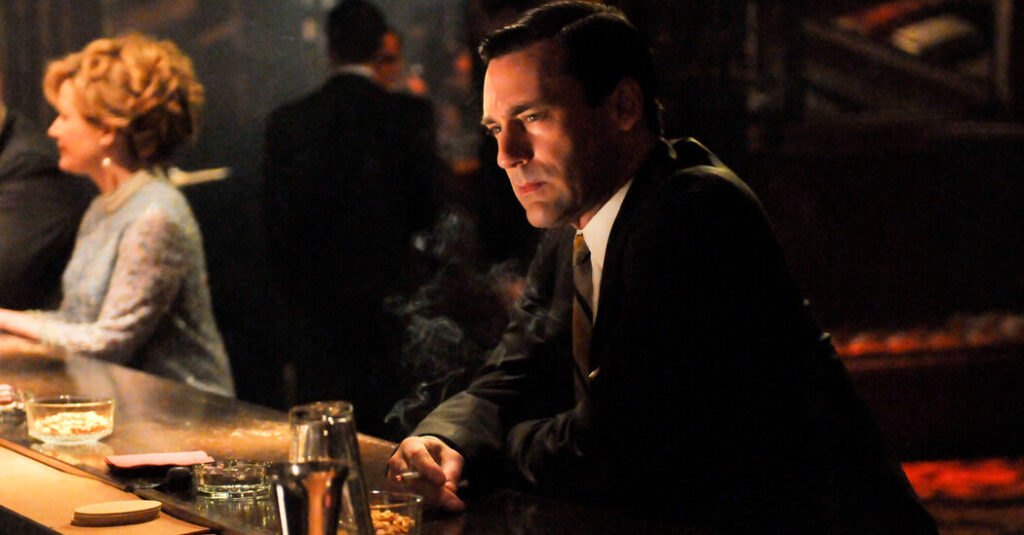
I did a mini-rewatch of “Mad Men” recently, though perhaps not for the reasons that its makers would have preferred.
On Dec. 1, HBO Max began streaming all seven seasons of the advertising-business drama. The series was remastered in 4K, a resolution not widely available when it first aired from 2007-15. It also came with a kind of bonus scene that it didn’t intend to offer.
The Season 1 episode “Red in the Face” includes a scene in which Roger Sterling (John Slattery), induced to overindulge on booze and oysters at lunch with Don Draper (Jon Hamm), vomits prolifically while meeting with clients. In the remaster, you can see, at the margin of the screen, a kneeling crew member operating the hose that makes a torrent seem to pour out of Slattery’s mouth. The hoseman was edited out of the original airing but not from the remaster. (Adding insult to indigestion, the episode was also listed under the wrong title on HBO Max’s site.)
The goof was embarrassing, but as Don Draper might understand, bad publicity is still publicity. The snafu led me down a rabbit hole of rewatching episodes — admittedly, at first, to check for other scenes that might have similar bloopers. (Rest assured, Part 2 of the Season 6 episode “The Doorway,” in which Don completes the circle by barfing at the funeral of Roger’s mother, is free of errant hoses.)
Then I just kept going. It’s hard to watch just a little “Mad Men,” which remains one of the most rewatchable series of its particular golden era. It’s particularly interesting to watch it in its new context, amid an array of streaming services with slick original shows made on princely budgets. These new shows, however lavishly produced and alluringly cast, could learn a thing or two from this old veteran, such as:
A show doesn’t have to be expensive to look rich
The “Mad Men” budget was estimated between $2 and $3 million per episode for much of its run — neither peanuts nor a fortune for its time, and certainly nothing like the megamillions that now get poured into the likes of “The Lord of the Rings: The Rings of Power.” It did not, like so many streaming series, shell out for jaw-dropping location shoots. It is a show shot largely on sets that looks like a show shot on sets. It put its money into talent and crew and the occasional Beatles song.
But it was painstakingly curated and designed — from wardrobe to food to props — to convey a rich, thought-through sense of history. (The notoriously meticulous attention to detail of the show’s creator, Matthew Weiner, made the hose-operator misstep that much more jarring.) It was not “cinematic” in the manner of today’s TV blockbusters, though perhaps it was in the sense of the period movies it styled itself on, like “The Apartment.” Its clear sense of place and time and its dedication to evoking the era through style and design were what made it immersive — not a budget the size of a small country’s G.D.P.
Episodes do not need to be two hours long
“Mad Men” aired on AMC, an ad-supported basic cable network. To make room for those ads, its episodes generally ran 47 or 48 minutes. (The exceptions included the finale, which still clocked in under an hour, and the occasional two-part premiere, depending whether one counts those as one episode or two.)
In the limitless world of streaming, running times have swollen like prize pumpkins, often turning into formless, poorly paced blobs of narrative that amble on well past the one-hour mark. The series finale of Netflix’s “Stranger Things” will be released in movie theaters, which, when an episode of “TV” runs two hours-plus, is arguably the only place it should be released.
It’s OK for your TV series to have real episodes
A related issue is the “We think of this season as a 10-hour movie” phenomenon, which has led many streaming series to feel like long, shapeless marches interrupted only by the appearance of the “Play Next” button.
“Mad Men” has the sort of ambitions one often associates with film, or, hell, even literature. But it is unmistakably and unashamedly TV. Its episodes have plots and subplots, story arcs and themes; they tell stories that serve a larger ongoing story.
Yet they don’t feel constrained or limited by the format; more than most shows on TV, “Mad Men” episodes could start in places you didn’t anticipate and go where you didn’t expect. “The Suitcase,” widely acknowledged to be one of the best episodes of TV drama ever, takes Hamm and Elisabeth Moss through a dark work night of the soul that turns revelatory and hilarious. It’s packed as tight as a hard-shell Samsonite, and is just as durable.
Some shows cast stars — great shows make stars
One adjunct of streaming’s open-paycheck approach to TV-making is the belief that you can cast your way to greatness by signing up established celebrities whom viewers already love. (Steve Martin, Martin Short and Meryl Streep are national treasures; that doesn’t make “Only Murders in the Building” one.)
But who knew anyone in “Mad Men”? You might have remembered Moss from a small role on “The West Wing”; Robert Morse had starred in “How to Succeed in Business Without Really Trying.” Before he was cast on “Mad Men,” Hamm has said, a network head executive told his representatives, “Jon Hamm will never be a television star.”
“Mad Men” cast actors rather than names, seeing leading-man charisma and complexity in Hamm, and in January Jones the kind of tragic suburban glamour that would define Betty Draper. (Let’s also not forget Kiernan Shipka, who grew with Sally Draper’s character and gave one of the most nuanced child performances in TV history.)
Casting relative unknowns allows the audience to come to them without preconceptions. It also puts the burden on writing and performance to elevate the work, rather than relying on built-in affection for a familiar name (even if, these days on TV, that name is often Jon Hamm).
Drama can and usually should be funny
In a Season 1 episode of “Mad Men,” Roger Sterling surveys the bounty of a room-service meal. “We’ve got oysters Rockefeller, beef Wellington, Napoleons,” he says. “We leave this lunch alone, it’ll take over Europe.”
The beauty of “Mad Men” was that in any given week it could be the best drama on TV as well as the funniest show on TV. This shouldn’t be a surprise — series like “The Sopranos,” “Lost,” and “Orange Is the New Black” also had that distinction. But it is a quality lost on many of the grim crime series that programmers are fond of lately (not to mention the occasional comedy like “The Bear”).
Dourness isn’t a sign of seriousness or quality; in fact, you can argue that if a drama lacks a sense of humor entirely, it usually lacks other necessities. This is not because audiences “need a break” from heavy moments. It’s that humor is a sign of a lively mind on the part of a show’s writers and its characters (many of whom, on “Mad Men,” made their living by their wits).
Entertainment doesn’t have to be formulaic
There has been a lot of talk lately about streaming platforms embracing retro TV — dialing back on ambitious, conceptual big swings and developing, in the wake of “The Pitt,” more meat-and-potatoes genres like cop shows and live-studio sitcoms.
It’s worth remembering, though, that when “Mad Men” started, a period drama set in an ad agency was few people’s idea of compelling material. The idea was that dramas were most likely to succeed if their settings had built-in stakes: a hospital, a police precinct, maybe the Mafia if you were HBO.
“Mad Men” was made according to no one’s formula. And it proved that the ordinary stuff of life — work, marriage, getting older — could get an audience to care, if you got them to believe that the characters cared. (It may not have been the most-watched series of its contemporaries, but it has had a more culturally resonant afterlife than most.) Streamers should keep this in mind before they decide their future lies in pushing a panel of buttons that was manufactured in the 20th century.
Seriously, make sure you hide the vomit hose
This one probably goes without saying at this point. But it never hurts to be reminded.
James Poniewozik is the chief TV critic for The Times. He writes reviews and essays with an emphasis on television as it reflects a changing culture and politics.
The post What Streaming TV Could Learn from ‘Mad Men’ appeared first on New York Times.