One year ago Tuesday, as Luigi Mangione was handcuffed and preparing to be walked out of a McDonald’s in Altoona, Pa., police officers began searching through his backpack. They quickly pulled out a hoagie, a loaded gun magazine wrapped in a pair of wet underwear and a bag of sliced bread.
The details were revealed in body camera footage shown in State Supreme Court in Manhattan this week during pretrial hearings, in which Mr. Mangione’s lawyers are arguing that evidence recovered at the time of his arrest should not be admitted at trial.
Mr. Mangione was arrested five days after the chief executive of UnitedHealthcare, Brian Thompson, was shot dead before an investor gathering on Dec. 4 outside a Hilton hotel in Midtown Manhattan. The gunman’s image was circulated widely, and Mr. Mangione had been at the McDonald’s for about 15 minutes when a manager, prompted by patrons, called the police to report that a customer resembled the image.
Over about a half-hour, more than a dozen officers came to the restaurant, asking Mr. Mangione why he was in the central Pennsylvania city, if he had been to New York and why he had provided a false name to the first officers who arrived, according to videos shown in court.
After Mr. Mangione was read his rights, patted down for the third time and handcuffed, two police officers, Patrolwoman Christy Wasser and Patrolman Stephen Fox, began searching his backpack. In two separate searches recorded on video, the officers recovered the magazine, a gun and silencer.
They also found several of Mr. Mangione’s writings, including a notebook, a letter and what prosecutors described as a hand-drawn map of his anticipated escape route.
One note shown in court said “keep momentum, F.B.l. slower overnight,” as well as “check reports for current situation.” Another, an apparent to-do list dated Dec. 5, listed several tasks, including “pluck eyebrows.”
Mr. Mangione faces a second-degree murder charge and other charges in Manhattan state court. If convicted, he could receive a sentence of 25 years to life. He also faces a federal prosecution. Trial dates have not been set in either case.
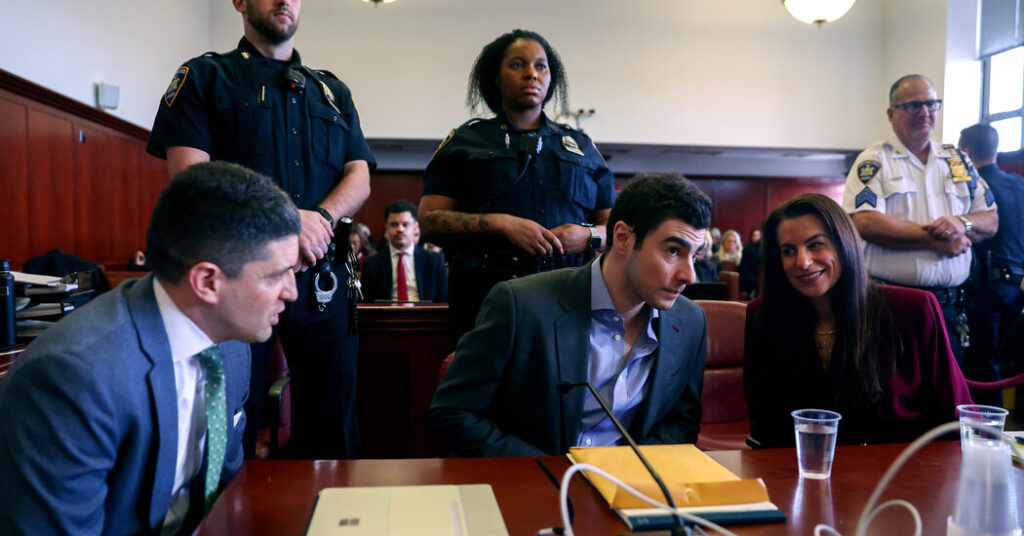
The hearings in state court, which began last week, are expected to last several more days and are meant to help the judge overseeing the case, Gregory Carro, to determine which evidence will be admissible.
By the time the hearings end, prosecutors with the Manhattan district attorney’s office, led by Alvin L. Bragg, are expected to have called more than 20 witnesses. The defense plans to call two.
Mr. Mangione’s defense lawyers have focused on the actions of the Pennsylvania officers immediately after they encountered Mr. Mangione. The lawyers have argued that the officers failed to read Mr. Mangione his Miranda rights at the point they were legally required to, ignored his request to remain silent and continued to ask him questions. They have also argued that evidence was taken from his backpack illegally without a warrant.
The stakes are high. If Mr. Mangione’s lawyers succeed in getting Justice Carro to throw out some or all of the evidence they have called into question, it could significantly affect the prosecution’s case.
Prosecutors have said that Mr. Mangione had personal writings with him at the time of his arrest in which he denounced America’s for-profit health care system and the “parasites” of the insurance industry. The police also found a journal by Mr. Mangione describing plans for an assassination, they said.
Prosecutors called both Patrolwoman Wasser and Patrolman Fox to the stand this week. Body camera footage played in court on Monday showed Patrolman Wasser reaching into Mr. Mangione’s backpack and pulling out the loaded magazine. Almost immediately, Patrolman Fox can be heard saying the bag belonged to a man who was “100 percent” the gunman from New York.
Patrolwoman Wasser can then be heard saying that she was searching the backpack to make sure there were no explosives, and that she preferred to look while she was at the McDonald’s before taking the bag to the police station.
During cross-examination, Mr. Mangione’s lead lawyer, Karen Friedman Agnifilo, pushed the officer on why she continued to search through the bag without a warrant, even after she had stopped thinking it contained an explosive. She pointed to the public nature of the restaurant and the patrons walking through the scene of the arrest.
Taking the stand on Tuesday, Patrolman Fox testified that Mr. Mangione’s refusal to answer questions had “heightened” his suspicion that there might be an item in the backpack that could “harm human life.”
Patrolman Fox, who ultimately read Mr. Mangione his Miranda rights and handcuffed him, also testified that he accompanied Mr. Mangione to his arraignment in Pennsylvania on charges of carrying a gun without a license, forgery, falsely identifying himself to the authorities and possessing “instruments of crime.”
During that arraignment, Patrolman Fox said, Mr. Mangione turned around to look at the throng of reporters in the courtroom and said it was “wild” so many had attended a hearing for a “mass murderer.”
Later, Patrolman Fox said he was walking quickly when the shackles around Mr. Mangione’s ankles caused him to stumble as he tried to keep up.
“I said, ‘I forgot you were shackled,’” Patrolman Fox told the court. “And he replied: ‘It’s OK, I’m going to have to get used to it.’”
Hurubie Meko is a Times reporter covering criminal justice in New York, with a focus on the Manhattan district attorney’s office and state courts.
The post Videos Played at Mangione Hearings Reveal New Details About His Arrest appeared first on New York Times.