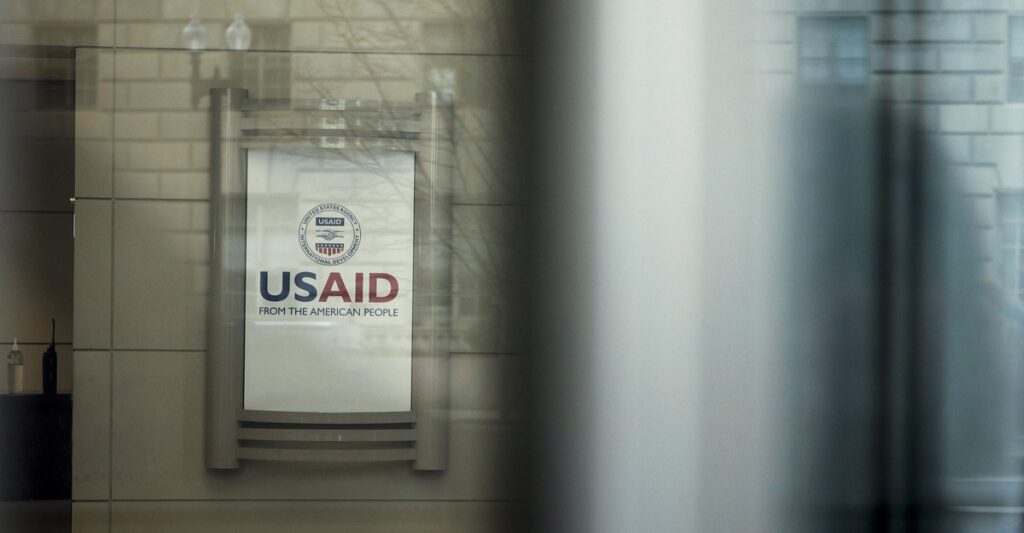
If the U.S. Agency for International Development is a front for the CIA, we’re about to find out all about it. A new official inside the agency is prepared to blow the lid off the whole conspiracy.
That official is Mike Benz, a right-wing influencer who popularized the notion that Taylor Swift is a secret NATO asset and once wrote, under a pseudonym, “I want white identity politics to grow like wildfire.” Benz rose to prominence last year by spreading fantastical claims about USAID, portraying the agency as a terrorist organization or a spy operation—or both. His comments caught the attention of Elon Musk, setting into motion the dramatic dismantling of the agency. USAID, Benz argued earlier this year, “is notorious for funding the darkest, most controversial, most horrifying projects known to all of mankind.”
So it was somewhat surprising for staff remaining at the decimated agency when Benz strode into their office last week. U.S. officials who spoke with me on the condition of anonymity to describe Benz’s position said he’s a special government employee, a type of executive-branch appointee brought in to perform important services for a limited period of time. Musk had the same status when his DOGE initiative took a chainsaw to the federal bureaucracy.
Benz’s mission, officials told me, is to use the agency’s archives to substantiate his own allegations about USAID’s pernicious influence in the world—its role in foreign regime change, its promotion of “state-sponsored hit pieces,” and its suppression of free speech. He’s fixated, for example, on communications among USAID staff following the 2024 election, which he has told associates holds the key to the agency’s wrongdoing. But his ambitions are ultimately broader, officials said. He wants to prove that USAID has secretly incited so-called color revolutions, a pejorative used often by Russian President Vladimir Putin to blame Western powers for popular uprisings in post-Soviet countries.
Benz did not respond to a request for comment. Current and former USAID employees predicted that Benz’s research is going to come up short.
Until this year, USAID provided food, medicine, shelter, and access to clean water in some of the bleakest parts of the world. Its programs treated acute malnutrition in Ethiopia, brought hygiene and sanitation projects to displaced Gazans, and offered security and shelter to Haitians fleeing gang violence. Its roughly 10,000 employees worked in more than 100 countries; in the most recent fiscal year, it spent $21.7 billion, accounting for a mere 0.3 percent of federal spending.
The agency was created by Congress in 1961, an outgrowth of Cold War competition. Humanitarian assistance, the thinking went, was vital to the kind of soft power necessary to counter Soviet influence. In its early years, USAID sometimes advanced CIA operations, perhaps most notoriously through a blandly titled Office of Public Safety that trained police and paramilitary forces in allied countries. A series of reforms sought to divorce development initiatives from intelligence work. Some clandestine work continued. In 2010, USAID created a social-networking service in Cuba designed to kindle opposition to the government.
Predictably, USAID is deeply unpopular with autocratic regimes, which accuse the agency of meddling in their internal affairs. In addition to food and clean water, USAID grants have supported election monitors, anti-corruption watchdogs, and independent media outlets. In 2012, Putin’s government blocked the agency’s grants and expelled its workers. Human-rights activists lamented USAID’s departure, but Russian authorities argued that its true aim was improper political influence. The same argument—that humanitarian assistance was a smoke screen for regime change—eventually found support among Trump acolytes.
[Read: Inside the USAID fire sale]
Enter Mike Benz, a brash 41-year-old who worked mid-level jobs in Trump’s first administration, including a short stint at the State Department. Afterwards, he founded the Foundation for Freedom Online, presenting himself as a “national expert on how the government, agencies, non-profits, and large internet platforms work together to censor the speech of Americans.” This year, the Trump administration has illegally targeted noncitizens for pro-Palestinian speech, according to a federal judge appointed by Ronald Reagan; threatened broadcast networks over unfavorable coverage; and encouraged campaigns of intimidation against people who criticize the slain right-wing activist Charlie Kirk. But in Benz’s telling, the foremost threat to free expression is USAID and associated U.S. humanitarian missions cloaking plots against global right-wing movements. “USAID declared censorship holy war against every single populist group,” Benz has said. If USAID didn’t exist, he argued, former Brazilian President Jair Bolsonaro would still be in power “and Brazil would still have a free and open internet.”
In the weeks before Trump returned to the White House and put Musk in charge of downsizing the federal government, Benz’s outlandish claims appeared to ignite Musk’s animus toward USAID. On Joe Rogan’s podcast, Benz argued that the agency’s very name was some kind of psychological operation. “Your brain is being tricked when you see the phrase USAID,” he said during the December 3, 2024, broadcast. “It’s not an aid organization.” USAID, Benz said, “is effectively a switch player to assist the Pentagon on the national-security front, to assist the State Department on the national-interest front, or to assist the intelligence community on a sort of clandestine-operations front.”
Musk reposted highlights from the podcast with the caption, “Mike Benz just revealed everything.” Weeks later, Musk’s DOGE initiative began freezing grants and putting agency staff on leave. Benz’s assertions—including his reference to USAID as the “Terror Titanic”—offered justification for “feeding USAID into the wood chipper,” as Musk boasted of doing in February. He called USAID a “criminal organization.” A Washington Post analysis at the time found that the billionaire had reposted, replied to, or otherwise mentioned Benz more than 160 times in the previous year, and that he had never posted about USAID before interacting with Benz’s content.
Benz’s influence quickly grew. He landed an interview on Tucker Carlson’s podcast and appeared with Secretary of State Marco Rubio in April to celebrate a move by the State Department to shut down an office aimed at countering foreign disinformation. “This is amazing news,” Benz said.
It was a remarkable star turn for a right-wing activist who once worked in the shadows. Benz used to blog under the pseudonym “Frame Game,” as NBC News reported in 2023, exposing comments he had made about “white genocide” and “Jewish influence.” In a lengthy post on social media responding to the revelations, Benz said he was Jewish and that his intent was actually to “get people who hated Jews to stop hating Jews.”
In one post, from 2018, he elaborated on his aims: “I want two things for the world my grandkids grow up in: (1) A nuclear proliferation treaty on ethnic identity politics in America, and (2) a reversal of white demographic suicide.” There were white nationalists who wanted to go further than that, he acknowledged. “I’m not a White Nationalist,” he wrote. “I don’t have any problem with White Nationalists; it’s just not me.”
Musk may have fed USAID into the wood chipper, but the agency is not fully dead. The Office of Management and Budget, led by the powerful Trump ally Russell Vought, gained responsibility for its oversight at the end of August. A U.S. official estimated that about 75 people still work at USAID, managing remaining contracts and helping transfer other functions to the State Department.
The majority of the agency’s employees used to be distributed around the world; they were laid off or put on leave. Those who remain occupy the ninth floor of an office building in downtown Washington, about three blocks from the White House. That’s where Benz showed up last week, telling his new colleagues that Vought had hired him as a special government employee and given him a mandate to investigate USAID from the inside. A spokesperson for Vought did not respond to a request for comment.
Benz has already chafed at aspects of his role, officials told me. He complained to multiple colleagues about the orientation session on ethics, arguing that his status as a special government employee should allow him to operate outside of traditional protocols, as Musk did. In these conversations, he expressed concern, one of the officials told me, that he could be accused of improperly benefiting from his government role by using nonpublic information on his social media. His online commentary continues unabated. In recent days, he wrote on social media that he holds USAID responsible for politically motivated arrests in foreign countries, including in Moldova, the former Soviet republic neighboring Ukraine.
[Read: The Trump administration is about to incinerate 500 tons of emergency aid]
Current and former USAID staff I spoke with predicted that Benz’s research project will end up being consistent with a pattern in Trump’s second term: acolytes of the president who whipped up supporters with grotesque tales of government wrongdoing suddenly gaining government power and struggling to find facts to support their mudslinging. This has played out most notably in the case of government files about Jeffrey Epstein, which Trump and his associates once dangled before their base as evidence of Democratic malfeasance but then resisted releasing once they took office.
It’s also consistent with the Trump administration’s willingness to devote government resources to the investigation of far-fetched claims that seem cribbed from extremist online forums. In June, I reported that the Department of Transportation had agreed to spend as much as $2.1 million to investigate assertions made by the president that diversity, equity, and inclusion programs were to blame for the deadly January crash at Ronald Reagan Washington National Airport.
Meanwhile, Epstein’s victims say they still lack answers. The Federal Aviation Administration is still short on air-traffic controllers who are needed to prevent deadly plane crashes. And, according to a study in the medical journal The Lancet, 14 million people could die over the next five years because of USAID cuts.
The post USAID Hired the Right-Wing Influencer Responsible for Its Decimation appeared first on The Atlantic.