The camel, so the old joke goes, is a horse designed by committee. So what happens when two designers share responsibility for a watch?
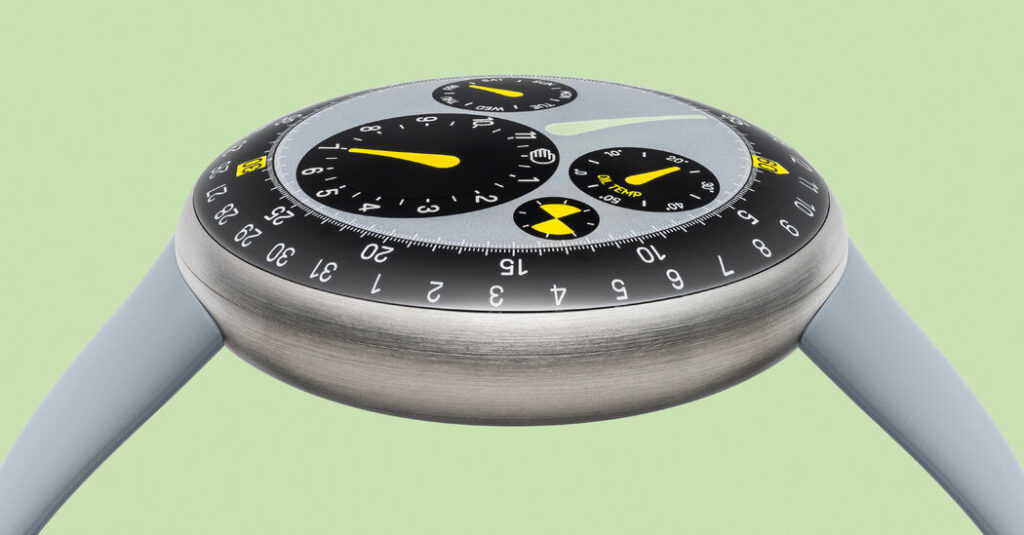
That was the situation recently when the Belgian watchmaker Ressence, founded by Benoît Mintiens, collaborated with Marc Newson, a well-known multidisciplinary designer from Australia, to create an 80-piece limited edition of Ressence’s Type 3 watch. The new model, unveiled Dec. 4, combines elements of Mr. Newson’s previous watch designs with Ressence’s signature rotating dial mechanism. It sells for 46,000 Swiss francs, $59,800 in the United States.
By the men’s own admission, it could have gone very wrong.
“It’s super rare that two designers work together on a similar product,” Mr. Mintiens said at the opening of an exhibition on the brand at the watch retailer Subdial in London. “Designers tend to have egos that don’t fit in one room.”
Mr. Newson echoed the observation, describing himself as something of a stickler about certain things. “I’m fairly unrelenting when it comes to the details,” he said in a phone interview. “It’s the old adage of simplicity being one of the most complicated things to achieve. The design’s very unforgiving.”
One such detail, according to Mr. Mintiens, was joining the new watch’s titanium case to its rubber strap: “The way the bracelet connects to the case, it’s a very sensitive thing. There shouldn’t be a split line between them. We had long discussions with the subcontractors about how to make sure that every strap fit perfectly.”
But far from disagreeing about details, such as matching the colors of materials or the exact curvature of the sapphire crystal dome, Mr. Mintiens and Mr. Newson both said that they had found the collaboration to be among the most relaxed of their careers.
“He’s very pragmatic,” Mr. Mintiens said of Mr. Newson. “Otherwise, he wouldn’t be where he is, because you always have to face the reality of the industry.”
Mr. Newson was similarly complimentary: “We didn’t go far from the existing philosophy that Benoît has created. So it was an incredibly sympathetic and straightforward collaboration.”
The two men were introduced about 18 months ago by Piano Chow, the owner of the Lavish Attic, which represents Ressence in Hong Kong. Once Mr. Mintiens suggested a collaboration, both men said that the idea fell into place, without the need for numerous concept sketches or prototypes.
“I think we’ve both had enough experience in the industry to be able to cut to the chase and get on with it,” Mr. Newson said. “I quickly formulated a very clear vision of what I thought the collaboration should look like. And Benoît was completely supportive.”
The project took a year from start to finish, Newson said. “Working with Benoit has been surprisingly swift by typical watch standards. That was one of the lovely things of working with a company like Ressence, because they’re relatively nimble.”
Mr. Mintiens said their shared vision was a factor in the collaborative process, but added that a recent change in his own thinking about Ressence may have helped as well: “If you would have asked me 10 years ago, I would have told you we were a watch company and we make design watches. Today I would say we’re an industrial design company and we make high-end watches.”
The distinction, Mr. Mintiens said in a follow-up email, was Ressence’s current ability to bring a designer’s mentality to every aspect of a watch, not just the visible surfaces.
Before founding Ressence in 2010, Mr. Mintiens worked at a design agency in Belgium on products including high-speed trains, luggage, consumer electronics and hunting rifles. But when asked if Ressence might branch out, he said he would stick to watches.
Called Type 3 MN, the new 45-millimeter watch is cased in titanium and uses the brand’s patented ROCS (Ressence Orbital Convex System) system of rotating subdials under an oil-filled crystal to indicate the time.
While the new model builds on Ressence’s Type 3 watch, which Mr. Mintiens described as the brand’s primary design, it also introduces features that would be familiar to fans of Ikepod, the watch company founded in 1994 by Mr. Newson and the Swiss entrepreneur Oliver Ike. (Mr. Newson ended his affiliation with Ikepod in 2012; the company was revived by new management in 2017.)
The shape of the original Type 3 hands was subtly changed, adding a concave curve from the base to the tip, to resemble those from Ikepod. And several details of the Type 3 dial were altered, producing a noticeable resemblance to Ikepod’s 1999 Megapode chronograph.
The alterations included: the new black, gray, yellow and pale green color scheme; using yellow to highlight the 60- and 30-minute markers; the addition of gradations to the minute scale; and the use of a sans serif font rather than Ressence’s in-house stencil-style font. Also, the indicators for the day of the week and the temperature of the oil in its display now use written scales rather than Ressence’s text-free graphic notation.
Mr. Newson, who has worked with Jaeger-LeCoultre on several iterations of its crystal Atmos clock and with HG-Timepiece on several clock designs, said watches were among the very first products he worked on when he began his career in the 1980s.
“I’d been designing watches even before Ikepod, when I was studying to be a jeweler. That was my original training: jewelry and silversmithing,” Mr. Newson said. Now that they’ve proven their egos can coexist, the question is: Will they repeat the experience?
“We started the project as sort of a one-off exercise and have had so much fun, so I wouldn’t rule it out,” Mr. Newson said. “We have nothing in the pipeline, but it’d be fantastic to think that we could work on other projects together. I think that probability is much greater now than it was when we first met.”
The post Two Designers Tackled a Watch. It Could Have Gone So Wrong. appeared first on New York Times.